alan little’s weblog
न वेषधारणं सिद्धेः कारणं न च तत्कथा क्रियैव कारणं सिद्धेः सत्यमेतन्न संशयः
na veṣadhāraṇaṃ siddheḥ kāraṇaṃ na ca tatkathā kriyaiva kāraṇaṃ siddheḥ satyametanna saṃśayaḥ
“Yoga is not achieved … by talking about it …” Hatha Yoga Pradipika 1.65
Nevertheless …
This page contains entries from my general weblog that I deem to be in some way connected with yoga.
If you actually want to read some of my real & serious thoughts about yoga, bits of them are to be found scattered through the diary I kept when I was studying in India, and some of my older postings on the yahoo and ezboard yoga discussion groups. I may, one day, find the time and mental energy to write some of them down more systematically and put them here.
Meanwhile, some of the most substantial pieces of writing here are only very peripherally about yoga, although they’re here because I came to them from the direction of studying the history of yoga. If you do that, you quickly discover that the roots of yoga are closely tied up with the older Hindu scriptures; that the oldest Hindu scripture of all is the Rig Veda; and that there is a controversy raging among archaeologists, linguists and historians about how old the Rig Veda is and where the people who composed it came from. This stuff has little or no direct bearing on my yoga practice but I find it interesting, and the pieces here about chariots, the genetics of Indian populations and the origins of Indo-European languages are concerned with it. There will probably be more in future.
goodbye guruji
19th May 2009 permanent link
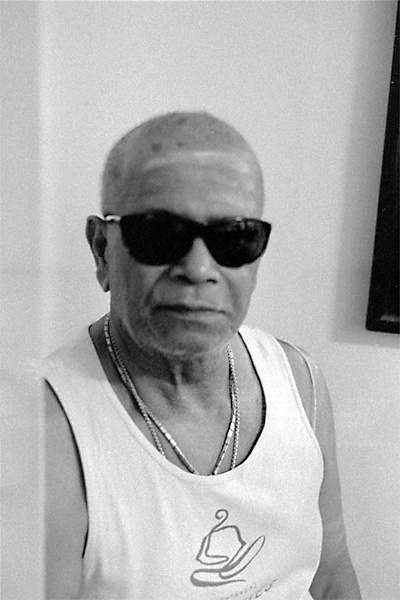
Sri K. Pattabhi Jois, 1915 – 2009
Yoga teacher Sri Krishna Pattabhi Jois, “Guruji” (dear/respected teacher) to his many admiring students, passed away yesterday in Mysore at the age of 93.
Guruji was a great teacher and an inspiration to many, including me. I think perhaps his greatest achievement wasn’t the last thirty years of steadily increasing fame and student numbers after western students discovered him and his teachings; it was the thirty or more years before that, when he kept a precious and wonderful form of yoga practice going more or less single-handed in utter obscurity until the wider world was ready for it.
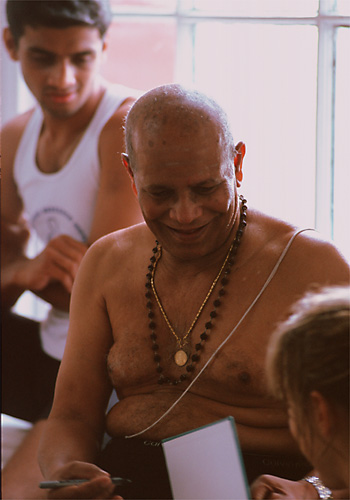
Guruji in New York, July 2000
UPDATE:Michael Smith links to some newspaper obituaries
moving beyond stretching
16th April 2008 permanent link
… if you aren't on your edge, the chances are good that your mind is wandering.
Steven Barnes on yoga asana practice
for some people – me, for example – being at some kind of personal physical limit seems to help with the focus.
me on yoga asana practice
cody on patanjali
1st February 2008 permanent link
I’ve been quiet lately I know. Sadly it isn’t because I’ve been working on my masterpiece.
Unlike Cody. Part Two of quite possibly the most helpful English-language version of Patanjali’s Yoga Sutras is published. Rejoice, and read.
one percent theory
24th January 2008 permanent link
“99% practice, 1% theory” is one of Pattabhi Jois’s famous bits of gnomic guidance on how to approach ashtanga vinyasa yoga.
I was sure this was just what I needed when I first started practicing yoga seriously. My life was down a pretty deep hole at the time, and I was convinced one of the reasons for that was too much reading and thinking and not enough doing. So for my first few years of ashtanga yoga, I deliberately concentrated entirely on practice and left the theory to be taken care of later. It was a series of philosophy lectures by B.N.S. Iyengar at a workshop in the summer of 2001 that finally convinced me it was time to start catching up on the one percent. So I bought Desikachar’s The Heart of Yoga, including his translation of and commentary on the Yoga Sutras, and read it. Pattabhi Jois says the Yoga Sutras of Patanjali and the Bhagavad Gita are all the 1% theory you need.
Sooner or later one’s karmic burdens reassert themselves, though. My practice-to-theory ratio is sill reasonably healthy, but Amazon has figured out that the former academic historian in me is irresistibly drawn towards books by western academics attempting to make sense of yoga’s history, and relentlessly recommends them to me. Fortunately so far they are few & far between. Ian Whicher’s The Integrity of the Yoga Darsana seems like it will be interesting one day, but I haven’t really managed to get to grips with it yet. I ground my way painfully through much of Joseph Alter’s Yoga in Modern India. One of the reasons I never made it as an academic was my belief that the ability to write is a vital skill for a historian. This belief is deeply unfashionable or even heretical in contemporary academia, and Professor Alter clearly does not subscribe to it. Just arrived is Elizabeth de Michelis’ A History of Modern Yoga. Let’s see how that goes.
yoga homework
8th January 2008 permanent link
Apart from finally putting some serious effort into my Russian, the other thing I need to get finished in the next few weeks is my anatomy homework. In November and December I attended two very interesting anatomy for yoga workshops, one on the hips and one on the back, and I still have homework assignments to complete from both of them. (Written, not “increase your outward hip rotation by three degrees in six weeks”). So blogging will have to take a rest while I focus on those.
On that subject, an anatomy book that has been on my “to read one day” list for a while now is Anatomy Trains by Thomas Myers. In the course of researching my anatomy homework I found a series of very interesting articles by him on website of Massage Therapy Magazine. Here for example is the beginning of a series on the psoas, a muscle crucial to much of human movement and posture and the cause of much grief in the screwed up movement and posture patterns of so many chair-sitting, inactive people these days.
not yoga?
6th January 2008 permanent link
My son’s assessment of one of my two half-assed asana practices so far this year: “Daddy, what you just did – that wasn’t yoga”.
Out of the mouths of babes …
Son, you’re most probably right about that and thanks for the brutal honesty. But guess what. All those times I manage to pull off the Patient But Firm act when you’re resisting going to bed? They’re yoga.
christmas thank you
24th December 2007 permanent link
A Christmas thank you to Peter Horst, who dug out for me a current link to Donna Farhi’s excellent article on how to do lotus safely, to which my previous link was broken.
cody on lotus
9th December 2007 permanent link
Cody, author of quite possibly the most helpful English-language version of Patanjali’s Yoga Sutras (Part One), also has a useful discussion of knee safety in lotus.
My thoughts on the matter here. (I also have helpful advice on what not to do)
As Cody Rightly Says: be wary about taking advice from strangers on the internet!
vande gurunam
5th December 2007 permanent link
वन्दे गुरूणां चरणारविन्दे
सन्दर्शित स्वात्म सुखवबोधे
निःश्रेयसे जाङ्गलिकायमने
संसार हाला हल मोह शान्त्यै
Since we’re on the subject of understanding Sanskrit chants in yoga class, here’s something that will be of no help at all to 99% of my readers. I though I might as well post it anyway. alanlittle.org’s first page in German and Sanskrit is some notes on the opening mantra in honour of Patanjali that is normally chanted at the start of an ashtanga vinyasa yoga practice(*). I put them together last year for a beginners class I was covering for my teacher while she was away for a few weeks. And they might be of more use to somebody on the web than they are sitting on my laptop’s hard disk, so, waste not, want not.
English translation, and Sri K. Pattabhi Jois chanting with correct Sanskrit pronunciation, here.
(*) As an internet yoga cynic once put it, “like having to sing a song about Babe Ruth before you start a game of baseball”(**)
(**) By which I can only assume he meant “like having to sing a song about W.G. Grace before you start a game of cricket”
pat robertson not wrong
4th December 2007 permanent link
Spiros at souljerky is generally a smart and perceptive guy, but I’m not sure what point he thinks he’s making by quoting [right wing TV evangelist] Pat Robertson:
Well the truth is that yoga is a form of meditation in the Hindu religion. And [in] some of the mantras they give you, you’re actually saying prayers to Vishnu and Krishna and you’re not even aware of it.
The idea of stretching is great. I think stretching before you exercise is fine. And they have some stretches that are part of the yoga regime which are very good for you. But when you get into that other stuff, and you’re into a higher consciousness, and you’re supposed to merge with your spirit in with the ever-present god, and gods everywhere, it’s a form of pantheism. It gets really spooky and I just don’t think you ought to be engaged with yoga. But in terms of stretching, by all means stretch.
I doubt – from what little I’ve read about him – that I would agree with many of Mr. Robertson’s opinions, but this doesn’t seem to me to be self-evidently wrong or even particularly controversial.
Yoga originated and developed in a predominantly Hindu culture, with Buddhist and Jain influences, and is suddenly enormously popular in the United States of America, a quite strongly Christian country. Surely it is a perfectly valid question for a Christian to ask, whether the concepts and purposes of yoga are compatible with the Christian concept of God. I’m not suggesting the answer is necessarily no – I know intelligent and thoughtful Christian yogis, whose opinions I respect far more highly than Mr. Robertson’s, who clearly have answered yes to their own satisfaction. But to suggest there is no question to answer strikes me as intellectually dishonest.
you’re actually saying prayers to Vishnu and Krishna …
Indeed you are. Or Ganesha, or Patanjali …
… and you’re not even aware of it.
If you’re not aware of what you’re chanting, whose fault might that be? If you care, then you can find out quite easily by asking your teacher or doing a bit of reading. If you don’t ask, you have no right to complain. If you do ask, and you don’t like the answer, then it’s your decision what you want to do about it.
I enjoy a good chant. My sanskrit is sub-rudimentary but enough that I do usually have at least a rough grasp of what I’m chanting about. I am not a Christian and so don’t personally care whether or not yogic philosophy is reconcilable with Christian doctrine. I’m not a Hindu either, but I have no problem with expressing respect for the aspects of the human condition that the Hindu deities seem to me to represent. (I’d love to believe in reincarnation but haven’t managed to do so yet; and on the off-chance Ganesha really is listening to the prayers and assisting the efforts of sincere students, well, I need all the help I can get)
(Where Mr Robertson is actually wrong is about stretching before exercise. Static stretching as an athletic warmup is thoroughly discredited – it actually temporarily weakens the stretched muscles. You should do it some other time.)
masters
9th November 2007 permanent link
My colleague Kai and I – not masters, but we’ve met some – were swapping stories over lunch about his fifteen year judo career and my ten years’ yoga.
Knees, inevitably – Kai’s anterior cruciate ligament that he says is better than new; my torn meniscus that still gives me trouble, indirectly.
A class with a little sixty year old ju-jutsu seventh Dan where Kai found himself flying through the air, surprised, without even having felt the guy touch him. Ki.
Backbending in Mysore, the day Sharath was sick. Pattabhi Jois’s grandson Sharath had been working with me on my backbending. My backbending was very stiff and heavy at that time (nowadays it’s almost respectable, on a good day). Fit, strong thirty year old Sharath had been visibly struggling, according to friends of mine who were watching. Came the inevitable day when Sharath was sick, and Guruji, then 86 years old, walked over to me. Oh no, I thought, poor old Guruji is going to injure himself trying to lift me, and the whole yoga world will hate me. A couple of attempts later, there I was floating upwards, surprised, with just the lightest pressure from a couple of fingers behind my hips. Prana.
Ki. Prana. Just enough force and no more, at exactly the right place and time. Nothing supernatural, just practice. Lots and lots and lots of practice.
If you expect to become a martial arts master in a matter of days, you have a very long couple of days ahead of you.
Tyler Hass
The time scale for “mastery” is decades … the idea of someone claiming to be a “master” under the age of sixty is ludicrous.
Marc MacYoung
infinite yoga
7th November 2007 permanent link
One thing I have learned in the last four and a half years is that some people have the discipline and motivation to be parents of small children, have a day job and still practice a full ashtanga vinyasa yoga series every day – but I’m not one of them.
I maintain a reasonable level of practice most of the time: forty minutes to an hour most days, and a full series a couple of times a week. Last weekend I went to a two full days workshop and this evening I have Mysore class with Bettina, so I absolutely can’t complain.
However: an important part of a yoga practice is maintaining the difficult balance between being motivated to keep practicing diligently, and accepting the reality of where you are without value judgement. Tuesday is my wife’s yoga class night. I leave work early to collect my son from kindergarten, so I don’t have time to pop to the gym at lunchtime. Usually we go Boys’ Night Swimming, but yesterday was cold, rainy and dismal so we stayed at home and the neighbours’ little boy came to play. After I dispatched one small boy home and the other into bed, I managed about ten minutes asana practice and five minutes meditation before I fell into bed myself.
Which, as I always remind myself in my diary on days like this, is infinitely better than no practice at all.
yoga herx
31st October 2007 permanent link
Scott Sonnon explains the Herxheimer Reaction: apparently a common medical phenomenon among athletes who have recently stepped up the intensity of their training. Intense metabolic conditioning heats the body, like a fever, which kills bacteria, who then decompose and release toxins into the surrounding tissues for a while at a faster rate than the body can flush them out. Eewww. Result: fever, flu-like symptoms etc. a couple of weeks after you begin the new high intensity training regime.
This is interesting. Yoga teachers talk a lot about asana practice eliminating “toxins” from the body. I doubt if much yoga as commonly practiced is intense enough to bring on the sort of thing Scott is talking about – but ashtanga as practiced in Mysore probably is if anything is. And it was common folk wisdom among yoga students when I was there that “everybody gets sick in the first few weeks. After that you’re fine”. Guruji always greeted students returning to the shala after this initial sickness with a beaming smile “very good – big cleansing”
I was always in two minds about this. I always thought it sounded possible, not to mention encouraging – of course I want to believe my yoga practice is “cleansing” my body as well as my mind, who wouldn’t? But I'm wary of wishful thinking and pseudo-medical mumbo jumbo, both of which are all too common in the yoga community among people who at best barely half understand what they’re talking about(*).
Clearly we don’t absolutely need to invoke elaborate exercise-induced biochemical syndromes to explain western yoga students getting sick in India.
Take the Kavery Lodge Hotel in Mysore. A few years ago it was the standard starting point for newly-arrived yoga students. As such, it was full of people who not only weren’t adapted to Indian germs’n’diseases, but who also had no immunity to each others’. The place is a veritable petri dish of all the world’s pathogens; I saw no reason to assume I would be any more resistant to American or Australian strains of the common cold than I would to Indian ones.
As it happened I got through my couple of weeks at the Lodge with no more than a slight cold. A month later, though, after I’d moved into my own apartment, I was heavily knocked down for a few days by a dose of fever and diarrhea. Clearly I would have preferred all along to believe this was cleansing induced by the incredible intensity and devotion of my yoga practice, rather than something mundane like not washing my hands thoroughly enough one day in a restaurant, but until now I couldn’t prove it. After that I was fine.
Scott Sonnon seems like an interesting character. An American who studied Russian martial arts in the Soviet Union, he’s worked on combining modern scientific knowledge of exercise physiology and psychology – including a lot of soviet stuff that still isn’t widely known in the west – with things taken from yoga and other traditional practices. Some apparently smart and knowledgeable guys seem to be very impressed by him. I have one of his books, which I've so far found interesting but not earth-shattering. Until recently most of his writings on the web seemed to be small articles apparently intended mainly as marketing teasers for his books, DVDs and expensive seminars – fair enough, the guy has a family to support like the rest of us – but now he’s started a much more substantial blog.
(*) This absolutely does not apply to my friend Dr. Ron Steiner of ashtanga.info, whose hip anatomy workshop I am greatly looking forward to this weekend.
yoga teacher blogs
28th August 2007 permanent link
It took a month, and one email doesn’t constitute a flood, but thanks to Francisco Malonzo for drawing my attention to some yoga teacher blogs.
Here’s certified ashtanga teacher Alex Medin. Hey, I almost know him – I went to a few classes at the yoga school he used to run in London. Although he wasn’t there at the time – he was in India and a friend of mine was covering his classes, hence my visit. He’s a fellow contributor to Nama Rupa too.
Here too are Santa Barbara ashtanga teacher Steve Dwelley, who qualifies as “well known” because I’ve heard his name before although I don’t think I’ve ever met him; and Lisa Hill, who according to Francisco is well known in Chicago (Cara?)
yoga works
7th August 2007 permanent link
My PSA level: 0.6 somethings per whatever. Very, very low anyway. (In this case, low is good) And my prostate itself: right size; soft, velvety texture … healthy.
Long sit in janu sirsasana b this evening to celebrate. It wouldn’t do to get complacent. Broccoli for dinner. (“Cherries are supposed to be very good for those ‘male’ issues as well”, says Yogamum)
happy birthday guruji
29th July 2007 permanent link
Yoga master Sri K. Pattabhi Jois was born on the July full moon, 1915 (Indian tradition is that gurus’ birthdays are reckoned by lunar months rather than calendar months). He has been practicing and studying yoga since his teens, and teaching since the 1930s.
Anne Finstad has an excellent piece on ashtanga news on the atmosphere in Mysore these days. Guruji has had health problems recently and at 92 is no longer able to teach as actively as he was even up to only a couple of years ago. This was inevitable at some point.
My four months in Mysore studying with Guruji were one of the high points of my life so far. I fully intended to return, but within a year of coming home my plans changed abruptly, so I never did and now almost certainly never will. We all have our dharma. In any case, I knew what I was experiencing was the twilight of the old days of ashtanga yoga in Mysore. The old yoga shala where Guruji had been teaching for sixty years had been drastically overcrowded for years and was due to be replaced by a new, bigger, glitzier construction just across the road from his house. I had a look round the new shala while it was under construction (but forgot to take pictures) and it was obvious things were going to be very different there. In general I don’t like what I’ve heard about the huge, crowded classes there, and I wonder if I would have been disappointed if I had made it back there at some point in the last five years.
Which doesn’t diminish in any way my respect and affection for Pattabhi Jois. Happy birthday Guruji.
A note on the picture: I quite often get asked for prints of it, but unfortunately it was a grab shot taken in the dark with a manual focus camera. It just isn’t sharp enough to print; I’ve tried several times. I can only just get away with it on the web. Why was Guruji wearing sunglasses indoors in the dark? Because he was teaching a couple of days after a cataract operation. He’s like that.
those who can, do
20th July 2007 permanent link
It occurs to me, thinking about yoga and blogging, that I can’t think of a single well known yoga teacher who has a blog.
It’s just a thought. I don’t mean to offend or dismiss any of my fellow yoga bloggers who manage to write interesting and worthwhile stuff without being well known teachers.
(Godfrey Devereux was a regular on an ashtanga message board I used to frequent years ago, and Erich Schiffman seems to be pretty active in the ezboard discussion group for his style of yoga, but message boards aren’t blogs.)
If I had comments on my blog, people could now flood me with links to dozens of fascinating yoga teacher blogs. Emails are always welcome.
on learning caution
6th July 2007 permanent link
I did something really stupid a few weeks ago, and I’m going to come clean and describe exactly what it was so that everybody else can avoid doing it.
Due to karmic burdens, my right knee and hip are much stiffer than my left, especially in lotus or half lotus positions. Yoga is to a large degree about recognising and accepting the reality of where you are, instead of which I decided I was fed up with this after all these years and was going to take drastic action to “fix” it.
I thought about various techniques I’ve picked up for learning/improving half lotus. Two good variations are to take a leg that is in half lotus and, rather than letting it rest on the other leg, take the other leg away and let the half lotus leg make its way to the floor under its own weight. You can do this sitting, as recommended by Donna Farhi (in a very good article to which my previous link unfortunately appears to be broken) or lying down as recommended by Donna Holleman in a class I took with her recently.
I haven’t got to the stupid bit. Donna and Donna are two of the least stupid yoga teachers anywhere.
Getting slightly more stupid now: there’s a thing sometimes called double pigeon that a lot of people swear by as a remedy for tight hips. Other people I know and respect say it’s ok but you have to take great care with the foot and ankle positioning for it to be safe; others still say it’s just downright dangerous and you shouldn’t do it at all. I have always been suspicious of it, and find it exceedingly difficult & uncomfortable, so I don’t often do it. Plenty of the people who recommend it are reputable and non-stupid though, so we’re not there yet.
I’ve been (re-)reading some stuff lately about a stretching technique I actually first learned about in my climbing days, long before yoga, in which you strongly contract a muscle in a stretched position and then relax it again. A stretched muscle tends to tense up to prevent over-stretching and injury; this technique overrides that reflex. It is safe, effective, scientifically proven and definitely non-stupid. The stretched limb needs something to push against though. And here’s where it all goes horribly wrong.
Do not: lie on your back on the floor. Put one leg in half lotus position. Bend the other leg ninety degrees as in a double pigeon and place the outside of the ankle on top of the knee of the leg that is in half lotus. Use this leg to provide resistance while you practice tense-relax stretching with the half lotus leg. Because guess what: physics. While that ankle is pressing down on the knee, the knee is also pressing up on it with equal and opposite force. And that ankle is one end of a long lever, the other end of which terminates at the cartilage on the inner edge of your knee joint.
Damaging the inner edge of the knee joint by squeezing it together it is the most common injury that yoga beginners inflict on themselves by overenthusiastic premature attempts to sit in lotus. Practitioners with ten or more years of experience should know better, but they don’t always.
Fortunately, having been such an overenthusiastic beginner, I have years of experience in dealing with yoga knee injuries. I always knew that knowledge would come in handy for something one day, although I rather hoped it would be for helping other people not myself.
Still I’m learning interesting things this time round. Lotus on the left side is out of the question for the time being; I just need to be patient with that. I can do rehabilitive stretches with my left knee bent as long as I’m very careful about my ankle position and I go into them very slowly. It’s good mindfulness training – the slightest moment of inattention earns me a sharp stab in the knee. Another question presents itself too: if my hip isn’t open enough to get into half lotus without hurting an only slightly injured knee, then maybe it wasn’t as open as I thought it was in the first place. I must have been sitting in lotus with slight pressure on the knee all along. More work to do – it’s just as well I enjoy doing it.
I probably should take glucosamine/chondroitin for a few weeks too in case there’s any actual cartilage damage, although that’s very much secondary to working on hip rotation and careful foot positioning.
No Disclaimer This Time: really don’t do this.
random words of wisdom
27th June 2007 permanent link
Various random yoga quotes that I picked up here and there.
Bryan Kest (mp3) in an audio interview on yoga peeps:
the challenges are really just getting onto the mat … with a baby, and another one on the way, and a busy life, the challenge is really just showing up.
My friend Tara in Mysore:
Have you ever done your practice and not felt better afterwards?
Lou Reed on Tai Chi (and yoga, and music …):
Nobody can do your practice for you
What you know does not matter - what you do matters.
Anything worth doing well is worth doing badly at first.
a kind of magic?
26th June 2007 permanent link
What is yoga asana practice for anyway? Part Four of a sporadic ongoing essay. (Part One, Part Two, Part Three)
This part originally began as Part Two of the series, but somehow it dragged as I was writing it and so ended up being last. This must tell us something. Most probably that I don’t personally find this part of the subject particularly interesting or relevant to my life and practice, even though plenty of other people seemingly do. Hatha Yoga as a way of raising kundalini, aligning chakras and so and so forth.
There is a certain tendency among gullible western yoga students of New Age tendencies to note and remember little bits of Patanjali and lots of the stuff about kundalini, chakras and the subtle body in mediaeval tantric yoga texts like the Hatha Yoga Pradipika, and not notice or care that those two bodies of learning represent quite different and to some degree contradictory perspectives. It is in the mediaeval tantric stuff that we find discussion of esoteric concepts like chakras and kundalini.
Patanjali is all about quite systematically analysing and learning to control one’s mental processes in order to learn that they are not Who You Are. Tantric hatha yoga was first documented much later – the Hatha Yoga Pradipika dates from about two thousand years after Patanjali. Those later texts may be documenting oral traditions that were already ancient when they were first written down, that go back to Patanjali’s time or even before. Or not. We may never know. And no matter how old, they are from a quite different tradition that is about quite different things than Patanjali.
Patanjali may have been aware of some of that stuff, but doesn’t appear to have regarded it as very interesting or important. In fact, he goes out of his way to warn us, at considerable length by his standards, that siddhis – supernatural powers or unusual abilities derived from the practice of yoga – are not what it’s all about at all. I have the impression that the authors of the mediaeval tantric texts seem to have somewhat overlooked that part. I’m not an expert, but I’ve heard Pattabhi Jois, who is, talk pretty dismissively about the Hatha Yoga Pradipika.
I don’t take it literally at all. That is, I don’t doubt that real, repeatable phenomena are being described by these texts; there are too many consistent descriptions of them, from too many independent sources, for that not to be the case. But I tend towards a sceptical/scientific/materialist view of them – not with a closed mind, I hope, but one that applies Occam’s razor and says: show me conclusively that these things can’t be satisfactorily explained as ordinary physical, physiological, neurological phenomena, then I’ll be ready to consider other hypotheses. I thought for a long time the standard explanations in old yogic texts of how and why these phenomena work were metaphorical or just downright wrong. Kundalini as the phlogiston of metaphysics.
While the original writers probably had a first person experience of what they were talking about that conformed to the basic laws of physics, all the baggage that has been attached because of misunderstanding has obscured the real knowledge to the point of fantasy.
Mushtaq Ali
Then I had some experiences, then I read a book.
Last summer I was working quite intensively on my backbending. I have a very stiff upper back, caused by … whatever. Rock climbing, desk job, unresolved emotional issues … it doesn’t matter. I have it. And when I started seriously trying to stop having it, one of the things that happened after a few weeks was that I started to feel little sharp tingles, like tiny electric shocks, between my shoulder blades. I put this down to nerve endings starting to get signals in places where nothing had moved for years, or something like that. Until one warm summer afternoon when I had just finished working on my backbends on the hill in my local park, and I got a huge jolt right in the mula bandha.
That was surprising.
Paul Grilley, about some of whose ideas I am sceptical, nevertheless has an interesting book entitled Yin Yoga. In it he cites the work of Japanese researcher Dr. Hiroshi Motoyama, who believes he has identified electrical currents flowing in the body’s connective tissue, corresponding to the chi meridians of acupuncture. Grilley describes and recommends a slow, relaxed yoga practice with long static holds in postures, that is designed to stretch and realign connective tissue rather than muscle fibres, in order to facilitate the free flow of these currents. (*)
Something else I learned in the last year, starting in some classes I took with Mark Whitwell: how, by chanting or doing breathing exercises whilst directing attention to the seven main chakras in turn, working up from the root chakra at the base of the spine to the crown of the head, to quite quickly get into states of deep inward focus – pratyahara – in which I feel a sense of great calm and contentment. This is nice. But does it mean I’m tapping into some kind of specal energy via my chakras, or are they just serving as a convenient focus for meditation in the same way that yoga asanas (see Part Three) also can? Different focus points can quite obviously have different effects – even for me with my limited experience, chakra-plus-breath meditation is different from breath alone, and very different indeed from heartbeat.
These techniques are real and powerful. But does learning to generate weird electrical impulses in your body or pleasant mental states have anything to do with actually becoming enlightened? Not as such directly, if we want to take Patanjali’s opinions on the matter seriously. At most we can take as a sign that we’ve learned enough mental and physical control to be able to direct and focus our attention in a certain way for a certain amount of time. Directed and focused attention is the useful skill that’s actually being learned here, not the coincidental and arbitrary things that we choose to use as the objects of our attention and focus when we’re practicing.
That was the state of my thinking/experience/understanding up to a few weeks ago, when I discovered the blog of science fiction writer, martial artist and all-round interesting thinker Steven Barnes. He has an interesting idea about the chakras corresponding to aspects of human psychology, similar to Maslow’s Hierarchy Of Needs - the root chakra to physical survival etc. Also worth thinking about.
(*) I note here, without necessarily expressing a conclusion either way, that this would appear to go against a general medical/physiological consensus that stretching connective tissue is unhealthy and dangerous as it can lead to over-flexibility and unstable joints. Something some very flexible yoga practitioners would do well to think about. The ashtanga vinyasa series are good here, since you can’t get by without being both adequately flexible and strong. I’ve seen very flexible students cruise through primary series and the beginning of intermediate, only to falter in a big way towards the end of intermediate where serious strength starts to be required.
seven people
19th June 2007 permanent link
OK. Another list to add to Cara’s eight. Eight again? Turns out to be seven, corresponding coincidentally [?] to the seven main chakras etc.
Seven people I have encountered in my life who I would regard as authentic masters/geniuses.
Three yoga masters:
The ayurdevic masseur who healed my knee:
Two musicians I have heard play live, one in an arena, one in a bar; one extremely famous, one somewhat less so:
- Neil Young
- Steve Lafleur
Most Talented Rock Climber Of His Generation, all round mad genius, and the only person on this list I ever knew personally at all well:
souljerky
7th June 2007 permanent link
You don’t need to read anything about yoga at all. As long as you get on your mat and do your practice on a (more or less) daily basis, everything else is secondary. Tertiary, even. Do your practice and all is coming.
However: if like me you still suffer from the morbid urge to verbalise and intellectualise everything, then you need to either get over it or read souljerky (formerly Sri Ganesha Tea & Book Stall). Easily the internet’s most intelligent yoga linkage and commentary.
seven
6th June 2007 permanent link
Seven main chakras. Didn’t Saint Teresa of Avila write about a castle with seven rooms? (Pardon my almost complete ignorance of Christian mystical traditions. There’s a guy on one of the yoga forums, a catholic and an advanced ashtanga practitioner whom I respect very highly, who could definitely put me right on this one)
Does the number seven crop up repeatedly in these matters because it is superstitiously regarded as an “auspicious” number in many cultures? Or is it regarded as an auspicious number in many cultures because it corresponds to something real, deep and important that has been recognised independently many times by advanced meditation practitioners in different cultures?
Or to something real but not especially deep or important? When I was a young software designer, I was taught as a cardinal principle that system design diagrams are primarily for communicating ideas to people, and that The Magic Number Seven, Plus Or Minus Two is therefore the correct number of boxes-with-interconnecting arrows per picture, being the number of things a person can easily accommodate at once in their short term memory.
Would a hypothetical intelligent species with eleven short term memory registers instead of seven then have eleven mystical energy centres, eleven rooms in the Castle of God, etc.?
Or: do we have seven short term memory registers not because of evolutionary coincidence but because that is in some computational/mathematical/engineering sense the right number to have? And supposing we were in the realms of Mathematical Truth / engineering optima, then Truth = Beauty = God and voilà, we’re back to deep and important.
Alternatively … but no. If I pursue this line of “reasoning” (for want of a better word) much further, people might start to think I’m stoned. Which, as it happens, I’m not.
This is a spinoff from Part Four of my ongoing series of essays on “advanced yoga asana practice: what for?” (Part One, Part Two, Part Three), which has been dragging its heels for some time but which I will definitely have to get my finger out and finish now.
the yogi ain’t psychic
24th May 2007 permanent link
On the 'psychic' issue, one must understand that it does not mean that you are telling the future or anything particularly mystical. Like Ninjutsu it is simply a matter of seeing psychological events manifested physically and structurally. If you understand what you are looking at you can see what is coming and head it off even before it begins.
Nate Morrison on the Russian martial art Systema
Martial arts, sitting meditation, and yoga asana practice look superficially different. They key thing they have in common is this: they are all about paying attention to what is, not to what you want or expect.
In my brief and long-ago martial arts career, in which I reached the giddy heights of brown belt in shotokan karate, I at least had enough awareness to know that thinking too much was my problem when it came to sparring. Once or twice in kata competitions I have clear memories of a state where there was no outside world, no worrying, just the movement – but for me at the time that was just a gift that sporadically happened. I had no idea of how to systematically encourage or pursue it. High level practitioners, I imagine, are people who have learned how enter that state more or less at will.
Climbing was similar for me. Now and again I had no-gravity days where I could do things right at my or beyond my normal limits with complete calm, grace and poise. They are among my life’s clearest and most enduring memories. But again, they were rare and random. Also, they tended to happen most often when I put myself way out on a limb in situations where a mistake meant the hospital at least, and there are consequences if you play that particular game too often. The flow state isn’t guaranteed to come every time.
For me it took another decade of hard life experience, and the discovery that ashtanga vinyasa yoga felt right for me, before I was able to start learning to cultivate these states in a systematic way. Some very fortunate people find the practice that is right for them early in life. Other people like me find it later; we are fortunate too. At least we found it.
I will be adding Nate Morrison’s words to my collections of quotes, comments & thoughts on sutra iii.16 of the Yoga Sutras of Patanjali:
परिणामत्रयसंयमादः अतीतानागतज्ञानमः ॥ १६॥
iii.16 pariṇāmatrayasaṃyamādḥ atītānāgatajñānamḥ
By meditating … the yogi obtains knowledge of the past and the future.
Patanajali now starts to talk about siddhis, or apparently supernatural/superhuman powers than can arise as side effect of yoga practice. Getting caught up in these, pursuing them for their own sake, is the biggest obstacle to true yoga..
The yogi ain’t psychic, says David Williams – he’s just the one who’s been paying the most attention.
Experienced meditators perceive separate events that occur in a fast sequence better than non-meditators, apparently [pdf] because they process initial visual perceptions more efficiently and thus free up mental resources more quickly to be able to notice the second event.
the touch of the wind
20th May 2007 permanent link
Somebody once told me, or I read somewhere, that the sensation of the wind on your skin can be a[nother] good thing to choose as your focus if you should happen to find yourself meditating outdoors.
Which I did today, so I did. I discovered that the technique has an interesting plus: if the wind should happen to stop for a moment, so might your mind for a second or two. Until you(*) blow it by noticing.
(*) “You” meaning who or what, exactly, at this point, since we just mentioned that our conscious processes appeared to have ceased a moment before? Big, big question.
toys for the mind
3rd May 2007 permanent link
What is yoga asana practice for anyway? Part Three of a sporadic ongoing essay. (Part One, Part Two, Part Four)
I disagree strongly with people who take the view that modern, asana-focused yoga practice is just physical exercise and has nothing to do with the other seven of the eight limbs of real yoga. I also disagree, although less vehemently, with those who say it is “only” a way to prepare the body for sitting meditation – although that’s important too. (I have no strong opinion either way at this point on the all tantra/kundalini stuff, about which more soon, maybe)
Check out this passage from a BBC radio interview of Sri BKS Iyengar by Mark Tully, starting at around 16 minutes (*):
[Tully]: Now Guruji is doing an incredible backbend. His head’s on the ground, it’s between his two bent arms. His back's arched and the other end of his body is only supported by his left foot. His right leg is pointing straight up towards the ceiling. [eka pada viparita dandasana; see also the man himself at 1:10 in this video on youtube] He must be concentrating incredibly hard to prevent him toppling over.
[Iyengar]: Now, you observe how I stretch my intelligence from the head to the foot, and from the foot to the head, so that the physical force and the mental force meet and bring oneness between body, mind and soul.
[Tully]: Now Guruji has literally flipped back onto his feet.
[Iyengar]: So that is my meditation. Because my intelligence did not waver at all. So I was present, my body was in the present, my physical energy was in the present, my mental energy was in the present, my intellectual energy was in the present – so the self is in the present.
[Tully]: So, for you there is no need for the ordinary form of meditation?
[Iyengar]: No. … My brain is relaxed. That is meditation.
Lately I’ve been practicing ardha chandrasana quite often (even though it isn’t in any ashtanga series). It’s a lovely position in many ways, but especially for me at the moment it’s a very challenging balance. Whether and how far I can turn my head to look up at the top hand is a pretty accurate gauge of how focused I happen to be on that particular day, how much or how little extraneous noise I’m allowing into my head. And, while one shouldn’t be judgmental about one’s own yoga practice (or anybody else’s), that is useful information. How many other chances in life do you get to quantify your level of cosmic oneness in degrees of arc?
Maybe when I’ve done ardha chandrasana a thousand times and got used to it, then I’ll need to move on to something harder to achieve the same effect.
The point – one of the points, at any rate – of yoga asana practice, is to give you something to do with your mind that’s difficult enough that you have to learn to control and focus your mental processes in order to be able to do it. It’s easy to get distracted by random thoughts flickering across your mind if you just sit and try to meditate, less so if you put yourself in a position where getting distracted means falling on your head.
If you’re in a position and fully focused on what your body is doing and how you feel in that position – not thinking about what you plan to have for dinner after class or the babe on the next mat – then you’re not just “preparing to” meditate – not thinking about your present practice as a means towards some future end – you are meditating.
You don’t necessarily have to be performing spectacular-looking “advanced” asanas for this to happen. But for some people – me, for example – being at some kind of personal physical limit seems to help with the focus. And if you spend time at your personal physical limits on a regular basis, they tend to move. Which can, as a side effect, result in you developing the ability to perform spectacular-looking “advanced” asanas. Which can be fun (I imagine – it has yet to happen to me), as long as you don’t confuse it for the object of the exercise or think it somehow makes you better than other people.
I don’t need to go to church – I am the church
Paul Chek
Ukrainian yoga master Andrey Lappa has an interesting and slightly different take on all this. He says beginners need a dynamic, vinyasa-style practice with lots of different asanas and controlled movement between them to give them something to focus their thoughts on. If you just ask them to sit still, they have so much random noise in their heads and no experience of how to control their thoughts that they will just be constantly distracted. Only later can more experienced practitioners start to move towards Patanjali’s ideal of a single stable, comfortable position for meditation.
(*) It should be illegal to publish audio on the web without a transcript. You can’t search it, it takes ages to listen to it, quoting from it is a laborious pain in the ass.
are you sitting comfortably?
3rd May 2007 permanent link
Yoga: what are all the fancy-looking body contortions for anyway? Part Two of a sporadic series. (Part One. Part Three. Part Four)
स्थिरसुखमः आसनमः
sthirasukhamḥ āsanamḥ
Posture should be stable (shtiram) and comfortable (sukham) is almost all Patanjali had to say about asana. But don’t underestimate what that takes. Arriving at stable, comfortable posture can be an epic journey.
Some people take the view that the whole point of all the other yoga postures (84,000 of them, according to some mediaeval tantric texts; a couple of hundred in regular use in current yoga schools) is “simply” (ha!) to prepare the body and mind to be able to sit in lotus position for long periods to meditate.
I’ve pointed out here before that getting the legs into into lotus position is only hard for westerners: Indians and others who grow up sitting on the floor find it easy. But there’s more to sitting for meditation than just being able to cross your legs. A few years ago I introduced an Indian beginner to ashtanga vinyasa yoga. [He lives in Mysore and now teaches Sanskrit at Pattabhi Jois’s yoga shala. I assume by now he probably has a way more advanced practice than I have, and will one day be famous as Sharath’s assistant. I hope he still remembers me when that time comes. Hi Lakshmish] Having grown up in a typical Indian village farmhouse with no chairs, he could get into all the lotus-related positions in the ashtanga primary series effortlessly (I at that point couldn’t do lotus at all, having injured my ankle a few weeks earlier.) His forward bending flexibility wasn’t up to much, though – and when I visited his college I noticed that most of the students there, although they could sit cross-legged or in lotus on the floor for hours, lacked either the core strength or the body awareness to sit upright. I’ve rarely seen so many slumped-forward torsos and rounded backs. That’s not conducive to meditation.
So what are the requirements for stable and comfortable sitting?
- “Open” hips. What this mainly means, in this context, is the ability to rotate the thigh outwards relative to the hip. That’s what getting into lotus without putting undue strain on the knees and ankles is all about. The right balance of strength and length in the hip flexors – the illipsoas complex – is also important: strong enough to hold the lower back upright, but not so tight as to pull it too much forwards
- A certain amount of strength and endurance in the core muscles of the lower torso. The abdominal wall and the spinal erectors need to be able to hold enough tension to support a straight and upright spine for a long time, but without straining or thinking too much about it. If the core muscles get tired, the lumbar spine will tend to sag either backwards or forwards, either of which is bad. This means you have to have developed both physical endurance in those muscles, and ingrained habits that train the nervous system to hold slight tension in them without having to involve the conscious mind all the time. (Moving nervous control of movements down from the conscious mind into the hindbrain and the spine is an important part of motor learning in all physical endeavours, from rock climbing to piano playing. It’s not for nothing that we talk about getting skills “wired”)
- An open chest - the ability to lift your sternum forwards and up, your shoulders and shoulderblades back and down. (The opposite of hunching over a desk). Without arching your lower back to tilt your whole ribcage. In order to breathe freely, you need an open and upright thorax on top of your strong and upright abdomen
… whereas your typical chair-sitting, desk-hunching westerner has almost no ability to rotate the thighs outwards, short, tight hip flexors, weak core muscles, a rounded upper back with hunched forward shoulders – and a long way to go.
So in a sense all yoga asana practice can be seen as just a way to develop these abilities – even stuff that to most people looks fancy and advanced. For example the ability to get into lotus no-hands, especially upside down, is not just a cool-looking stunt but also an important benchmark. (It is possible to use your hands to assist in shoulderstand; rather less so in headstand or handstand) The no-hands bit tests/demonstrates good hip flexibility, and in general spending time upside down builds the core strength needed to hold the torso straight and requires considerable mental focus. I can’t, yet, at least not on a regular basis – have managed it a couple of times in shoulderstand, on occasions when spells of particularly assiduous practice happened to coincide with spells of particularly hot weather.
So is it absolutely necessary to go through years of yoga asana practice before you can meditate? No. Lots of people don’t. Yoga teacher Godfrey Devereux says he asked his zen teacher how people who haven’t done yoga manage it, and the answer was that is possible to learn to sit just by sitting, but for the average westerner it takes a long time and involves a lot of discomfort. Maybe a few years of diligent yoga asana practice is a short cut for lazy people?
acro yoga
1st May 2007 permanent link
I have some pictures from the Acro Yoga classes in Köln in April up on flickr.
I haven’t used flickr before. I’m uncomfortable with the idea of somebody else’s software automatically cropping my pictures to make thumbnails, messing with my colour balance etc. But a couple of people had asked about the pictures and were waiting for them, I haven’t touched my photo gallery pages for ages (should do something about that one day), and life is too short to edit HTML by hand. So I’ll see how it goes.
not yoga?
24th April 2007 permanent link
I was trawling my mail archives today looking for something else, and stumbled across these pointers that I sent to somebody who emailed me a little while ago. Just in case they might be of more general interest, the question was:
I was wondering how tight were your hips when you first started out? I'm trying hard to stretch everyday, but my knees are so high above the ground that I cannot sit crosslegged? Were your hips that tight?
I assumed/hoped the guy probably goes to a yoga teacher who can teach the standard stuff competently, so I thought I would try to be helpful and point out a couple of things I learned by myself / in other contexts. There’s probably no position the human body is capable of assuming that somebody hasn’t labeled as a yoga asana somewhere in the last five thousand years. Nevertheless these things are useful and not that often taught in yoga classes
I wasn't that tight. In some ways I was quite flexible - hamstrings for example - from years of climbing & martial arts, training for high steps & kicks. Other ways - hips, shoulders - extremely tight. I think if I hadn't had *something* I was good at from day one, I would have found the whole yoga business too discouraging and wouldn't have stuck with it.
I could sit cross-legged, although not with a very straight back - but in my early attempts at “lotus” my foot barely came above my knee.
Here are some hints & tips that you won't get in many standard yoga classes or texts:
- squatting. Surprisingly good hip opener, also good for quads, back etc. Very important to keep your heels down, with weight on them, and your feet turned slightly out with knees tracking in the same direction as the feet, not collapsing inwards. The closer together and the more parallel you have your feet, the harder it is to balance.
A good game to play (actually a Chi Gung practice) is squatting facing the wall, with your toes as close to the wall as possible. But trying not to touch the wall with anything but your toes - also not to fall backwards onto your ass. You can start a bit away from the wall, and only go down as low as you feel comfortable, and gradually work closer/lower. Then, if you have tight shoulders like me, doing it with your arms stretched overhead makes it *really* interesting.
-a gymnasts' stretch that I've not encountered often in yoga classes: kneel on your elbows & knees. Support your weight on your elbows and spread your knees sideways, keeping your legs bent. (Imagine from above you look like a frog). Go to a comfortable stretch point and stay there a while. (Try to keep your back straight and not let your lower back sag) Then tense your inner thighs as hard as you can, as if you were trying to pull your knees back together or push them down into the floor, but without actually letting them move. Then on an exhale, relax suddenly, and you may find you can go a bit further. Repeat a few times. A soft surface helps _ I sometimes practice this one in bed - on a hard floor it's very uncomfortable for the knees
Don't on any account let yourself be pressured into trying lotus or half lotus too soon, you can hurt yourself if you try to bend your knees & ankles into lotus when your hips aren't ready.
(So where did you learn that last one, Alan? The gymnast/frog thing? Well. I originally picked that one up about a quarter of a century ago, although I haven’t felt the need to try it myself on a regular basis until quite recently. [So I don’t actually know if it works yet. Check back in a few months. It feels like it ought to] I learned it in a university sports hall(*), where the gymnastics club – predominantly female – used to train on Monday nights. The climbing wall overlooked the sports hall. At eighteen-nineteen I presume the young ladies were pretty decrepit and superannuated as gymnasts, but somehow that didn’t prevent the climbing club – predominantly male – from turning up en masse on Mondays nights to, er, train seriously and at the same time pick up hints and tips on state of the art stretching exercises. Yes.)
(*) I believe this was also the place where – about as long ago then as then is now, although then it seemed like longer – Roger Bannister ran the first four minute mile. But I’m not sure and I can’t be bothered to google it just now.
backbending breakthrough
19th April 2007 permanent link
I’m a slow learner, Part Two. (Part One here)
More backbending wisdom: at the yoga conference in Köln I went to a backbending class with Iyengar yoga teacher Rita Keller. She’s really good. Iyengar yoga is a style I don’t practice and I haven’t found the few classes of it that I’ve tried congenial. Which isn’t to say that it isn’t good for a lot of other people or that Iyengar teachers don’t know a whole lot of useful things. Especially about how to to bend backwards safely. I’ve even seen normally really hardcore ashtanga yoga purists(<ancient link from some long-lost yoga message board long ago>) recommending learning safe backbending from Iyengar teachers.
The key to safe backbending: lengthening the spine, especially the otherwise vulnerable lumbar spine. There are two things you have to do to achieve this.
- Pull the navel inwards & upwards. You don’t necessarily have to suck your belly in hollow – some ashtangis do practice & teach this way – but there has to be tension & intention in that direction. The navel is trying to be closer to the sternum than to the pubis.
- At the same time, tuck the coccyx and the perineum down and slightly forward. Or, as Rita Keller puts it in lovely German, pull the “Sitzfleisch” down.
Quite apart from whatever esoteric effects these things may have one one’s prana, nadis and chakras, they lengthen and stabilise the lumbar spine in a whole range of important physical ways:
- the tight abdominal muscles act as a guy rope connecting the front and sides of the ribcage to the front and sides of the pelvis.
- they generate hydraulic pressure in the abdominal cavity (this I have known since I read it three year’s ago in David Coulter’s Anatomy of Hatha Yoga)
- they bundle the abdominal organs firmly against the spine, so they don’t cause strain by swinging about when you move (this I read a couple of weeks ago in Donna Farhi’s Yoga Mind, Body & Spirit)
- they lengthen the spine itself, so that there is more space for the vertebrae to bend back without pinching the disks
- when you go into a backbend, if the lumbar spine is stiff and stable then other places - the hip joint, the thoracic spine and the shoulders – have to produce some of the movement and the strain is spread evenly. Otherwise the tendency, especially for people like me with tight upper backs and shoulders, is that nothing else moves and the unsupported lumbar spine folds backwards and gets crushed.
Rita had us spend quite a lot of time at the start of the class practicing forwards and sideway bends with the abdomen held correctly. Why? I assume to get us used to moving with the torso as a single stable unit and the lumbar spine supported all the time, never letting excessive lordosis (arching) or instability creep in. When we did get into some standard backbends, with some important additional advice about generating tension the whole time with the legs rather than just pushing into position then passively staying there, I was both deeper into the positions than I normally get and more comfortable.
The relevant bit here with regard to my learning speed: every ashtanga teacher in the world tries to teach this slight-pelvic-tuck-and-abdominal-tension business to every beginner from Day One, under the title of mula bandha and uddiyana bandha. So people have been trying to get me to grasp it for ten years now. I’ve had a theoretical understanding of how the mechanics of it work at least since I read David Coulter’s anatomy book three years ago. And yet it took having it explained to me in this particular way in this class, for me to really grasp how to apply it effectively going backwards.
Maybe Rita Keller just happens to be the teacher who can explain this stuff in a way that I personally can grasp. Maybe my backbending practice has just now reached the point where I can usefully apply this information and I couldn’t before. Or maybe I’m just a slow learner when it comes to this sort of thing. Which would be fine. Yoga isn’t a race.
That Disclaimer Again: you may wish to consider whether or not taking advice about how to do difficult yoga asanas from random strangers on the internet would be a wise course of action.
maybe i’m just slow
19th April 2007 permanent link
Maybe I’m just slow, but these days in yoga classes I find myself again and again being told things again that other people told me years before, but now suddenly they make sense and I can see how they could work for me in my practice, where before I couldn’t.
Maybe I’m just slow at this kind of stuff. Maybe these people are are explaining certain things in a particular way that makes sense for me, whereas those other teachers before explained them in other ways that made sense to themselves and to other students but not to me. Maybe I was set for a long time in pursuing my practice in a particular way, and not able/ready to integrate other perspectives and new information – and maybe that was the right thing for me to to to build a base of solid understanding in my body and mind. Maybe after ten years of practice and study I now have some basis and context to understand things that were just random bits of information before.
It would be easy to get frustrated here and think oh, if only I’d understood this when so-and-so told me it eight years ago, then I’d be so much further on now. So what? There is no “further on” in yoga practice. Yoga practice is about being where you are and focusing on what you are doing now, not on what you may or may not be able to do in the future. Being able to perform cool-looking physical stunts is [great fun, but …] a side effect and basically irrelevant.
A couple of examples:
I have very tight shoulders, from fifteen years of rock climbing and more years than that of working sitting hunched over desks. I can barely lift my arms straight up over my head – which is a major disadvantage in things like handstands and backbends. Jenny Sauer-Klein was talking about how useful it is to have an extra margin of movement in the shoulders in handstand, and not to be right at the limit of your flexibility just getting your arms straight overhead. But Jenny, I said, I am right at my limit just getting my arms straight up overhead. She showed my a very simple little half downward dog stretch leaning against the wall, which she promised should do the trick fairly quickly. We’ll see. But I distinctly remember that a yoga teacher I went to for a short time when I first arrived in Munich tried to teach me the same thing years ago, and I tried it for a little while but it didn’t seem to do much and I didn’t stick with it.
Maybe now I’m more motivated. Certainly now I know a lot more about how to use my hips and abdominal muscles to protect my lower back in this stretch, so that I can be sure I am working my shoulders & upper back and and not just sagging harmfully into my lumbar spine.
(The other example got too long, so it’s coming later as a separate posting)
oh dear
16th April 2007 permanent link
In Dona Holleman’s class: “who here can do full lotus postion?”. A lot of hands go up. “And who can do headstand?”. More lots of hands. “Ok – who can do full lotus and headstand, but can’t get into full lotus in headstand?”
Oh shit. Suddenly my hand is looking awfully lonely up there.
“OK, you - up. Up!”. Dona has a very no-bullshit teaching style. Up into headstand I go, in front of fifty strangers, and she shows me how to take take the first leg into half lotus, then rotate the thigh back as far as I can so that the other leg has somewhere to go. I don’t get it this time but, as Jason Nemmer says: if the mind knows something is possible, the body will catch up sooner or later.
The smoothness of my lift into headstand did, however, impress at least one yoga chick who told me so over lunch. All suffering brings its rewards.
yogablogging
15th April 2007 permanent link
Wot, no yoga conference liveblogging? Nope. I did bring my laptop and I thought I might, but it’s just not realistic. When you’re doing seven to nine hours of yoga classes a day – mostly pretty physical, too, the ones I tend to choose – you’re not doing much else except getting as much sleep as you can, and walking the culinary tightrope between the scylla of needing energy and the charybdis of needing an empty stomach in yoga classes.
Typically after the last class you’re fairly wiped out. It’s back to the hotel for a shower and a clean shirt, then out for something to eat(*): enough for energy for the next day, because you won’t be eating much during the day, but not so much that you still feel full in the morning. By then it's well past nine o’clock and bedtime, because …
In the morning, you need to be up early to get a small breakfast in. Some don’t, but I feel I need it so I do, and then I just hope that the first class doesn’t involve too much by way of upside down or twisting. Shortly after breakfast comes the first of four or five classes for the day. Repeat.
I did take some notes, and I might post some of them over the next few days. I always learn enough at these things to last me through well over a year of trying to work out how they might fit into my own practice at home. I’m still absorbing lessons from my short visit to Ilya Zhuravlev in Moscow last year – sign of a good teacher.
(*) In Köln, I recommend the Govindam (Indian vegetarian) restaurant on Roonstrasse and Habibi’s Falafel on Zülpicherstrasse. There's also an Osho meditation centre that has a decent cafe that’s popular with yoga chicks.
yoga babes
14th April 2007 permanent link
Michael Blowhard is interested in women in yoga (preponderance thereof), yoga clothing and the semiotics of women dressing up. This one’s for you, Michael.
Something I noticed this evening, not for the first time: yoga chicks. Well duh. As I mentioned a little while go in a comment chez Russell, there ain’t a straight guy who does yoga who hasn’t noticed and been motivated by them to some degree at some stage. But today in particular: what they wear.
Yoga guys tend to have a dress theme of loose, lived-in cotton earth tones, plus matte black cotton lycra in actual classes – sorry Michael, it’s still the only viable answer. As my roommate in India put it: “yoga guys mostly dress ok, in an ‘I'm a traveling guy and I don't have many clothes’ sorta way”. I assume she was being kind. Yoga chicks – similar. Somewhat more colourful and elegant variations on the same basic theme.
It all changes when the sun goes down.
The guys: much the same. Clean shirts, hopefully. The girls: at least half of them suddenly resplendent in evening dresses, heels and full makeup. This struck me today in the foyer waiting for the German Yoga Conference post-classes concert in Köln, and I assume a high proportion of the thus-resplendent ladies were the home team with access to their full wardrobes. But I can state from personal observation that if they were living out of backpacks somewhere in the depths of rural India, that wouldn’t stop them either. How do they do it?
yoga teaching (again)
8th April 2007 permanent link
A couple of smart people whose opinions I respect: Michael Smith and my friend Jeff by email (UPDATE: and Lianne at yogalila) have drawn my attention to an article from the New York Times about young yoga teachers.
I say, hmm …
There are far too many people attempting to teach yoga these days with nowhere near enough experience to actually have anything to teach, well meaning and dedicated though many of them no doubt are. They should stop and get a few years practice in, then think about it.
Age is a red herring. I have no problem at all with the age of yoga teachers as such. Experience and commitment are the issue. Arjuna of ashtanga.info (and several other information-packed but design-challenged yoga websites, most of them in German) is much younger than me, but I have the highest respect for his experience, knowledge and dedication – and not just because he is super fit and can do amazing advanced asanas.
But somebody who, like one of the “teachers” mentioned in the NYT article, has ten months practice experience and then does a two month teacher training, knows nothing and should not be attempting to teach before they have actually learned something.
I have been practicing yoga for about ten years. Admittedly somewhat sporadically for some of that time, and somebody more dedicated and willing to put the hours in could have reached a similar level of physical practice in half the time or less. But. I’ve been though a lot of challenges and changes in that decade, and my yoga practice has been a thread of continuity and sanity through all of them. I've been content and inwardly at peace with myself for the first time ever in my life, largely due to the yoga. Why on earth would I consider trusting my valuable practice time to somebody who hasn’t themself been through something at least vaguely similar?
(Actually, I hardly ever go to classes these days anyway. I try to make it to my ashtanga teacher once a week when she’s not in India, just to make sure that I don’t stray too far from the straight and narrow in my own practice the rest of the time. A couple of times a year I go to workshops for inspiration and to pick up new ideas, the lessons from which I then spend the rest of the year slowly absorbing on my own mat at home. This is the next one. Encouraging students to have their own independent practice and not always be dependent on classes should be an important goal for every yoga teacher.)
I’ve written about this before, and now I find I don’t have very much more to say about it. Beware of well-meaning but underexperienced yoga teachers. A two hundred hour “certification” means very little - that’s four or five weeks full time work, folks. How much can you learn in four or five weeks? You need a teacher who shows clear signs of their yoga practice having been the central focus of their life for a substantial period of time.
heavy yoga
7th March 2007 permanent link
How to resume blogging after a long pause? Make a big song-and-dance about it, or just quietly pick up again about where you left off? Just quietly pick up, I think.
So.
Due to circumstances beyond my control – my wife’s birthday – I spent last weekend in a very nice spa hotel in the Bavarian countryside.
This hotel had, among other things, quite a well-equipped gym. And, for reasons to do with some stuff I’ve been reading lately, I thought it would be interesting to see if I can deadlift my own weight these days. I can’t quite, as it turns out. (But nearly. And I think it must be over twenty years since I last tried that particular lift)
Here’s something I noticed afterwards. There’s a moment when you start to pull and you think, oh shit, this is actually hard, the bar isn’t just going to come off the ground on its own. There’s a moment when you think ah, nearly there, I just need to straighten my back a bit. The bar presumably must have moved upwards during the bit in between where there’s no time, no world, no consciousness. Just like it sometimes is in yoga, if you’re doing it properly.
The gap between “outward” western activities like lifting weights, and “inward” eastern activities like yoga asana practice, is nowhere near as big as many people involved in the latter like to think. (See also this rather good article about meditation by a bodybuilder)
just breathe
19th November 2006 permanent link
Apart from the demise of my laptop in March, another reason for the dormant state of alanlittle.org lately is that I have been very busy and having a great time doing The Best Job I Ever Had.
At the start of the year I accepted an offer of an permanent job as technical product manager of the system I was previously working on as a consultant. It worked out well for a while – I had a really good team, interesting projects, and times were good. In the latest company reorganisation, however, my job – whilst retaining its title at least for the time being – looks like being stripped of much of its responsibility and interest.
The situation is nowhere near as bad of the demise of the previous Best Job I Ever Had, ten years ago, when the company I was working for was taken over shortly after the breakup of my first marriage. The beginning of my yoga practice was one of the main things I grabbed onto to keep my head above water through that particular shipwreck. This time round I have stable and happy home life, and still plenty of possibilities at work. Nevertheless, even a minor setback like this still has some important lessons to teach me about what matters in yoga.
While I was having a good time at work I was also enjoying my yoga practice immensely. Hey, I went to Russia and learned some cool new asana tricks. Hey, I more or less spontaneously learned to meditate on my chakras in order to see lights and induce feelings of bliss. This turns out to be both easy and fun, though probably without great cosmic significance. But so what? It’s only when times get a bit harder that you get to find out if yoga really helps.
For the last couple of weeks I’ve been trying to treat my setback at work as a chance to contemplate things like The Transient And Illusory Nature Of Material Things and Attachment As The Root Of Suffering – the bits of yoga that actually matter. And today I did a fairly intensive backbending practice – perhaps not the best possible idea in the circumstances. Backbending has a tendency to be emotional-turmoil-inducing at the best of times, let alone at the end of a weekend spent brooding on the Cruelty Of Fate. Even today, though, the peace that comes from just watching the breath going in, watching the breath going out, was there eventually. Even if it was only for the last four or five breaths of a two hour practice, that’s enough.
alan endorses …
24th September 2006 permanent link
[Seven weeks since I last published anything? How did that happen? Blogging without a laptop is proving very difficult indeed, I just don’t have the time at home. And I was away for three weeks – on holiday in the Italian Alps, visiting family & friends in Moscow, and attending various yoga events at which I learned vast amounts. Including …]
I’m on record as being sceptical of fashionable designer yoga. That includes anything to do with chic and glitzy yoga centres. The Ashtanga Yoga Centre in Moscow, as you can plainly see, isn’t one.
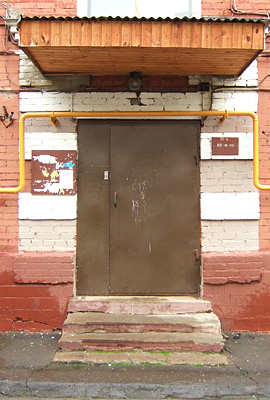
I thoroughly enjoyed Ilya Zhuravlev’s class there a couple of weeks ago.
Recommended for anybody who happens to be in town. Not for non-Russian-speaking beginners; but if you already have a practice and know the sanskrit names of asanas, and can work out the Russian for left and right, hand and foot (this takes at most half an hour to master), then you’ll be fine.
And if you do get lost, well, having an excuse to look at the beautiful Russian yoginis either side of you every now and again does no harm at all.
Ilya is the editor of yogamagazine.ru (English-language version coming soon, he says, maybe), who published a translation of parts of my Mysore Diary in their issue dedicated to Pattabhi Jois. And having met him and some of his friends, and seen just how dedicated and serious they are in their mission to bring authentic and serious yoga information to their country, it’s all the more an honour and a pleasure to have spent time in their company, both in writing and now in person. I’ll be back.
None
13th September 2006 permanent link
Einen Tod muß man in Marichyasana D sterben.
Bettina Anner
Is difficult to translate. Something like …
You have to die somehow in marichyasana D.
… were my yoga teacher’s kind and compassionate words of wisdom when I ventured to suggest that perhaps her adjustment of my Marichysana D today might conceivably be bringing my forward knee a little far from the floor.
but what is it for?
31st July 2006 permanent link
So what is advanced yoga asana practice for anyway? Possibly quite a few different things, which I’ll try to address one by one starting with this one:
for demonstrations?
A saying I‘ve seen attributed to various senior Indian ashtanga yoga teachers: “Primary series: very important. Intermediate series: fairly important. Advanced series: for demonstrations”
I also read somewhere, I think in Elizabeth Kadetsky’s book, that BKS Iyengar had that film made in 1938 as a marketing exercise when he was already planning to leave Mysore and set up his own yoga school in Pune.
In other words, demonstrating fancy-looking advanced asanas in public is at least partly grandstanding; but it’s supposed to be grandstanding in a good cause.
That seems to be precisely one of the concerns that the critics of the Ana Forrest demo have: advanced asana demonstrations will attract people, but they will be the wrong sort of people. They are mistaken. It doesn’t matter why people decide to try yoga. The vast majority won’t stick with it in any case, and the minority that stay, stay because they have discovered what it’s really about. I started going to yoga classes to keep fit, learn to do cool-looking things, and hang out with beautiful women – and I’m not the wrong sort of person.
Part One of a sporadic series. Part Two. Part Three. Part Four.
but is it yoga?
31st July 2006 permanent link
Yoga Journal has some footage of an advanced yoga asana demo by Ana Forrest at a recent conference, complete with a surprisingly biting comment thread about whether what Ana is doing is legitimate yoga or just ego and circus tricks. The people on the ego and circus tricks side should know better – yoga is about what’s going on in someone’s mind, the outward appearance of what they are doing has little or nothing to do with it: “spirituality is not determined by the practice, but … by the focus or intent of the practitioner” (David Swenson). Nevertheless it did make me think about what advanced asana practice is for anyway? Thoughts on that to follow; but first, some observation on this Ana Forrest comment thread and related things.
The comments themselves quickly degenerated, as these things do, into “that isn't proper yoga”. “Oh yes it is”. “Isn’t!”. “Is So!”
I, as will become apparent if it isn’t already, am uncompromisingly in the Is So! camp. The Isn’t! point of view isn’t entirely without merit either, though. There’s a well known and very vigorous expression of it in an article from a few years ago by vipassana meditation guru S.N. Goenka:
Patanjali has defined asana just by one phrase i.e. the posture in which one can sit for a long time, steadily and with ease. Only this very statement of Patanjali about asana has been elaborated up to 84 types of tiresome postures and all of them are now preached in his name. Poor Patanjali has been reduced to the status of circus trainer and he, who preaches to become aware of the inhalation and exhalation of natural breath, the intermittent stage between the two its elongation and its contraction, has been wrongly associated with the attempted and rigorous breathing exercise of pranayama. Breathing exercise too is not bad. It has got its own advantages but the same should not be ascribed to the name of Patanjali. Likewise different yogic postures too have got very good healthy impact over our body, but the same should also not be said as prescribed by Patanjali in his famous treatise. A sage who bestowed our country with a highly spiritual knowledge of yoga should in no way be allowed to be depicted as a kindergarten P.T. teacher who teaches asana or pranayama.
Something that is entirely without merit, though, is this comment by one of the Isn’t! school of thought regarding Ana Forrest:
Ana Forrest has only showcased her own body and not yogasanas. Yoga demos should be given to show the dynamism and purpose of yogasanas. She has, however, used asanas as a background to show her own contortions. None of the poses she struck were classical in nature and therefore have no names, purpose, or need.
Utter crap. If this person is so well educated about yoga asanas are “classical in nature”, then s/he knows very well that the Gheranda Samhita says there are eighty four thousand yoga asanas, although it only bother to describe a few dozen of them.
As to ones that are well documented common knowledge in our day: BKS Iyengar’s Light on Yoga, the best known modern yoga textbook in the world, describes two hundred. There are about a couple of hundred in the ashtanga vinyasa primary, intermediate and advanced series, overlapping largely but not completely with the ones in LoY. New York yoga teacher Dharma Mittra has documented over nine hundred. Yoga Dancer has online descriptions and photos of over four hundred and fifty.
(Actually, there are probably only a couple of dozen fundamental asanas, and all the crazy-looking advanced stuff consists of variations or combinations of these)
So, anything in Ana’s demo not in one or more of these well known standard compendiums? Nope. I found the comment so obviously egregiously wrong that I went back and looked through the first two clips again. All standard stuff, or obvious variations thereon:
- I.
- viparita chakrasana: one legged variation (= a gymnastics back walkover)
- virabadrasana 1
- eka pada galavasana
- adho mukhavrikshsana (handstand): variations
- ashta vakrasana
- eka pada sirsasana
- chakorasana: easy variation (leg over shoulder)
- supta trivikramasana
- tittibasana
- urdhva kukutasana
- tittibhasana again
- urdhva prasararita ekapdasana
- bhuja dandasana
- II.
- chakorasana
- bhairavasana (vinyasa)
- kashayapasana: supine variation; normally done prone
- hanumanasana
- samakonasana
- yogi dandasana: parivritta, dwi pada variations
… there were only three or four of these where I even had to pause to look up the sanskrit names.
And in the highly unlikely event Ana Forrest had managed to come up with positions of the human body that weren’t among the eighty four thousand alluded to in the Gheranda Samhita, instead of this collection of (slight variations on, in some cases) perfectly standard, well documented asanas – so what? Why would something not “classical” therefore have “no purpose or need”?
Until I find time to come up with thoughts about what advanced asanas practice is for anyway, you can see other videos of advanced asana practice here (more Ana Forrest), and, controversially but nevertheless easily the most impressive asana demo I’ve ever seen, B.K.S Iyengar filmed in 1938: Part 1, Part 2. Yoga Peeps has an interview with Ana. And if you want to study pictures of what nearly all those things I listed in Sanskrit look like, Yoga Dancer should have them, and ashtangayoga.info has the ones that are in the ashtanga advanced series.
link blogging
10th July 2006 permanent link
For Buddhists, the attainment of samadhi at its various depths is more a skill than a supernatural grace. Like piano playing or golf, it is something that can be learned reasonably well by most people with sufficient motivation and regular practice.
I don’t usually do pure link blogging – especially not when I'm hardly blogging at all anyway – but any remaining readers I may have could do a lot worse than go and read this wonderfully clear and concise article by Shinzen Young explaining basic concepts of buddhist meditation, with passing references also to Christian contemplative traditions and yoga.
Found via the 216 other people who had already tagged it under “yoga” on del.icio.us
asteya
1st June 2006 permanent link
Big news in the small pond of the Ashtanga Yoga web at the moment is that somebody has posted extracts of a film made in 1938 of famous yoga master B.K.S. Iyengar and his teacher Sri T. Krishnamacharya on youtube.
This film is a fascinating historical yoga document showing two of the last century’s greatest yoga masters in their prime. It’s well worth any serious yoga student’s time. Its quite well known and widely available from Iyengar Yoga centres all over the world. And, I suppose, if these clips make more people aware of it so that they go out and buy and watch the whole thing, that will be good. I do find myself wondering, though, whether I’m the only person who’s concerned about the asteya aspect.
Asteya is one of the yamas. Yamas, often translated as “observances”, are the first of the eight “limbs” of classical yoga as described in the Yoga Sutras. They concern basic precepts for how a yogi should live a morally acceptable life. Asteya is yama number three, and is usually translated into English as “non-stealing”. I take that to imply a broad interpretation of “not stealing”, possibly closely related to the Buddhist concept of Right Livelihood. So I take it to cover things like making an honest attempt to ensure my clients and employers get value for money. And not posting other peoples’ copyright material on the internet.
The guy who posted the clips is of the opinion that “the film is so old that any claim to copyright has expired”. I doubt if he knows what he’s talking about. I admit my legally-purchased copy of the video doesn’t carry any kind of copyright statement, and I Am Not A Copyright Lawyer – but from what I’ve read I understand that copyright at least for written materials is a number of years after the death of the author. I don’t know if that’s the same for film or if BKS Iyengar would count as the “author”, but if he does, he isn’t even slightly dead. Even if the content itself isn’t copyright, I’m pretty sure the particular physical manifestation of it in the form of the VHS videos sold by various Iyengar Yoga Institutes worldwide would be – so unless the guy on youtube either has the permission of the video’s publisher, or (unlikely) is using the original film reels with their currrent owner’s permission, I would be quite surprised if he’s as clean as he thinks he is.
It’s not like the video is difficult to get hold of once you know it exists. American (NTSC) and European (PAL) versions are available at the Iyengar Yoga Institutes in San Francisco and Maida Vale, London. Five of the top ten links for a google search on “1938 Iyengar video” are online shops where you can buy it in the States, England and Australia (San Francisco and Maida Vale are links nos. 2 & 4)
(How do I square my concern about this particular copyright grey area, with the fact that I am a regular user of legal-only-in-Russia music download service allofmp3.com? By not claiming to be completely consistent or in any way perfect, that’s how)
UPDATE: my comment on this issue on ashtanga news kicked off an interesting discussion on whether, and under what country’s law, footage filmed in India in 1938 may or may not still be copyright. I do remember reading something about by whom and it what circumstances this film was made; I think it was in Elizabeth Kadetsky’s First There Is a Mountain: A Yoga Romance, but as I don't have the book I can’t check.
the peacock’s tale
12th March 2006 permanent link
Bettina Anner demonstrates pincha mayurasana.
Pincha Mayurasana, the “feather of the peacock” position, is an elegant looking and quite difficult yoga posture in which you are balancing on your forearms instead of just on your hands. It’s a bit ahead of where I’m “supposed” to be in the ashtanga intermediate series but, like a lot of ashtangis, I do play around from time to time with asanas that are a bit more advanced than what I “should” be doing. Right now I have decided to do more than dabble with pincha mayurasana, because it requires a lot of shoulder mobility. One of my biggest physical challenges in yoga is that I have very tight shoulders from rock climbing and years of working hunched over desks (or, as I am now, sitting in half lotus on the floor hunched over my laptop). Pincha mayurasana should help.
I have always found it a daunting posture. Learning any upside down balancing posture almost inevitably involves a certain amount of falling over, and the further your head is from the floor the scarier that is. I learned to tuck my head and roll out of headstand years ago, but I always assumed it would be a lot more difficult and scary to do it from a position where my head wasn’t already on the floor. Not so, as it turns out, but for a long time I was put off by remembering my mate L learning pincha mayurasana in Mysore. (I will not name L in full here, on the offchance that he might not like his yoga students reading about his former foibles and failings). Every morning for what seemed like weeks, L would kick and flail his feet up into pincha mayurasana only to crash down, still kicking and flailing, onto the mat of the woman opposite, usually landing round about where her head was. As the days went by the poor woman started to look more and more nervous (quite understandably) as the moment for L’s attempt at pincha mayurasana drew near.
However, I have discovered that it actually isn't all that hard after all. Here’s how you learn pincha mayurasana in two easy steps:
- Mess about with it sporadically for a long time, going up with your feet against a wall so you can’t fall over
- Spend half an hour one afternoon practicing kicking up, tucking your head and doing a forward roll out of the position. This turns out not to hurt at all on the nice thick new yoga mat my wife got me for Christmas.
- Now that you’re not afraid any more, get it in a week.
Step (1) is unnecessary.
I realise now that this is another thing I could have learnt years ago if only I’d been paying attention. At a workshop I went to once – admittedly in a session where I was taking photographs and not doing the class – the teacher had everybody practice the tuck and roll thing. The main thing that struck me at the time was that two of the students – my teacher and my wife’s teacher – were persistently doing it wrong. They were both so happy and comfortable in the position they looked like they couldn’t imagine why anybody would want to fall over from it; when they finally were persuaded to come down they had to be told off for elegantly arching over into backbends and placing their feet lightly on the floor instead of falling.
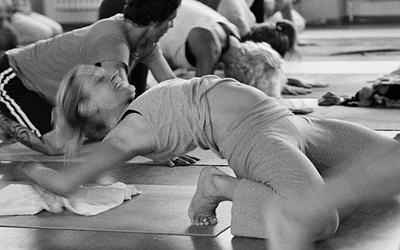
(Does this count as A Photo A Week? We’ll see)
That Disclaimer Again: taking advice about how to do difficult yoga asanas from random strangers on the internet may not be the wisest thing you could possibly do.
yegge on yoga
10th March 2006 permanent link
[people] prefer their current, very real pain to some imagined possibility of a different kind of pain.
Steve Yegge may not have realised that he was coming up with a piece of universal and profound human wisdom in an essay about (the programming languages) Scheme and Java. Or perhaps I underestimate him.
Be thine own palace, or the world's thy jail.
Nobel prizewinning economist Amartya Sen (whose book The Argumentative Indian is high on my reading list) may well not have had yoga in mind either when he quoted John Donne in a review of a book about development economics, but it’s an admirable summary of what yoga is all about nevertheless.
priorities
28th February 2006 permanent link
Meandering towards a Tuesday Family Life Vignette.
if you want to get things done, you positively have to understand at any given point in time what is the most important thing to get done right now and if you're not doing it, you're not making progress
Says Joel Spolsky – a quote that has been at the top of my office todolist.txt file for some time now. Joel is talking about managing priorities on software projects. The point has some relevance to life in a broader context, although I think one would have to have an extraordinarily simple life for there to be one identifiable Most Important Thing one could be doing in most situations. As Paul Graham points out:
There are an infinite number of things you could be doing. No matter what you work on, you're not working on everything else.
I have also lately been reading Steve Pavlina’s blog. (I think I first came across Steve via a link from Joel.) Steve is also interested in things like priorities and time management, but would very much take the view that whether managing a software project is the right thing for you to be doing, is far more important than whether you are managing your software project effectively. He is right to quite a considerable degree.
Paul Graham, on the other hand, is wrong to a large degree when he rules out as Most Important Things
work that has zero chance of being mentioned in your obituary. … there's a whole class of tasks you can safely rule out: shaving, doing your laundry, cleaning the house, writing thank-you notes-- anything that might be called an errand.
As any Zen practitioner could tell Paul, for an enlightened person whatever you are doing at any given moment, if you are fully focused in that moment and living it without distractions, is the right and Most Important Thing you could be doing. Washing the dishes or sweeping the floor are perfectly good candidates. Sufficiently advanced washing up is indistinguishable from Lisp hacking.
See also the Bhagavad Gita, in which we learn (paraphrasing wildly) that there’s no point fretting about the situation you find yourself in, you are where you are and all you can sensibly do is do your best at the task you find yourself confronted with. This is taught in business schools too, as the concept of Sunk Costs. It also used to be called “Oriental Fatalism” by Victorians who believed it was the reason why Indians – whose ancestors were inventing philosophy and higher mathematics while the Victorians’ ancestors were still running around in the forest painting themselves blue – were a terminally degenerate civilisation doomed to be ruled forever by the descendants of blue-painted barbarians. Which turned out not to be the case.
One learns from yoga asana practice that the whole Bhagavad Gita thing makes complete sense. The point is just to be doing your practice, with whatever limitations you happen to have today, without seeing it as a means towards some distant end goal. This is a tricky one in ashtanga vinyasa yoga, and other outwardly physical-looking forms of yoga, where there are very impressive-looking advanced practices which, if we are honest, are a large part of the attraction to start sutdying these forms of yoga for a lot of people. Having cool-looking advanced practices for students to aspire to, though, is just one of yoga’s clever motivational tricks to encourage tapas – diligent, dedicated practice – and is fine provided you also manage to hang on to an attitude of aparigraha - non-grasping, non-attachment to results – and realise that developing the ability to perform cool-looking advanced tricks is an enjoyable side effect, not the object of the exercise. The object of the exercise being (ok, cessation of the fluctuations on the mind, inner peace, elightenment etc. etc.) to be doing your practice, focused on what you are doing and not worrying about other things. I never have any doubt when I’m doing my yoga practice, that what I’m doing is the right and best thing for me to be doing at that moment in time.
The point I am sneaking up on being: that by any conceivable standard [except Paul Graham’s, who is wrong] there can be no doubt you are doing the right thing, when the thing you are doing is escorting a nearly three year old boy on his first ever bike ride round the block, catching the last half hour of winter twilight as your Boys’ Night activity while mum is away at her yoga class.
treatment house
14th February 2006 permanent link
People email me from time to time to ask if I can recommend any Ayurvedic therapy centres in India. Until now I’ve always had to say no, but not any more.
This man, P. Vijayan of Kerala, generally known as “Vijay”, is an Ayurvedic masseur and one of a handful of true geniuses I have had the privilege of encountering in my life.
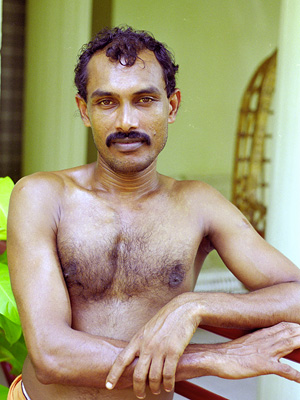
Vijay used to work in a beach resort hotel in Kovalam for the winter season when a lot of yoga students are usually there – Kovalam is a popular spot for western ashtanga teachers to teach their own winter classes before they go to Mysore. Outside of Kovalam in winter, though, it was difficult to track him down. I haven’t been in touch with him since I was last there in 2002.
A while ago a friend of mine whose family lives in the same part of Kerala was interested in getting in touch with him – I asked around on a couple of yoga message boards if anybody had his home address, but no joy. Then last week one of his students emailed to let me know he now has his own Ayurvedic therapy centre, Treatment House, in a village near the Kerala state capital Trivandrum. The address:
TREATMENTHOUSE
Center for Kerala Traditional Ayurveda & Vijay’s Foot Therapy
P. Vijayan
Athiralayam, Choozhattukotta
Malayam (p.o.), 695571 Trivandrum
Kerala, South India
Tel +91 471 2280774
www.treatmenthouse.com
I really can’t recommend Vijay highly enough. I should get on with my long-overdue story about how he finally fixed my right knee after surgery and physiotherapy failed.
Added to my yoga links page.
Alan on Ayurveda (Indian traditional medicine): I don’t believe Ayurveda’s explanation of how/why the body, and ayurvedic treatments, work. I don’t doubt for a moment that some of the treatements do work, and I certainly wouldn’t rule out the possibility that ayurveda has effective treatments for things western scientific medicine can’t deal with yet. It seems unlikely that highly intelligent and dedicated people would have got everything completely wrong for thousands of years. In particular I think the Ayurvedic approach of looking broadly at diet and health as whole has a lot to commend it compared to western medicine’s tendency to look for technological quick fixes for individual problems and ignore the bigger picture.
pain, no gain
25th January 2006 permanent link
If you think something’s supposed to hurt, you’re less likely to notice if you’re doing it wrong.
Words of [highly relevant to] yoga wisdom from Paul Graham.
See also ashtanga yoga teacher David Williams.
If it hurts, you are doing it wrong.
Compare and contrast quite possibly the worst advice ever put into writing by any senior yoga teacher:
People not used to sitting on the floor seldom have flexible knees. At the start they will feel excruciating pain around the knees. By perseverance and continued practice the pain will gradually subside and they can then stay in the pose comfortably for a long time.
BKS Iyengar, Light on Yoga, discussed here.
finding yoga teachers
20th January 2006 permanent link
Somebody wrote to me the other day:
Hello Alan,
I saw your web blog and thought this might be a question you could answer. I’ve been practicing yoga for about 15 years off and on. I practiced Hatha for a few years and now am on to Kundalini. It’s been brought to my attention by my fiancé who is Indian, that it’s difficult to find a good teacher in the West as it’s not so important in NA whether there is a lineage and whether that knowledge is passed down along with blessings to the next teacher. It seems we are not so serious here what with our oxymoronic power yoga centers and the like....
Originally I was attracted to Kundalini as it seemed to integrate a more balanced view of exercise that comprises spiritual teachings. But now I’m wondering if I’ve made the right choice. I want to get serious about yoga and find a practice that takes me through this life. I’d like to a) find a yoga that follows a lineage and is anchored in a tradition and b) be able to find that school in Vancouver, British Columbia.
Is it possible or necessary to find a teacher who has been taught by a guru and whose practice of yoga has been blessed. Any suggestions you might have would be received with great thanks.
Interesting question – the current western rash of well-intentioned but inexperienced and under-qualified yoga teachers, versus the Indian mindset about direct guru lineages (allegedly) dating back hundreds or thousands of years. My thoughts:
it’s certainly necessary to find a teacher who is dedicated and serious – I wouldn’t regard it as worth studying with anybody whose yoga practice wasn’t the central focus of their life. It’s also important to find somebody whose teaching style you personally are comfortable with and who teaches a style of yoga that suits you. That doesn’t mean it has to be all laughs all the time – nothing worthwhile is – but if you don’t basically like your teacher and mostly enjoy your practice, then you’re not going to be motivated to carry on for very long.
Direct guru lineage is a good positive indication of a teacher having the necessary qualities, but I don’t see it as a be and end all in itself. In ashtanga vinyasa yoga – the style I personally practice, – direct guru lineage is the norm; most (though not all) of the good teachers have studied directly with and are blessed/authorised by Sri K. Pattabhi Jois.
I’m very much a believer in the qualities of the teacher being more important than the content of the teaching. On yoga message boards I constantly come across people saying “well, I have a good teacher of Yoga Style X in my town and no teacher of Yoga Style Y, but I want to practice Yoga Style Y so which book/DVD should I buy?” (where Yoga Style Y tends to be the one I personally practice). I always say stick with the good teacher. Depressingly often that’s a minority opinion.
Even some of the “oxymoronic power yoga” teachers you seem unimpressed by are good and serious yoga teachers – admittedly maybe a lower proportion than in some other yoga traditions.
Something else to watch out for is that these days, yoga being so fashionable, there are far too many yoga teachers who are doubtless very dedicated, enthusiastic and well-meaning, but have started teaching far too soon and really don’t have enough experience and knowledge yet. I personally wouldn’t consider studying with anybody with less than about ten years regular and committed practice under their belt. “Under their belt” is a good phrase there: in many martial arts styles it’s possible for a dedicated student to get to black belt level in maybe five years or a bit less; but then it’s a big mark of pride among “real” black belts to have practiced so much that you’ve worn most of the black silk outer layer off of the belt and it’s well on the way to being white again. You should be able to detect signs of the same thing having happened in your yoga teacher – trickier to spot without the belt though. Yoga mats don’t last long enough to be a reliable visual indicator.
Lots of vague generalities there; I’m afraid I don’t know and can’t personally recommend anybody in Vancouver. I can say that in Canada any ashtanga teacher who has studied/trained with a guy called Darby in Montreal is likely to be good.
Steve Pavlina is of the opinion that “my writing time is better spent producing articles to be seen by thousands of people rather than individual emails to be seen by only one person.” Re-use, Steve, re-use. If something interests you enough to be worth writing a long/considered email response, maybe just write it and then decide to post it too.
dedication and determination
14th January 2006 permanent link
Many people say they lack the time [for daily yoga practice], yet they can eat, sleep, work, chat and sometimes even quarrel. What they really lack is dedication and determination, not time.
(well known Indian yoga teacher) Yogacharya Venkatesh of Mysore
sometimes details do matter
11th January 2006 permanent link
Sometimes, however, details do matter.
In one of the yoga DVDs I borrowed from my teacher, Pattabhi Jois is talking Sharath through a demonstration. They get to Marichyasana D. Most people find Marichyasana D the hardest thing in the ashtanga primary series. I struggled with it for years, and still don’t find it easy. So Guruji clearly thinks it is worth pointing out an important detail about how Sharath is doing it:
Your hips and feet one line you take, easy is coming. Your feet is coming touching here [points to knee] trying you – no. Not coming that asana. This method!
In other words (English isn't Pattabhi Jois’s first language, or even his second or third), the foot that is on the floor should be tucked back towards the buttock. Like Sharath in this dodgy DVD screen grab:
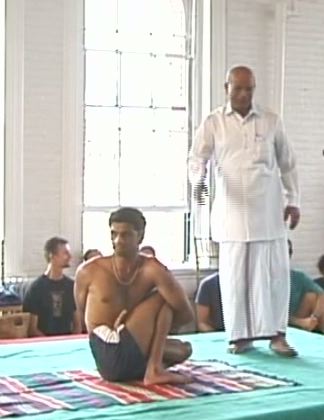
Whereas I’ve always done it with the foot that is one the floor quite far forward, trying to bring that foot and the knee of the lotus leg close together. Here I am a couple of years ago, with the foot way forward although sadly not very far in towards the knee:
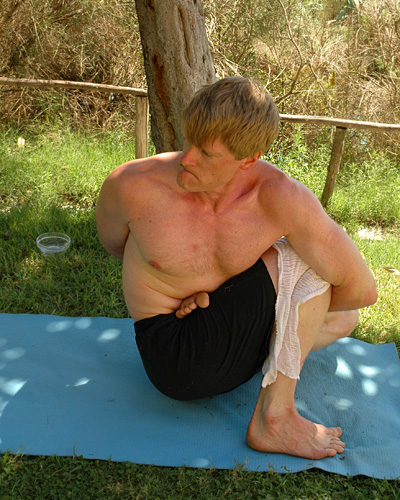
Sharath is of course thinner, stronger and more flexible than I am. But his grandfather is right, as he usually is about matters yogic: when I try with the foot further back, it’s an order of magnitude easier for me too.
For some reason I thought foot forward was the correct position, and that it was supposed to be a preparation for this even harder position from the first advanced ashtanga series, in which the foot on the floor completely crosses over the lotus leg (Lino Miele demonstrates):
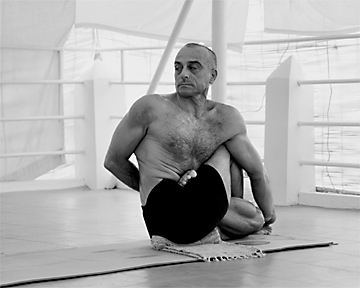
Why did I never pick up on this up before? It could have saved me months or years of struggling. I can’t have been the only person making that mistake either – I assume Pattabhi Jois wouldn’t go to the trouble of pointing it out in a public demonstration if he didn’t think he had been seeing far too much of it. It doesn’t really matter – a large part of yoga practice is accepting that you are where you are, difficulties you are having now are a golden opportunity to learn and regrets about the past are pointless. Still I find it curious – it was Sharath who taught me this position, so where did I get the idea about doing it with my foot in the wrong place? Maybe Sharath didn’t think to tell me where to put my foot – he has probably been able to do Marichyasana D effortlessly for as long as he can remember without having to worry about the details, and could do it easily even if he did have his foot in the wrong place (here’s my friend Arjuna – also thinner, stronger and more flexible than I am – doing it effortlessly with his foot quite a bit further out than Sharath). Maybe Sharath did tell me, but I was too busy struggling to hear or remember. Whatever. I know now.
Also worth noting that the reason this particular detail is important is because it concerns the functional mechanics of getting into the position efficiently. It has nothing to do with anybody’s preconceptions about neatness or elegance of form.
(Just out of curiosity I checked BKS Iyengar’s Light on Yoga. He says the heel of the foot on the floor should be against the perineum, whereas in ashtanga yoga it’s more out to the side because we are supposed to be trying to get both buttocks on the floor – although not many people actually can in this position. Iyengar’s yoga approach is different from Pattabhi Jois’s and his versions of postures aren’t necessarily canonical; nevertheless I find it interesting that he also doesn’t say the foot should be forward.)
(While I’m in the mood for checking books, I now find that Pattabhi Jois in his book Yoga Mala – which I read four years ago, although evidently not carefully enough – also clearly says there that the heel should be pulled in towards the buttock)
Standard Disclaimer: taking advice about how to do difficult yoga asanas from random strangers on the internet may not be the wisest thing you could possibly do.
watching yoga
11th January 2006 permanent link
My yoga teacher is away studying with Pattabhi Jois in India for two months, so I took the opportunity on a pre-Christmas social visit to plunder her shelf of yoga videos and DVDs that won’t be of any use to her while she’s away.
They made for some inspirational viewing over the Christmas holiday. One thing that struck me (again) was the very marked difference between the way advanced Indian and western yoga practitioners approach yoga practice and look while they are doing it.
Two of the films were of Pattabhi Jois’s grandson, Sharath Rangaswamy, doing advanced demonstrations. Some bits of them are so breathtaking they draw gasps and bursts of applause that an audience that includes some western practitioners who are pretty seriously capable themselves. But depite [because?] of being capable of such feats, Sharath performs quite a few basic postures in an outwardly lackadaisical and casual-looking manner that advanced western practitioners never would. Here are pictures of him doing some basic asanas in ways that would throw most western yoga teachers into fits. In the time I studied with Pattabhi Jois and Sharath, I never saw any sign of either of them caring about what students’ postures looked like per se.
The only time Sharath ever gave me anything amounting to advice about technical details of “alignment” in a posture was to radically shorten my stance in parsvottansana – you can see him in the third picture from the bottom on this page, doing it himself with his feet much closer together than most people teach it. A friend of mine asked me at the time “if anybody but Sharath had told you to do it like that, would you still think it was right?”. I thought she was rather missing the point: if I didn’t trust Sharath’s judgement and do what he suggested I should do, what on earth would have been the point of going halfway round the world to study with him?
One of the other videos was of Pattabhi Jois leading some of his advanced western students through an intermediate level demonstration. Here there was much more straightness and outward elegance of line in the most basic postures, with Pattabhi Jois looking on and smiling approvingly in just the same way as he does when Sharath does the same postures completely differently. Despite that there are differences between the westerners too, and it’s interesting – and inspiring in a different way(*) – to see that there are intermediate-level things that people who are quite rightly regarded as advanced practitioners, some of the best yoga teachers in the west, still have visible difficulty with.
(*) It is not however a good idea to justify one’s own practice, even to oneself, as the sum of all the weaknesses one has observed in more advanced practitioners. My teacher is rightly unimpressed every time I try to justify one particular quite basic and simple asana I am weak at by saying “but Sharath does it like this too”. She and I both know Sharath does it like that because he doesn’t feel the need to do it any “better”, doesn’t need to do any additional work on the things that asana works on, whereas I do it like that because I really can’t do it any better.
yoga links
18th December 2005 permanent link
A while ago I linked to a very interesting article about the health benefits of diaphragm breathing by Kelly McGonigal. Last week I noticed whilst checking links in and from my site that it had gone missing. I wrote to Kelly asking if there was any chance of her putting it back; she replied very promptly and politely, saying not just yet because she’s working on a bigger & better version. Fair enough. I will point to it again when it reappears.
UPDATE: Lianne at yogalila points to an archived copy of the original essay.
Meanwhile the rest of Kelly’s website is well worth a look. In particular she is interested in serious research on the health benefits of yoga – regular readers know that I am too, and I have subscribed to Kelly’s newsletter. (She’s a babe too)
the dance of shiva
9th December 2005 permanent link
In a pratyahara-deficient moment in my yoga practice I noticed that four-armed Shiva appeared to be in the room practicing with me:
You have to be really advanced, or practicing facing a mirror with with a window behind you at midday in winter, for this to happen. I could of course quip cynically that a reflection of a shadow of a true yoga practice is about all I will ever aspire to; but it wouldn’t be fair or true, so I won’t.
who does the asking?
6th December 2005 permanent link
Writing about yoga courses in convents reminds me that months ago I meant to write a longer response to Michael Blowhard’s comment on vedanta:
I've had many experiences with Hinduism, yoga philosophy, and Buddhism when it was as though the speaker or writer were inside my head, discussing far better than I ever could the questions my own mind spends much of its energy chewing over. These religion/philosophies speak to me intuitively as much as they fascinate me intellectually.
To which I replied in a comment:
Hear hear. One of the only times in recent years I can remember being absolutely rapt, fascinated, hanging on every word in a lecture - even wishing I had a tape recorder with me instead of relying on notebook and recollection, which have always served me well enough in the past - was a philosophy course I attended with BNS Iyengar, a senior Indian yoga teacher (not *the* famous elderly Indian yoga teacher Mr Iyengar, the other one. Iyengar is a common name)
This is the gentleman:
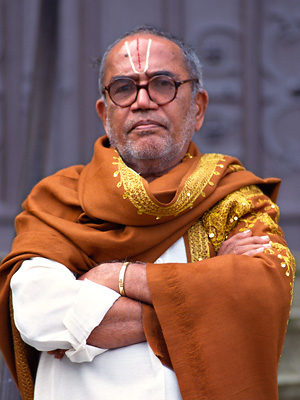
BNS Iyengar
Now, in another of his meditation postings, Matt Webb finds himself thinking:
This isn't going to make much sense: It's like there were two "me"s. One was doing the breathing and the quietness, and the other was churning away with thoughts just as much as any hour of the day, only saying things like "oh, that's good, good breathing there".
It absolutely makes sense. In one of those meditation classes, Mr Iyengar told us to focus on visualising a candle flame and “if thoughts come, ask them to leave”. A simple little phrase, but it turns your head inside out a bit if you then suddenly think, “but wait a minute – who’s doing the asking?”. The sudden realisation that there is a me who isn’t just whatever stream of semi-random noise happens to be passing across the surface of my consciousness – so who or what is that, am I, then? This might not be an awareness-altering concept for you, dear reader, but it was for me, and it seems to be the central thing people learn in the beginning stages of all forms of meditative practice: the ability to observe oneself and one’s reactions to things with some degree of detachment, to not be completely caught up all the time in the citta vrtti, the fluctuations of the mind.
Pattabhi Jois, the yoga teacher I studied with in India, famously likes to say “yoga is 99% practice, 1% theory”. No amount of abstract thinking or reading philosophy texts is going to change anything if you don’t get your mat out and focus your mind on your practice on a daily basis. So prior to that course I deliberately avoided all yoga theory & philosophy, and just got on with doing the practice and seeing what happened. I had decided for various reasons of my own that I had lived too much of my life up to that point lost in thinking and verbalising and abstractions, that that in many ways hadn’t done me much good, and that it would be good for me to do something differently. It seemed to work quite well for a couple of years, but then Mr Iyengar convinced me it was time to start catching up on the 1% theory. I went out and bought TKV Desikachar’s Heart of Yoga, which is a fine book containing among other things Desikachar’s commentary on the Yoga Sutras of Patanjali. If one day I ever finish studying and absorbing that (it’s only been four years so far) I may move on to other texts.
It’s interesting to see two senior teachers of the same form of yoga with such different approaches. Pattabhi Jois’s approach is very much to teach students the physical aspects of the practice, encourage them to practice those diligently and let the breath control, mind control, meditative aspects arise naturally out of that over time. He does occasionally come out with nuggets of theory & philosophy wisdom in front of groups of students, but doesn’t teach anything like formal philosophy classes. His English, in any case, is limited.
Mr Iyengar speaks much better English, and also very much gave the impression that the physical practice is just matter of “ok, here are some asanas we have to do in order to be able to sit properly. Good. Now we can get onto the interesting stuff”. Which for him seems to be philosophy and meditation classes. (He can teach the physical stuff if he feels like it. I know this because I know a couple of his western students who have quite impressive advanced practices)
Now I think of it, this was also the yoga course where I finally learned how to approach lotus position safely, after two years of hurting my knees by doing it wrong. All in all a week well spent.
contemplation
2nd December 2005 permanent link
I wrote to Matt Webb, mentioning the time I attended a yoga course in a convent and talked to one of the sisters about yoga and Christian mystical traditions:
Yoga is clever. I once attended a yoga course that was hosted in an Anglican convent in England, and got talking to one of the sisters. I asked her whether she thought it was incongruous for a course in yoga – rooted as it is in Hindu traditions – to be taking place in a Christian setting. She said she didn’t find it so. Christianity has meditative, mystic traditions that are basically the same thing, but in Christianity there is no help or advice on how to go about pursuing meditation, or “contemplative prayer”, in a systematic way. You’re just supposed to sit down, still your mind (how?) and be open to grace. The sister said what she found fascinating about buddhism and yoga is that they, over several millenia, have assembled a whole collection of tricks and techniques for helping a still and open mind to happen, different ones of which work for different people.
Then I found this in an interview with Buddhist monk Shinzen Young that Matt links to:
nowadays there's an enormous dialoguing and cross-fertilization that goes on between the Christian contemplative tradition and the Buddhist one, simply because we recognize each other's similarities. The thing I particularly like about Buddhism is that it has a step-by-step methodology that's very technique oriented, and gives you something to do, almost like a computer program, like a flow chart. That appealed to me very much. But by and large, around the world meditative traditions are basically dealing with the same material, so you come up with similar type experiences. So although what I say will be specifically out of experience on the Buddhist path, much of it is applicable to Christian, Islamic, Jewish mystical traditions also.
Matt says he’s interested in the Christian contemplative prayer thing, but I can’t help him any further with that since I’m not a Christian. It’s just something I heard talked about a few times and filed under Moderately Interesting.
yoga globalization
30th November 2005 permanent link
In my mailbox this morning I learn that a Russian yoga magazine containing a translation of excerpts from my Mysore Diary will soon be on its way to me in the post. I will be interested to hear what Maria has to say about the the translation.
Old-school Russian yogis have a reputation for being amazingly hardcore. Apparently yoga was banned in soviet days, or at least heavily frowned upon, as a quasi-religious activity, so only the most dedicated yogi dissidents pursued it. I am honoured to be admitted to their company, even if only in writing.
Yoga globalization: this came about because the Russian magazine editor met my German yoga teacher on a train in Delhi. And Russia becomes the fourth country where I’ve had yoga photographs published in newspapers and magazines – the others being the USA, Germany and Australia.
yogapundit?
28th November 2005 permanent link
Is it just me, or is Sri Ganesha Tea & Book Stall (mythic tea, real books, basic information) clearly the best yoga news’n’links blog in the world? (And not just because they link to me)
Sri Ganesha (not, I assume, his real name) appears to have some kind of affiliation with Eddie Stern’s ashtanga yoga school in New York – thus knocking rather a large whole in NY ashtangis’ reputation for being dedicated and proficient, but perhaps a little wanting in the self-deprecating humour department.
interconnected zen
26th November 2005 permanent link
I’ve never been much into pure link blogging, and since I’ve been using del.icio.us I do even less of it than I used to. But Matt Webb’s adventures in the land of meditation look like they are going to make interesting reading.
yogalilapalooza!
26th November 2005 permanent link
Wow. I won the yogalila sweatshirt draw. I haven’t won anything like that for ages. Sophie informs me it is actually a ladies’ sweatshirt – I hope Maria will like it.
yoga and fitness
18th October 2005 permanent link
The place where I’m working has a pretty good employee fitness programme (also open to contractors), including a gym where I do my yoga practice at lunchtime – easier than doing it at home with a toddler jumping on me. This week they’re doing various fitness assessment specials to encourage people to sign up, one of which was body fat measurements outside the canteen at lunchtime.
I have 13.3% body fat, which is fairly low for a man of my age. But my Body Mass Index (weight over height squared) is 25, which is quite high. Lowish fat and highish BMI apparently means I’m quite muscular. Which is interesting. Yoga is the only exercise I do on a regular basis these days. I gave up rock climbing ten years ago; up until four years ago I was doing a fair bit of mountain biking and snowboarding, but those too came to an end when I became first an expectant and then an actual father. I sometimes ride my bike to work, which is a 20 mile round trip – but only a couple of days a week at most in summer and not at all in winter, and this summer was so lousy I hardly did it at all. So really just yoga – forty minutes to an hour and a half, four to six times a week.
Practicing yoga for the sake of one’s health, a firm body, or enjoyment is not the right approach.
But if doing it means you get a healthy, firm body as side effect, then that means you don’t have to spend time and energy on other activities aimed at maintaining fitness, so you have more time for yoga …
yoga sceptic
7th October 2005 permanent link
One of the things in my perpetually unfinished drafts folder is an essay on “materialist yoga”, in which I talk about my belief that many of the effects and benefits traditionally claimed for yoga are real observations of real phenomena, which should in principle be explainable without resorting to some supernatural concept of “god”.
So I’m interested when I see studies that seem to be going in that direction, or entire vast bibliographies of such studies; and I’m frustrated when I see such things being done with what look to me like absolutely basic mistakes.
One thing I immediately and automatically assume is bullshit is people claiming that their religion’s sacred texts, including the particular archaic language in which they were originally composed, are the direct literal word of God. (I once saw a website whose author believed the King James Bible was what God had in mind all along. Why then did it take Him sixteen hundred years’ worth of drafts in other languages to get it right? He must manage His to-do list about as effectively as I do mine) One variant of that claim, distressingly common in yogic circles, is that the sound of the Sanskrit language in Hindu sacred texts has some kind of special effect on consciousness, irrespective of whether or not one actually understands the texts. Hmm.
So this abstract in the bibliography I just mentioned rather jumped out at me:
This study tested the prediction that reading Vedic Sanskrit texts, without knowledge of their meaning, produces a distinct physiological state. We measured EEG, breath rate, heart rate, and skin conductance during: (1) 15-min Transcendental Meditation (TM) practice; (2) 15-min reading verses of the Bhagavad Gita in Sanskrit; and (3) 15-min reading the same verses translated in German, Spanish, or French. The two reading conditions were randomly counterbalanced, and subjects filled out experience forms between each block to reduce carryover effects. Skin conductance levels significantly decreased during both reading Sanskrit and TM practice, and increased slightly during reading a modern language. Alpha power and coherence were significantly higher when reading Sanskrit and during TM practice, compared to reading modern languages. Similar physiological patterns when reading Sanskrit and during practice of the TM technique suggests that the state gained during TM practice may be integrated with active mental processes by reading Sanskrit.
Travis, Frederick, T. Olson, T. Egenes, and H. K. Gupta. Physiological patterns during practice of the Transcendental Meditation technique compared with patterns while reading Sanskrit and a modern language. International Journal of Neuroscience, Jul. 2001, 109(1-2):71-80
It’s unfair to comment on a paper based on the abstract. I would read the whole thing if I could, but the International Journal of Neuroscience doesn’t have online archives. So, thoughts based on what I can glean from the abstract:
A basic factual error in the first sentence doesn’t exactly inspire confidence: the Bhagavad Gita isn’t Vedic. It was composed hundreds of years later than the Vedas, in a language that had changed significantly from Vedic Sanskrit. (wikipedia:Sanskrit) I wouldn’t expect peer reviewers for a neuroscience journal to know this, but somebody who is sufficiently interested to want to do a study like this should.
I’ll give the authors the benefit of the doubt by assuming they know more about EEG readings and measures of statistical significance than they do about the history of Sanskrit. So assuming the effect they say they found is real – what could be causing it?
- Western yoga or meditation students might regard Sanskrit, and not German, Spanish or French, as inherently associated with things sacred or mystical – or just as something connected with their meditation or yoga practice – and respond to it accordingly.
How could a study control for this? Not easily. It would probably be quite difficult to find a group of study subjects who had meditation experience but wouldn’t recognise Sanskrit (Japanese Zen practitioners?). - Classical Sanskrit is not a natural language. By the time of the Bhagavad Gita it was well on the way towards being a formal language used only for scriptural and literary purposes; it wasn’t anybody’s everyday language. Perhaps it might therefore have an inherently more regular and calming-to-the-mind structure than vernaculars like German, Spanish or French?
-
The Bhagavad Gita, like most ancient sacred texts, was passed down by oral tradition for centuries before it was written down (although not as long as the Vedas were). As such, it must have rhythms and structure that are particularly suited to be memorised, highly evolved to fit comfortably into slots in the human mind. Modern translations produced in post-oral cultures are not likely to have these qualities. Good verse in any language might just be inherently more pleasing to the mind than clunky prose translations, regardless of where the verse came from.
These things might be recognisable to some degree even if one doesn’t understand the languages concerned. Lots of people listen to and appreciate singing in languages they don’t understand. - Now I’m really clutching at straws but … Vedic Sanskrit contends with Mycenaean Greek (much less of which has survived) for the title of oldest extant Indo-European language. The early Classical Sanskrit of the Bhagavad Gita is still quite similar to it. Maybe (very tentatively) it therefore has some kind of special resonance for native speakers of Indo-European languages? The study was done in America, so I assume the subjects were native English speakers – repeat with subjects who aren’t native speakers of Indo-European languages. (Those Japanese zen practitioners are looking more and more attractive)
The claim that merely reading Sanskrit texts without understanding them has special effects is a very strong one. It’s more commonly said that reciting Sanskrit texts has a special meditative effect. It’s obvious how that could be:
- Most of the people who can chant long Sanskrit passages from memory are Brahmins who (a) understand the language fluently and (b) have been trained from childhood to memorise these texts. Reciting from memory requires a very high degree of mental focus - pratyahara, and is therefore inherently a meditative activity.
- Some western yoga students (e.g. me) also memorise and can recite a few snippets of Sanskrit scripture. But we associate the language strongly with our yoga practice and, since we don’t understand the texts like Brahmins do, possibly have to concentrate even more to remember them correctly without any clues from the meaning.
I remain sceptical about the alleged specialness of the Sanskrit language. If the language itself, irrespective of the setting and of what the text actually says, really does have the kind of special effect that some people – apparently including the authors of this study – believe, then my hypothesis would be that the effect comes from one or more of the following, in decreasing order of probability/importance:
- people associate it with particular activities & states of mind and react to it accordingly
- verse from oral cultures has been very highly refined and evolved over many generations to fit comfortably into the human mind
- classical Sanskrit is an artificial language, produced by many generations of clever people taking an existing natural language and deliberately refining it in the direction of order and aesthetic pleasingness.
No divine intervention required.
more gas
6th October 2005 permanent link
Michael Blowhard complicates the yoga-oxygen picture still further by pointing to this Yoga Journal article about research on the physical benefits of yoga. In it we encounter the entirely plausible hypothesis that:
… yoga poses help increase lung capacity by improving the flexibility of the rib area, shoulders and back, allowing the lungs to expand more fully. Breathwork further boosts lung capacity … by conditioning the diaphragm.
gas exchange yoga
4th October 2005 permanent link
I was thinking whilst cycling to work the other day[*] about something David Williams said at the yoga course I went to with him in July: he wouldn’t be surprised if as much oxygen passed through the body in one hour’s ashtanga yoga practice as in the other twenty three hours in the day of other activities.
(Unfortunately for me, perhaps,) I’m not the sort of person that hears a claim like that and just thinks “wow, cool”. Instead I think “wow, that would be interesting if it were true. Now show me the numbers”.
According to yoga anatomy guru David Coulter, a normal resting breath for a “healthy young male” is about half a litre, and the maximum possible breath is a little under 5 litres. So a factor of 10 difference – quite a lot, but less than 23x. And that's the theoretical upper limit of what would be possible for a super-yogi who breathed at the maximum possible throughout their yoga practice, and an absolutely relaxed resting breath the rest of the time. I don't think such a person exists.
In ashtanga vinyasa yoga, we don’t in any case attempt to breath the absolute maximum possible volume of air. We are supposed hold muscle locks in the lower abdomen throughout our practice – bandas – one effect of which is to prevent breathing into the abdomen and instead keep as much of the breathing action as possible up in the diaphragm and ribcage. This serves a number of purposes, some of which are:
- It supports and stabilises the lower back, thus protecting it from injury.
- It requires a high degree of mental focus to sustain consistently for an hour or more, thus discouraging thinking about extraneous things whilst practicing – pratyahara.
- It provides (one day, so I’m told) the core body strength and control that’s needed to perform cool-looking advanced handstand manoeuvres.
- It encourages breathing into, and opens up, the upper and rear portions of the lungs. And, according to senior ashtanga teacher Graeme Northfield, “the posterior section of the lungs is where most of the gas exchange occurs”.
Really? That’s interesting. Let’s look for some support for that claim too. What does google think about “lung region gas exchange efficiency”? It thinks there is a handful of medical papers that do indeed seem to be in the right general area, but they don't appear to contain the answer to this particular question. Skimming them anyway, I discover that “ventilation/perfusion ratio” appears to be the key technical term – how much air is getting into a particular region of the lung, versus how much blood supply is there to exchange gases with it. Lots of papers about how to measure it, how it deteriorates in emphysema cases, etc. etc., but nothing clearly saying here’s how it varies in different parts of a normal healthy human lung.
So (pulling numbers out of my ass since I couldn’t find them anywhere else) let’s assume a hypthetical ideal ashtangi is breathing using two thirds of their maximum lung capacity, but the third they’re not using is only half as efficient as the rest. But wait – resting breath also uses almost entirely the less efficient lower part of the lungs. So our ashtangi is breathing seven times the volume of a resting breath, but using parts of the lungs that are “twice” (?) as efficient. So the answer could be 14.
That’s per breath. What about breathing rate? I’ve timed my breaths during practice at four per minute during seated meditation at the end, around twenty per minute in strenuous arm balancing postures. Presumably somewhere in between the rest of the time. Where in between? No idea. My resting breath rate? No idea, have never counted it. Probably also somewhere between four and twenty. Does a higher breath rate mean more gas exchange anyway? I guess not necessarily; the air probably has to be in the lungs for a certain amount of time for gas exchange to occur. Coulter has a chart saying something about this too, but I didn’t understand it and I don’t have the book in front of me right now anyway.
Too many unknown variables to actually come up with an answer. It looks as though David Williams’ factor of 23 is on the high side if taken literally, but he’s on to something. A factor of 10 might be vaguely credible.
Couple of links stumbled across whilst “researching” this entry: a huge bibliography of books and research papers on the physiological effects of yoga, one of which is an interesting-sounding book entitled Science of Breath.
[*] Not having yet reached an elightened state of being fully absorbed in the activity of the moment at all times.
(no) yoga practice diary
30th September 2005 permanent link
This has never been a yoga practice journal, for reasons some of which I wrote about a while ago. Some other people do choose to write practice journals, and I dip into a few of them from time to time. Here’s quite an interesting one I found recently.
Just now, though, I feel the urge to vent about the general – dismal – state of my practice. It all started the last week in August. Maria and I had our wedding celebration at the end of August (although we actually got married some time earlier), and the week leading up to it was completely full of fetching parents from airports, doing all the last minute preparation stuff one has to do for these events, and having the series of gradually increasing mini-parties with arriving friends that led up to the Main Event. I had no time to even think about practicing, but I was happy.
Afterwards we went to New York for a week’s honeymoon. We had enough time that I actually did practice most days – and how was it, with jetlag, after a week of solid partying and no practice? It was great. Super smooth, focused, even flexible. Locals were telling us the whole time how lucky we were to have arrived after the hot, humid weather was over; I meanwhile was sweating so much in my yoga practice the skin on my fingertips wrinkled. I went to Dharma Mittra’s (non ashtanga) advanced class one day, which was kind of crazy but fun as a one-off holiday treat. There wouldn’t have been any point going to one ashtanga class, and Maria would have been completely within her rights to kill me if I had even thought about going to Eddie’s Mysore class every morning on our honeymoon.
So far, so good. But I also picked up some kind of bronchial infection from going in and out of all that unhealthy air-conditioning all week, that resulted in a couple of weeks of a heavy cough when I got home. Work went crazy too, not unexpectedly. During my two weeks holiday I went from being the new guy on the team to manager of a high pressure project. I knew before I went away this was going to happen and I’m enjoying it; but there’s still a huge difference between paddling along a calm river seeing the edge of the drop ahead, and actually being in the white water with rocks all around you.
David Williams’ strictures about practicing every day notwithstanding, trying to ujayi breathe while you’re coughing green chunks really isn’t fun so I didn’t. So that was another ten days off – and this time it did all go horribly wrong.
For the last six months or so (prior to August) I had been getting into quite a good left side marichyasana d – which is something I had struggled towards for years due to an old injury to my right knee. That’s gone, although I’m reasonably confident two or three weeks consistent practice will bring it back again. In the summer I was also just starting to be able get my hands and feet together in supta kurmasana without any assistance – this was something Sharath was able to put me into easily when I was in India, but I had never managed it on my own.
Why so bad? Is the cumulative effect of two layoffs much worse than one? The heat and humidity in New York are certainly good for yoga practice compared to cold, stiff Germany. My mother-in-law is staying with us at the moment (having, heroically, looked after our son for a week in a country where she doesn’t speak a word of the language, so that we could have a honeymoon), and the resulting piroshky-heavy diet certainly can’t be helping. The scales say I’m not putting weight on, but my yoga practice thinks I am.
None of this matters anyway. A proper yogi just does his or her practice, whatever that happens to be at any given moment, and is content with it. It’s part of the nature of ashtanga vinyasa yoga though, with its fixed set of practice series of ascending difficulty, that it attracts achievement-oriented people who worry about where they are on the ladder; learning to let go of that attitude is a big challenge for many of us. I think I’m ok – I do find it a little frustrating that I’m struggling now with things I could do easily three weeks ago, but it’s not a big deal.
Practicing yoga for the sake of one’s health, a firm body, or enjoyment is not the right approach.
… says ashtanga yoga guru Sri K. Pattabhi Jois in Yoga Mala. Nor is practicing yoga in order to be able to perform cool-looking physical feats. All those things are side effects. Neverthless, I don’t see much harm in enjoying them along the way, as long as one doesn’t get them confused with the actual object of the exercise.
yoga friends
11th September 2005 permanent link
Bettina Anner, the first person in Germany authorised to teach ashtanga vinyasa yoga by Sri K. Pattabhi Jois, has a new website. I do wish people wouldn’t use Flash unnecessarily, but that’s not going to stop me supporting my teacher and friend.
Another of Bettina’s friends and students, Nathalie Prieger, also has a website coming for her clothing company Mandala Fashion. I’ve written about Nathalie’s stuff before: it’s good. If you’re a girl. I’ve tried several times to persuade her to make clothes for men too, because it’s difficult for us to find suitable yoga kit; I have yet to convince her that I am a viable market.
adventures in cookery
15th August 2005 permanent link
Cookery lessons I have learnt lately:
Instant dosa mix, impulse bought because you happened to see it in the shop: disaster. Pan full of sticky goop. Get your rice, get your beans, get your methi seeds and do it the way your teacher in India taught you: success. In cookery, as in yoga, shortcuts rarely produce good results. Following the traditional method takes more time and effort, but does produce consistently good results.
But the day after your successful masala dosa party, eating leftover coconut chutney with frozen shop-bought chapatis seems like a pretty sad reminder of a day trip with a friend in India, where our packed lunch was light, fresh, buttery chapatis made that morning in his mother’s farmhouse kitchen, and salty, spicy coconut chutney with red chillis and coconuts fresh from the tree on his father’s farm. Those were good times. These are too but … those were too.
I do make my own coconut chutney, but with dried coconut from the shop – Bavarian city planners having unaccountably forgotten to line every road with coconut palms as they do in India – and of course it’s not the same. I can make my own chapatis but, as one of my cookery gurus explained to me, it’s something you really need to practice every day – like yoga – and I don’t. Shop-bought ones do taste terribly of preservatives.
kali ray
6th August 2005 permanent link
Last week I went to a yoga class with well-known American yoga teacher Kali Ray. I’m perfectly happy that ashtanga vinyasa yoga is right for me, and in general I don’t go to other kinds of yoga class these days, but big-name famous yoga teachers don’t some to Munich every day and I was curious. (I wrote these notes for a yoga message board, but then it seemed a shame not to get maximum mileage out of them)
General Atmosphere: too many pastel cotton salwar kameezes and fixed smiles, and not enough faded sweaty lycra, for me to be completely comfortable. That’s just my personal cultural prejudice, your mileage may vary. (I’m completely comfortable with rotund elderly Indian guys teaching classes in their underwear)
Format of the class: chanting, asana, pranayama, meditation.
Chanting: om nama shivaya. Fine by me: I enjoy a chant now and again, and have the utmost respect for Lord Shiva. Not sure if it’s completely ok to get non-Hindu beginners to chant this though; it might offend their religious beliefs if they knew what they were chanting, which they probably didn’t.
Asana: Very gentle beginners’ practice (about half the people said they had no prior experience of this kind of yoga) but still interesting.
General principles: emphasis on mindulness of the breath (ujayi, but no bandas), breath-movement synchronisation and “natural alignment” without strain. Different levels of flow series, but always ok in a more advanced class to do an equivalent from an easier series if you can’t do something. Asanas approached by breathing in and out of them several times (described here as kriya, we would call it vinyasa) before holding.
Session heavily based around gentle spine-flexing exercises: cat arches, cobra-to-child-pose vinyasas … seems like a good idea for a beginners’s class.
Kali Ray’s assistant Tom comes round with verbal assists and gentle adjustments, and is clearly a very good and confidence inspiring yoga teacher.
Cobra – we don’t do this in ashtanga. Good to have a chance to play with it and feel how the diaphragm and upper back work in it. David Coulter in his anatomy book recommends a low cobra lift with no assist from the hands as a diaphragm exercise – I can see why.
A simple sitting twist - easy baradvajasana variation without the foot in half lotus, but held for long enough to get a really good rotation. Kali Ray says think of rotating the vertebrae one by one, not turning the torso as a unit. Not sure if I did, but good advice.
Shoulderstand variations with the feet up the wall, arching the hips away. Helping beginners to learn to get the upper back straight and upright without too much strain or balance worries.
And a deceptively simple little killer that I will be adopting on a regular basis. Lie on your back with your butt against a wall and legs up the wall. Take your right leg and rest your ankle on your left thigh, just below the knee. The ankle bone or just above should be on the thigh, not the foot or the ankle joint. Then, keeping your left heel on the wall, gently bend your left leg. Hold your right foot in your left hand, gently ease your right knee towards the wall with your right hand. Keep your hips pressed to the floor – if you don’t, nothing happens. If you do, hoo-ee. If you don’t feel this really strongly in the rear hip and glute, then I assume that unlike me you can aready do leg behind head easily.
Pranayama: very gentle. Single-nostril breathing, no retentions.
Meditation: short (5 to 10 minutes?) sitting meditation. Beginners allowed to sit with their backs against the wall – better, I think, than having them try to sit upright when they can’t and strain their lower backs.
ahimsa
20th July 2005 permanent link
I feel terrible today – some kind of summer virus I picked up from Jack (thanks Son). I went to work though, because this is only my third week in a new contract and I have a couple of important things that have to be finished. Now, if I’m serious about my yoga then this arguably violates the principle of ahimsa, non-harming. Forcing myself to work when I’m sick is clearly harming myself. On the other hand, letting my new colleagues down early in a new project conflicts with my longer term duty to provide for my family. That’s not about losing one billable day, it’s about reputation.
Of course feeling lousy at work for a day or two because of unfortunate timing simply isn’t a big deal in the grand scheme of things.
David “I never missed a day’s yoga practice in thirty years” Williams says skipping practice when you are sick is exactly the wrong thing to to – that’s when your body most needs to be energised and cared for by yoga practice. That doesn’t necessarily mean two hours of heinously advanced asana contortions though. The place where I’m working has a company gym, with an aerobic studio that’s used for classes in the evenings but generally quiet the rest of the time, so I’ve been doing my yoga practice in there at lunchtimes.
Today’s “practice” consisted of half an hour’s lying down relaxation followed by a few simple breathing exercises. (And it’s surprising how uncomfortable for the lower back it is to just lie down on a hard floor when you haven’t got everything warm and loose with asana practice first. It’s ok after a few minutes though). Better than nothing? Probably. Better than a day in bed with Harry Potter and the Half-Blood Prince and a large pot of ginger tea with honey, lemon and whisky? Probably not.
commercial policy
20th July 2005 permanent link
It seems to be quite the thing lately for bloggers to complain about being “spammed” by marketing and PR people. I have mixed views on this.
I get a lot of requests for links from commercial yoga sites. These I generally ignore or politely decline – the latter if the people concerned have made the effort to write personally rather than just indiscriminately spamming me. I make exceptions for sites like Purple Valley Yoga, where they have yoga interests very close to my own and I know from other sources that they have a good reputation.
I would gladly prostitute myself for photographic toys, but sadly nobody has ever taken me up on my offer to do so.
And the other day I got a mail from Ross Stensrud of Fortuna Classical, whose company apparently makes an audiophile-grade hard disk jukebox that comes preloaded with classical music metadata. As Ross says, this is exactly what I described last year:
Somebody who is willing to spend … thousands of dollars for a … digital jukebox might well also want it to come with some decent metadata (i.e. not the crap that is in CDDB) pre-loaded rather than having to key everything in themselves from scratch.
I’ve never used Fortuna’s products, and the only piece of audio gear I might personally be in the market for right now is an Airport Express. But since Ross has made the effort to search for websites that might be relevant to his products, actually read them (this is the crucial step, folks) and send individual emails, I wish him every success.
pratyahara
5th July 2005 permanent link
The “ashtanga” in “ashtanga vinyasa yoga” – the style of yoga I practice – means “eight limbs”, and refers to the eight limbs of classical yoga as described in the Yoga Sutras of Patanjali.
The Yoga Sutras are about two thousand years old, give or take a few hundred years. (I’m writing this on the train, without access to textbooks or the internet). They are mainly about the mental states associated with, and obstacles to, advanced meditation. Asana – yoga postures – is mentioned as the third of the eight limbs, but only very briefly: three verses out of a hundred-odd.
There are Indian carvings that appear to be of gods sitting in yogic meditation postures from thousands of years before Patanjali, but the first written records we have of anything resembling the elaborate physical postures and breathing exercises most people in the west now associate with the word “yoga” are much later – the Hatha Yoga Pradipika and related texts are only about six hundred years old. It’s entirely possible that earlier written texts existed but have been lost, or that the Hatha Yoga Pradipika etc. recorded practices that were already ancient oral traditions; but there’s no proof of it.
So did Patanjali practice anything that outwardly resembled what we now call “ashtanga vinyasa yoga”? Probably not. I would be quite surprised to see video footage – or even ink-on-palmleaf drawings – of him demonstrating the modern ashtanga sixth series.
How, then, does an outwardly very physical and even athletic-looking practice like modern “ashtanga vinyasa yoga” relate to the eight limbs of classical yoga as recorded by Patanjali? It’s a legitimate question, quite often asked by sceptical practitioners of other forms of yoga and meditation. Here's how.
For the point I want to illustrate I’ll skip over limbs one, two and four – yama, niyama and pranayama – although they’re involved too – and cut to limb five, pratyahara. Normally translated into English as “sense withdrawal”, pratyahara is about transferring one’s attention from what is going on in the outside world, to whatever the yogi’s chosen object of attention might be. That is the beginning of learning to direct and sustain the mind’s focus, and hence of meditation. In asana-oriented physical yoga practices, the chosen object of attention is the body and what we’re trying to do with it.
Several of the asanas in the ashtanga yoga primary series involve having one foot in half lotus postion, and then either reaching round and holding the toe from behind, or clasping the hands behind the back. Because I had tight hips and shoulders and a bad knee when I started yoga, getting into these positions was very slow and difficult for me. In most of them I still can’t just grab the foot or the opposite hand without having to think about it and grope around a bit. And here comes the pratyahara bit: it occurred to me recently that while I’m doing that, I can’t see my foot or my hand. And I don’t see anything else either. My eyes are open, and presumably they’re generating signals up the optic nerve and into the visual centres of my brain as usual, but my consciousness is paying no attention to them whatsoever. It’s fully focused on where the reaching hand is in relation to the other hand or that elusive lotus foot, with no attention to spare for anything else.
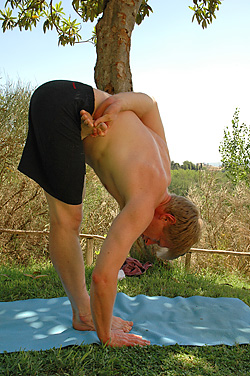
ardha badha padma padmotasana
Yoga is clever. I once attended a yoga course that was hosted in an Anglican convent in England, and got talking to one of the sisters. I asked her whether she thought it was incongruous for a course in yoga – rooted as it is in Hindu traditions – to be taking place in a Christian setting. She said she didn’t find it so. Christianity has meditative, mystic traditions that are basically the same thing, but in Christianity there is no help or advice on how to go about pursuing meditation, or “contemplative prayer”, in a systematic way. You’re just supposed to sit down, still your mind (how?) and be open to grace. The sister said what she found fascinating about buddhism and yoga is that they, over several millenia, have assembled a whole collection of tricks and techniques for helping a still and open mind to happen, different ones of which work for different people.
david williams notes
4th July 2005 permanent link
Key messages from the course I attended with David Williams in Berlin at the weekend: physical yoga practice is just a way, one of many, to arrive at a state of meditation. The focus of attention in ashtanga vinyasa practice should be mula bandha and breath. What the asanas look like isn’t important, and in any case should be adapted to the needs of the student and will be different for everybody.
You can achieve enlightenment through yoga without ever having sat in lotus position or stood on your head.
Don’t hurt yourself in pursuit of an outwardly advanced-looking practice. People who are attracted to asthanga are generally Type A, ambitious, achievement-oriented and will push too hard. As an ashtanga teacher, David is forever trying to get students to back off; can’t remember ever having to tell somebody to stop slacking & try harder.
Don’t hurt yourself; don’t hurt other people either. There are teachers out there pushing their students too hard and injuring them.
[I’ve never seen this. I managed to hurt my knees all on my own trying to achieve lotus with poor technique, and I knew one person in Mysore who said Pattabhi Jois strained her hamstring. But I’m hearing quite a few people lately saying it's widespread and I have no reason to disbelieve them. I’ve never been involved in the intense big-city ashtanga scenes in places like New York or London]
David can say asana doesn’t matter and be listened to. He’s been there (years in Mysore), done that (the entire astanga advanced syllabus), got the teeshirt (there probably weren’t Ashtanga Yoga Research Insititute teeshirts in the 70s). Would students listen to a less qualified teacher who said it? Some – achievement-oriented ashtanga types – might take it as just somebody who can’t hack it making excuses. So in a sense paradoxically it does matter – if only for teaching, if only as a credential to be able to say it doesn’t matter.
I took lots & lots of notes. I was thinking of just editing them and sticking them up on the web, but I decided that wouldn’t be right. If you want to hear all of what David has to say, go to one of his courses. They’re well worthwhile.
yoga for men
4th July 2005 permanent link
90% of 80 year old men have prostate problems, says David Williams. One yoga practice that is supposed to be very helpful for the prostate is janu sirsana b, where you bend forward over one leg whilst sitting with your perineum on the heel of the the other foot.
Like this, although you can’t see where the foot is from this angle:
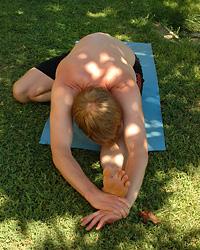
David says he learned this from Pattabhi Jois, then had it confirmed by a student who had prostate cancer whose oncologist recommended sitting with his perineum on a tennis ball.
Hmm. This is one that I tend to skip if I’m short of practice time, because it’s physically one of the easiest things in primary series for me. I’m a typical type A ashtangi – why relax and do something easy when you could be struggling with the next difficult thing? Clearly that needs to change – I’m only 44, but it’s never too soon to start taking proper care of yourself.
David also very strongly recommends doing stomach lifts and nauli as a general abdominal toning exercise. I don’t recall him saying anything specifically about the prostate in connection with this, but another teacher I know, Raphael da Bora, did. I do nauli occasionally when I feel like it, but not on anything like a daily basis. That, too, needs to change.
UPDATE: and if you want to avoid a whole host of prostate, bladder and bowel problems (it’s nearly 40 years too late to avoid appendicitis in my case), then don’t sit, squat.
yoga workshop pictures
3rd July 2005 permanent link
Just returned from a great weekend in Berlin, attending a weekend course with David Williams. David is one of the most experienced western ashtanga vinyasa yoga practitioners who first learned the system in the mid ’70s. Interesting perspectives, quite significantly different from how a lot of people are approaching their yoga these days.
Notes to follow, meanwhile here are some pictures.
Many thanks to David, and to Henning of the Prenzlauer Berg Yoga Shala who organised the event.
This is one of the great beauties of digital photography. The event finished this morning, and the same day I have the pictures edited on the flight home and ready go to on the web. Try doing that with film. I used to be able to go the the lab to drop film off, go to the lab again to collect it, spend a whole evening scanning film (and did anybody, ever, not hate doing that?) and have the pictures up within a few days; but that was before I was a father. It would never happen now.
yoga sutras text complete
27th June 2005 permanent link
My Yoga Sutras project now has the full sanskrit text, in Devanagari and romanised using the standard International Alphabet for Sanksrit Transliteration. The bits I’ve checked are correct, but I haven’t proof read the whole thing yet.
Coming soon: transliterator.py, a python module for transliterating between non-roman scripts and common romanised transliteration schemes. Version 0.1 will support devanagari with three common sanskrit transliteration schemes and (sort of) cyrillic. “Soon” means when I’ve finished checking the Yoga Sutras text that it generated and written (some, at least) documentation.
yogashchittavR^ittinirodhaH
24th June 2005 permanent link
योगश्चित्तवृत्तिनिरोधः
yogazcittavRttinirodhaH
yogaścittavṛttinirodhaḥ
Two things I would have found really useful for working on my Yoga Sutras project (full text coming soon) are (1) a single table showing at-a-glance the characters of the devanagari alphabet, their unicode numeric values, and their equivalents in three of the most commonly used transliteration schemes, and (2) a little program to take a transliterated text and convert it into unicode devanagari.
I couldn’t find either, so I wrote them. Here is the sanskrit-at-a-glance chart. I will be releasing the software as soon as I’ve fixed the (currently) last known bug, and finished checking the Yoga Sutras text it generated.
UPDATE: oops. A moment’s cross-browser testing on my Mac shows that the devanagari text displays just fine in Safari but not in Camino (the Mac version of Mozilla) or Opera. I’d be grateful to hear from anybody reading this how it goes in Internet Explorer on Windows.
blogging advice
9th June 2005 permanent link
If you don’t have time to finish writing anything substantial, you can at least keep the momentum going by publishing inconsequential little five minute scraps. (The number of people who have emailed me in the last two days wishing me luck with my week as a single dad is – well, not huge, but more blog-related correspondence than I normally get in two days. Thanks folks). Alternatively you can publish embarrassingly unfinished skeletal drafts of more substantial things, on the basis that (a) again, it at least gives the feeling and appearance of having done something, and (b) you have more incentive to work on an embarrassingly unfinished skeletal draft if it’s out there in public for all to see, than if it’s sitting in the “Drafts” folder on your laptop and nobody else knows it’s there.
So, I have just published an embarrassingly unfinished skeletal draft of Alan’s online edition of the Yoga Sutras of Patanjali.
What’s that about then? As a barely-intermediate yoga practitioner with a barely-rudimentary grasp of sanskrit, I’m scarcely very well qualified to have opinions on the fundamental yoga text. But I do have a small collection of notes, quotes and thoughts on various bits of it and I thought I might as well pull them together, for my own benefit and in case they might be of interest to anybody else. Also, most of the online and paper editions I’ve seen have the sanskrit text in either devanagari or transliterated, but not both, and I find it useful to see both; and websites that have the text in devanagari often have it as images rather than proper editable, copyable, linkable text. (For good reason, as I quickly discovered – a lot of browsers still don’t display devanagari text properly. Presumably as India steadily becomes the software capital of the world somebody will eventually get round to fixing this). So if nothing else, my “edition” will at least have the devanagari text as proper text, plus a standard transliteration.
UPDATE: Lianne from yogalila points me at Kofi Busia’s site, which has the sanskrit text in a font that apparently displays correctly for her in Firefox, although it doesn’t for me in Safari. He also has audio of the Sutras being chanted.
lotus without tears iii
6th May 2005 permanent link
I just found this very good article by Donna Farhi with lots of good advice, both on the physical aspects of how to approach lotus safely and the mental aspects of how to cope with yoga “challenges” generally.
To lift the leg into Ardha Padmasana (Half Lotus Pose), reach your right hand under your calf to grasp the outside of the right lower leg near the ankle. Flex the foot so that you can no longer see the sole, and slowly lift the leg up, rotating the shin and thigh outwards as you do so. Carefully place the ankle on the upper thigh near your groin, with the outer ball of the ankle joint supported by your thigh. Continue to draw the little toe of your right foot back towards your outer knee to prevent the rotation from coming at the ankle or knee. If you pull the leg up by grasping the top of the foot and allowing the foot to sickle, you will only overstretch the ligaments of your ankle and knee rather than opening your hip.
I wish somebody had told me this when I was learning lotus. The trouble is, the people teaching me probably had had open enough hips when they started that they did it without having to think about it or struggle with it, and so didn’t need to explicitly know these things. (It’s also possible that they did tell me, but I was too busy cranking my foot towards “the goal” by brute force to listen to them)
Lotus Without Tears Part 1, Part 2
UPDATE Christmas 2007: my original link to Donna Farhi’s article was broken. Peter Horst kindly pointed me to another copy of the same or a very similar article.
yoga curmudgeon iv
2nd May 2005 permanent link
I never intended “yoga curmudgeon” to be an ongoing feature of this blog, but on the basis that it’s easier to go with momentum than fight it …
This practice assumes you come from a floor-sitting culture.
… says [senior ashtanga yoga teacher] John Scott about the ashtanga primary series. The primary series, as its name suggests, was originally envisaged as a basic introductory practice for Indian students, but it contains lots of postures – mostly involving legs in lotus or half lotus position – that a lot of western beginners find very challenging and take years to learn.
This doesn’t mean, however, that ashtanga vinyasa yoga practice is inherently impossible/unsuitable/dangerous for adult western beginners as some people think. It just means that they have more work to do, will (generally) progress more slowly and need to be more careful, than teenage Indian boys like Pattabhi Jois and BKS Iyengar were when they started studying yoga in the 1930s. Western hips, backs and shoulders tend to be excessively tight from years of sitting on chairs hunched over desks; it is this, not different-shaped bones, that makes routine (for Indians) sitting postures like lotus a big challenge for most westerners. And that damage can be undone – it just takes time (and patience and hard work).
yogalila
29th April 2005 permanent link
Michael Smith links to yogalila, a yogini group blog, because they have some interesting stuff and because they link to him.
I am jealous, until I look and see that hey, they link to me too!
They appear to be fans of Andrey Lappa and Ana Forrest, two yoga teachers who are very high on my list of non-ashtanga teachers I would jump at a chance to study with (if it didn’t mean having to go to Los Angeles or Kiev).
New yoga pictures coming soon, ladies.
lotus without tears ii
27th April 2005 permanent link
Useful discussion going on at the moment on the ezboard ashtanga yoga discussion group on what to do with your feet in order to aovid hurting yourself while you’re learning lotus position.
I have in the past described online yoga discussion boards as “at best a case of the one-eyed leading the blind”. But I actually think this is an area where moderately experienced amateurs like me who have been through learning lotus with tight hips, and consequently had knee problems along the way, might have something to contribute that a lot of even very highly qualified and experienced teachers don’t. A lot of teachers, I think, are teachers because they start off with healthier and more flexible bodies than the average beginner, hence make rapid progress and are encouraged to think “hey, this stuff is great, why don’t I get into teaching it?”. Which is fine – but then no matter how many students they have seen, and helped, with tight hips and knee problems, they’ve never been through it themselves. And, as mentioned in the discussion, I think some of the “helping” poses that are commonly taught can be counter-productive and risky.
Sorry Michael, no tips for avoiding any of the “patience and hard work” – just how to avoid damaging your knees while you’re doing the hard work.
Lotus Without Tears Part 1, Part 3
music, meditation and catholicism
21st April 2005 permanent link
Alex Ross, on probably the last occasion I will ever quote somebody quoting the Pope, says Herr Ratzinger (the first Bavarian pope for 950 years, and guess how long I have known that factlet?):
has said that rock music styles are incompatible with church liturgy. In 1986 he described rock music as 'the secularized variation' of an age-old type of religion in which man uses music — and drugs and alcohol — to lower 'the barriers of individuality and personality,' to liberate 'himself from the burden of consciousness. Music becomes ecstasy ... amalgamation with the universe.' This 'is the complete antithesis of the Christian faith in the redemption.'
The description seems fair enough, although the idea that rock music is somehow fundamentally different from where classical music came from seems odd; and since I am not a Christian I have no reason to care about or be bothered by the disapproving tone or the bit about the “antithesis of the Christian faith in the redemption”.
yoga curmudgeon iii
8th April 2005 permanent link
On the yoga message board I frequent, there are a couple of ultra-purists who specialise in criticising and vilifying the slightest deviation from what they say as the one pure and correct ashtanga vinyasa yoga method as taught by Sri K. Pattabhi Jois. I don’t agree with these people’s methods and tone – abusing under-qualified yoga teachers and talking down to inexperienced students are rarely constructive ways of addressing issues. I find myself increasingly, however, agreeing with what they actually have to say.
Here’s one response to somebody who posted a message basically saying that their ego had been dented because they visited another teacher’s class, and weren’t allowed to do as advanced things as they normally did with their regular teacher. This broadened into a general discussion of whether teachers should stick rigorously to the way the practice is taught in Mysore, where students are only allowed to go on to the next posture when they are capable of doing the previous one at least half-credibly; or whether it is ok for teachers to allow students who aren’t ready, to go through the entire practice series making sketchy attempts at easier versions of the things they can’t do properly. (It isn’t)
If what you mean is that everyone has their own path to finding their truth, I would agree. But I disagree regarding the practice. If I went ahead and “did my own thing” I can assure you my yoga practice would be much easier on my ego because I would skip all the hard bits. But that is not the point, is it?
If you just want to brush over the hard bits and skip along doing the bits that are easy and not stop and face what is difficult for you, it is just excercize. If that is all you are looking for, that is exactly what you will get. Same weak body, same weak mind. Whatever you practice reinforces what you practice. If you want to practice having a weak mind and a weak body, you will end up with a weaker mind and a weaker body. Congratulations!
There’s no particular reason why I should care about what somebody else is doing, especially somebody I don’t even know who is probably thousands of miles away in America. It has no bearing at all on what I do in my practice. But this resonates with my own experience – I started with a teacher who didn’t stop people when they couldn’t do things properly and (though I still like and respect the guy) I now think with hindsight it was better for my ego than for the development of my yoga practice. [Although would I have carried on going if I had had my ego seriously bruised in my first few classes? I was already pretty emotionally battered at the time; that’s why I was in a yoga class in the first place]
Now I think the way ashtanga is taught in Mysore is right: when students get to a posture they can’t do, they are stopped at that point and assisted until they can do it before they are allowed to carry on with further postures. “Do” in this context doesn’t mean “perform immaculately and effortlessly”, it generally seems to be more like “can be put into the position by a competent teacher without too much effort, and shows signs of making credible attempts on their own”.
There are exceptions. When I was in Mysore, there was one posture in the middle of the primary series that I was nowhere near being able to do on one side because of an injury. Sharath, Pattabhi Jois’s grandson and assistant, knew this and still taught me the rest of the series. I don’t think anybody in the ashtanga yoga world would question Sharath’s judgement – I certainly wouldn’t. But I still knew when I got home that filling that big hole in my practice was Priority Number One, and I’ve spent the last couple of years (minus a year off yoga practice when Jack was born) working on it. I can do it now – still with difficulty, and not every day, but in the last two weeks I only missed it in one practice. Two days ago I did it unassisted in class for the first time. (My teacher wasn’t looking). Along the way I’ve learned a great deal about patience, how progress often comes unexpectedly just when you were getting disheartened, and the anatomy of the psoas muscle.
This is all about the balance between two basic yoga principles – ahimsa, not causing harm, and tapas: dedicated, diligent effort. Ahimsa includes not hurting oneself in pursuit of some preconception of what an “advanced” yoga practice might look like; tapas implies not giving up at the slightest hint of difficulty. There’s clearly a tension between these two; B.K.S. Iyengar even describes tapas as a kind of inward-directed himsa, violence, without which outward-directed ahimsa, non-violence, isn’t possible. (I don’t particularly like that definition, but who should you pay attention to: me, or one of the most experienced senior yoga teachers in the world?). I’m clearly tending towards the tapasic end of the scale just now.
(It strikes me that sanskrit tapas is clearly from the same Indo-European root as the German tapfer: brave, courageous)
more guest yogabloggers
7th April 2005 permanent link
I came across some excellent comments in the ezboard ashtanga yoga discussion forum, that throw some light on the topic Yannis and I were discussing a while ago – what “correct alignment” alignment in yoga postures actually means, and whether what is regarded as correct in one form (Iyengar yoga) is necessarily appropriate/relevant in another (ashtanga vinyasa yoga). One guy was of the opinion that the two forms just take different routes to the same place:
Iyengar stresses alignment from a very early stage and supports the asana with props to achieve that alignment, where Ashtanga is happy to let the student make their best attempt at the asana and then gradually come to realize alignment as they develop.
Other people pointed out, however, that it’s not as simple as there being one correct canonical form of every asana (which Iyengar-trained people often do seem to assume), and Iyengar and ashtanga yoga just take different routes to reaching it:
what may be correct in one may not be appropriate in another.
…
Mixing the two, attempting to force “perfect pose” into a flow system, you can injure yourself too.
lord of light
21st March 2005 permanent link
If the world were all city … the dwellers within it would turn a portion of it into a wilderness , for there is that within them all which desires that somewhere there be an end to order and a beginning of chaos.
Space Opera is all very well – although I found Charlie Stross’s Iron Sunrise, the sequel to Singularity Sky, disappointing – but from time to time you need to read a real novel. For which purpose Roger Zelazny's 1967 classic Lord of Light is serving me admirably at the moment. I’m sure somebody whose blog I read put me on to this one; I apologise to whoever it was for the lack of a link, because I can’t find or remember who you were just now.
yoga curmudgeon ii
17th March 2005 permanent link
I was visiting family and friends in England for most of the last week, far to busy with seeing people I haven’t seen for too long to have any time for writing anything.
One thing that did strike me though: when I’m in England I like to browse bookshops. Amazon in Germany can get me any English language books I know I want, but what about the ones I don’t know I want? There’s no serendipity there. In Waterstones on Deansgate in Manchester there’s plenty. I spent a happy ten minutes in Photography being amazed by the work of Ferdinando Scianna, then wandered over to Yoga.
Seven years or so ago, when I still lived in Manchester and had just taken up yoga, the Waterstones yoga “section” consisted of about a dozen books. Now it’s four whole shelves. Some of the ones I did recognise are good and serious books: BKS Iyengar’s classic Light on Yoga; Pattabhi Jois’s Yoga Mala, which I didn’t even now was out in a mass market paperback edition (and I don’t need it because – ha! – I have an autographed hardback copy of the first English language edition); David Coulter’s Anatomy of Hatha Yoga – have I ever mentioned that this excellent book is a must-read for anybody who’s serious about their yoga practice? Yes? Good. I’m sure some of the books I didn’t recognise are good any worthwhile too. But not all of them.
There were, for example, at least four books on ashtanga yoga. None of them by properly authorised teachers; and in any case, there really isn’t that much to say about ashtanga yoga. It deliberately eschews a lot of explicit theory and philosophy in favour a “just do the practice and see what happens” approach, and the practice you are supposed to follow is completely standardised. So why would the world need lots of books with pictures of different people doing the same practice series?
[I, hypocritically, have four such books. At least mine, unlike the ones in Waterstones, are all by highly qualified senior teachers]
(One of the ashtanga books was co-authored by somebody I met in Mysore who I know is a dedicated and serious yoga practitioner even though s/he isn’t an authorised ashtanga teacher (yet?). I don’t doubt this person’s motives and seriousness. Their book had the best pictures too.)
I suppose I should be glad to see this level of interest in yoga, and to a degree I am. But four shelves of books, most of which have little or nothing to add to what has already been said, are a sure sign of people rushing to cash in on a bubble. The current yoga fad won’t last, real yoga is hard, and people publishing me-too yoga books – like the legions of well-intentioned but inexperienced and underqualified people rushing into teacher training courses – will be left high and dry when it ends.
I might be wrong and even if I’m not, some of the people who start doing yoga because it’s fashionable will find themselves gradually taking it more seriously and having their lives changed for the better by it, which is a Good Thing.
wish i was there (2)
16th March 2005 permanent link
Looking through my referrer logs for last month, I discovered this page with lots of pictures of Mysore, including one of mine. Good for getting a feel for what the place looks like from a non-yoga-student perspective.
morning light after yoga class, mysore
It’s rude to use other peoples’ pictures in this way without permission. But the one they’re using is one of my favourite atmospheric Indian street photos, and they’re not sucking up that much of my bandwidth, so I’ve decided to just be happy that a few more people are looking at my picture than would otherwise.
Various commenters on the page talk about delayed plans to build a Bangalore-Mysore expressway, and about Mysore becoming a satellite city for the Bangalore tech industry. At the moment the physical transport infrastructure in Mysore (like practically everywhere else in India) is a joke for a modern, high tech economy. Mysore is only a hundred miles from Bangalore but the journey takes three to four hours by road and there’s only one “fast” (still over two hours) train a day. Internet connectivity is good, but there comes a time sooner or later on every project where you want to get people face to face in a room. Mysore won’t be able to function effectively as a high tech satellite of Bangalore until it’s possible to do the round trip in a day without being completely knackered at the end of it.
On the other hand, if you’re not trying to run projects and have meetings you might legitimately question whether Mysore getting sucked into the orbit of Bangalore would necessarily be a Good Thing. It would of course be great for people who own land in or around Mysore that might be suitable for building office parks; people with the relevant qualifications who think they would prefer to live in pleasant, laid back Mysore instead of the traffic-crazed overpriced metropolis of Bangalore might also mistakenly think it was a good idea, until Mysore too turned into a traffic-crazed overpriced metropolis. Which would be a shame, because at the moment it’s a nice place.
Makes me wish I was there.
busted
12th February 2005 permanent link
The phone rang while I was doing my yoga practice last night. It was my yoga teacher, wanting to postpone a publicity photo shoot for her new website that we had planned for this morning.
I said fine, and apologised for taking a while to get to the phone because I had to escape from supta kurmasana first. She was appalled: “what! You interrupted your yoga practice to answer the phone? You should never, ever do that – just let it ring.” Oops.
small world yoga (2)
4th February 2005 permanent link
I was talking to one of my Indian colleagues on the way to work today and mentioned that I’d spent a few months in Mysore. “You weren’t studying yoga with Pattabhi Jois were you?”, he asked. I said I was.
Turns out my colleague grew up in Mysore and went to school with Pattabhi Jois’s grandson Sharath. His father studied for ten years with Pattabhi Jois, was a yoga teacher himself and was a close friend of Norman Allen, Pattabhi Jois’s first ever American student.
Small world.
yoga curmudgeon
27th January 2005 permanent link
In which Alan sort-of-reviews a yoga DVD he hasn’t actually seen.
People whose opinions I respect seem to be very enthusiastic about Paul Grilley’s Anatomy for Yoga DVD – “the best DVD on yoga, period” (Dan McGuire) – and I’ve been checking it out with a view to deciding whether I need/want to buy it in addition to David Coulter’s marvellous book Anatomy of Hatha Yoga (a full review of which I will probably never get round to writing).
I’ve noticed a disturbing trend in how people seem to be taking Paul Grilley’s message, though. These comments are about that and not about what he actually says on the DVD which, as I said, I haven’t seen.
Apparently Grilley’s central theme is that everybody has a different shape and different physical limits, and so there cannot be a single definitive right shape or end point that is the same for everybody in any yoga asana. I completely agree with this.
One point Grilley makes that seems to catch people’s attention is that there are fundamental skeletal limits to how far each individual can go in particular postures now matter how long and how diligently they practice – the proportion of their limbs and the shape of the joint surfaces of their bones. Sooner or later, if you could overcome all other physical limitations in a posture you would still reach a point where you have bone pressing against bone and that’s it. Finito. Impossible to go any further and dangerous to try. And this point is different for everybody, because we all have different shaped bones.
I don't doubt that either – but people seem to be latching on to it as an explanation (excuse) for why they have great difficulty with routine, standard postures …
you doubt you will ever be able to get your knees even an inch closer to the floor. … That may well be true--but it probably has nothing to do with your yoga practice. Instead, it's simply the way your bones are structured. And yoga will never change that.
This is the main message Paul delivers in his superb DVD on yoga anatomy
Tim Noworyta
… and that, I think, is bullshit. Lotus, for example, isn’t that difficult. Most Indians I have seen try it can do it quite easily. And since Indians, especially upper caste Indians, are genetically pretty similar to Europeans, how likely is it that Europeans generally have different shaped hip joints that made it harder for them to sit in lotus and similar postures? Not very. They just sit on chairs. There may well be people whose hip socket shape makes lotus impossible, but I think they’re probably a tiny minority.
if you're trying to choose between two theories and one gives you an excuse for being lazy, the other one is probably right.
Paul Graham
Terry Slade (Terry is one of the founding fathers of ashtanga yoga on the web, and a thoroughly sound guy from what I can tell of the e-contact I’ve had with him over the years) is a huge Grilley fan, but he was probably right first time:
I have always thought that the huge amount of deep chronic tension that I have in my body is what makes it important for me to be careful to find the right way to practice yoga
I'm all for yoga students having a sound grasp of anatomy and not hurting themselves. I’m not for encouraging beginners (and anybody, e.g. me, with less than about ten years of diligent regular practice is a beginner) to think their limitations are probably inherent to their skeletal structure and it’s not worth bothering to even try.
Here are a couple of questions to ask yourself about asanas (postures) you “can’t do”:
Have I tried it at least a thousand times? Pattabhi Jois says you need to have done an asana a thousand times before you really know it. (If you go to class a couple of times a week, and don’t practice otherwise, and attempt your problem asana in all the classes you go to – well, there’s that “ten years” figure again)
Can a teacher get me into it? It is normal in ashtanga vinyasa yoga, the style I personally practice, for teachers to assist or “adjust” students in asanas the student is currently learning. I believe this is less common in other yoga styles, and some people think it is bad because it encourages students to feel dependent on the teacher. I understand that point of view but don’t agree with it. The best teachers, such as Pattabhi Jois and his grandson Sharath, can adjust students way beyond the student’s perception of what is possible. Which can teach you several things: what the position should feel like, so you know what you’re working towards; that limits you might have thought were physical were actually in your head after all; not to get too comfortable with your perceived limits.
The hardest position in the ashtanga vinyasa yoga primary series, for most western students, is called Marichyasana D. It involves putting one leg into half lotus position then twisting round, wrapping an arm round the opposite knee and clasping your hands behind your back. Pardon? Like this (only better):
When I first saw it, I thought it just looked ridiculous. My attempt at putting my foot onto my opposite leg to get into half lotus ended somewhere just above my knee. I could have just thought “ok, I know I have a bad knee, this is clearly impossible for me”. But after a while I started to see progress, and people around me in class learning it, so I thought well ok, one day. After trying it for about four years I was getting close: then I went to Mysore, where Sharath put me into the position a few days after I arrived. Within a couple of weeks of thus being shown that I could do it, on my “good” side I could do it myself.
The side where my injured knee is in lotus is proving more difficult: three years after Sharath could get me into the position, I can still count on my fingers the number of times I’ve managed it on my own. For one of those three years, though, I was busy starting to learn something far more important, namely how to be somebody’s dad, and hardly had time to practice yoga at all; then when I began practicing again it took another half a year to get back to where I was before I started making progress again. Nevertheless, my teacher and I both agree that it feels like it could be Real Soon Now.
The point being: something that initially looks and feels impossible may indeed actually be impossible because you have the wrong shaped bones – or it may just need five to ten years of diligent effort. And if it matters to you, then you shouldn’t assume one until you’ve tried the other.
lotus without tears
22nd January 2005 permanent link
Michael Smith is considering my advice about whether special meditation chairs are a good idea:
Of course the correct answer, long term, is to develop the ability to sit comfortably for long periods in lotus. Which, however, starts with developing the ability to sit very uncomfortably for very short periods in lotus. And takes years.
Padmasana, lotus position, the position in which the Buddha is normally shown sitting, is the iconic yoga position. There’s a good reason for that: once you can do it comfortably it is the most stable, supported sitting position for breathing exercises or meditation. (It has proven medical benefits too). Unfortunately a lot of western yoga students pursue it not for that reason, but because it’s seen as an “advanced”, cool-looking physical feat. In Indian eyes it isn’t at all: most Indians, who grew up sitting on the floor, can do it quite easily even if they aren’t otherwise particularly fit or flexible. But for many westerners who grow up sitting on chairs and consequently have very little mobility in their hips, it is difficult. It can take years to learn and a lot of people hurt their knees trying.
Lotus seemed frighteningly far away to me when I started yoga. I had even tighter hips than most western men – I had been rock climbing for years, and friend of mine who has taught yoga to a lot of climbers says they tend to have very tight hip flexor muscles because of all the high-stepping manoeuvres that climbing involves. (If I had known that years earlier it would have helped me a lot). In addition, my whole right side from (at least) the ankle to the hip was much tighter than the left because I carried a serious knee injury for years. Seven years on, I can get into lotus quite comfortably once I’m warmed up. I rarely sit in it for longer than about five minutes, but at this stage that’s more about monkey mind than physical discomfort. I actually find easier yoga sitting positions, such as a fairly loose half-lotus, more comfortable now than sitting on chairs.
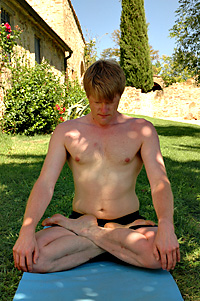
padmasana
If I can learn it, starting where I was seven years ago, then most people can. Along the way, though, I had two years of knee pain caused by going about it the wrong way, that should have been avoidable.
(I have one of those wedge-shaped meditation cushions that I bought during the knee pain period because I thought it might help. And maybe it did at the time, but I never use it any more. I feel more comfortable and stable sitting on the floor – and comfort and stability are the desiderata for all correct yoga positions according to Patanjali: shtiram sukham asanam)
There is excellent advice on how to learn lotus safely in this article in Yoga Journal by Roger Cole. This has the clearest explanation I’ve seen of the most common lotus-related knee problem that lots of western students have – the cause and how to avoid it – information that could have saved me lots of trial and error, some of it painful, if I had known it sooner. Short version: it’s all about outward rotation of the thigh in the hip socket. People who try to get into lotus when their hips aren’t flexible enough have to pull sideways on the foot to get it up onto the opposite thigh. The knee is not designed to bend sideways; trying to get it to do so puts excessive pressure on the cartilage on the inner edge of the joint and is painful and dangerous.
A couple of other bits of safe-lotus advice that I’ve picked up over the years: British yoga teacher Godfrey Devereux showed me how to fully bend the leg, with the heel firmly against the upper thigh, while the thigh is still in a comfortable position. Then you can move the whole folded leg as a unit, pivoting at the hip, without any movement in the knee. Also important to keep the foot flexed. This technique ended my two year spell of knee problems and got me into lotus without pain for the first time.
Corrolary that I learned myself: even though the main motion should come from the thigh and not from pulling on the foot, until you are very flexible you will still need to use your hands to guide and assist the foot up onto the opposite thigh. Do not pull on the foot. If you hold the foot it’s very likely that you will at some point pull too hard on it in the wrong direction, thus bending the knee sideways again. Much better instead to hold the shin just above the ankle – that way you can guide the heel in horizontally towards the hip/navel with much less danger of pulling upwards.
Ahimsa. Ahimsa is the fundamental yoga principle of not doing unnecessary harm. As many yoga students discover the hard way, that includes not harming yourself in pursuit of the outward appearance of an “advanced” yoga practice. Of all Indian religious groups, Jains place the most emphasis on ahimsa – this thousand year old Jain yogi has chosen not to force himself into padmasana and is using an easier meditation position instead.
Jain yogi, Sravanabelagola
Disclaimer: taking advice about how to do difficult yoga asanas from random strangers on the internet may not be the wisest thing you could possibly do.
Michael Blowhard is right: “Patience and hard work … play discouragingly big roles”.
Lotus Without Tears Part 2, Part 3
coffee yoga?
18th January 2005 permanent link
And what, excessively puritanical western yogis might ask, is Alan doing recommending coffee? Even if it is in a good cause? To such people I say, ha!
Pattabhi Jois personally recommended coffee to a friend of mine as a solution to the difficulty she was having making it to class on time at 4:30 in the mornng. Mysore is a couple of hours drive from India’s finest coffee growing area, and a lot of yoga students take full advantage of this fact. My own coffee habit is – well, perhaps more than it should be – but still at one of my regular cafe haunts I had to beg them to make a special reduced-strength version of the rocket fuel they normally served.
yoga tourists?
7th January 2005 permanent link
The minimum enrolment period at Pattabhi Jois’s yoga school in Mysore is a month. At times the school is so busy that the amount you can expect to learn in a month is really pretty minimal. Russell says “The first month they ignore you. The second month they take you apart. The third month they put you back together.” I don’t know about “ignore”. “Observe”, perhaps. I’ve also heard another senior teacher say he doesn’t feel he knows a student well enough to work seriously with them until he’s seen them every day for at least a month. And I should point out that when I was in Mysore Sharath, Pattabhi Jois’s grandson and assistant, was doing some pretty major work on me within a couple of weeks – admittedly he already knew I was planning to stay at least three months.
Not only is the amount you’re going to learn questionable if you only sign up for a month; some longer term students (a minority) also have a very snobbish attitude towards short term visitors and refer to them as “yoga tourists”. And what does Pattabhi Jois think about them?
We see so many students who come from all over the world to study with us. Some of them have full-time jobs and only get four weeks vacation per year, but they choose to devote that time to coming here to practice with us. To see this dedication and to see the happiness in people – that is what is truly rewarding.
Quoted, with the permission of the editor, from an interview with Pattabhi Jois in the latest issue of Nama Rupa magazine. More to follow.
Update: Russell writes to point out that “The first month they ignore you” was him quoting somebody else and he doesn’t agree with it either. His experience was more like mine: “If I have been ignored the first month, with attention given to me every single day, then being ignored is wonderful!”.
but before i go …
23rd December 2004 permanent link
Train Your Brain By Watching Experts Perform A Task? Randall Parker links to an interesting study – “once the brain has learned a skill, it may simulate the skill without even moving, through simple observation … When we watch a sport, our brain performs an internal simulation of the actions, as if it were sending the same movement instructions to our own body”
This strikes me to a degree as obvious and nothing new. When I was into rock climbing, ten years and more ago, it was generally known that visualisation and mental rehearsal worked. I also read that one’s technique can actually improve during rest periods and injury layoffs. When you are actually climbing, or doing physical training, you are often fatigued and afraid, and these things interfere with learning efficient technique. A lot of technique training is hard-wiring what you have learned into the reflexive nervous system so that you can do it without conscious mental effort. Apparently taking time out can allow the neural pathways that you have trained to become hard-wired more efficiently than if you only ever work them under stressful conditions.
That's all about mental rehearsal and one’s own training sessions though. What’s interesting here is that the technique learning process also comes into play watching people exercise the same skills. When I was studying yoga in India, I certainly enjoyed watching one of the most concentrated collections of advanced yoga practitioners on the planet doing their practice, and I may have thought there might be tips about technique that I could consciously learn and copy by watching such people; but I didn’t think that there might be such a profound neurological basis for it, or that it might be part of the reason why I made much faster progress there than I normally do at home.
If you’ve never tried to do a handstand in your life, and you see somebody float apparently effortlessly into a handstand, then fold their legs into lotus position, and then proceed to do lots more complicated stuff starting from that position … then you probably just think “wow, that’s amazing”. If you yourself have tried to do those things for a while then you can think “wow, that’s amazing that she can lift her feet so cleanly from there when I have to jump. Now, where are her hips in relation to her hands when she lifts off? …” In other words, you’re watching more analytically, looking for specific things.
These days I only have time to go to class once a week, and when I do I’m focused on my own practice not on watching the other students. The rest of the time I practice on my own at home. One of the techniques I use when I’m trying to learn intermediate-level techniques without a teacher is replaying mental videos of advanced students I saw doing the same things in Mysore three years ago.
Musicians listening to music show different patterns of brain activation to non-musicians.
The point I’m rambling towards making is this:
It’s intuitively obvious to anybody who practices things like dance or martial arts (or climbing or yoga, to take examples where I actually know what I’m talking about) that this sort of learning occurs. What’s new and interesting about the research Randall Parker links to is that we’re just beginning to understand how it works at a neurological level.
mysore yoga blog
21st December 2004 permanent link
Russell, “a less-than-fit, recovering alcoholic lawyer studies Ashtanga yoga for nine months in India with the masters, Sri Krishna Pattabhi Jois and family”. And writes very openly and interestingly about his experiences.
guest yogablogger
13th December 2004 permanent link
Yannis wrote a long and thoughtful response to my comments on Nancy Gilgoff’s views on ashtanga and Iyengar yoga, and very kindly gave me permission to quote his mail.
It is obvious to me that a lot of the criticism of the Iyengar system from ardent and experienced Ashtangis comes from a place of ignorance not knowledge.
My simplest question to any detractors (and they exist on both sides) is: have you studied both systems with equal love and devotion so you acquire a deeper understanding of both? Competent and devoted Ashtangis toil long and hard on their practice and eventually some of them come to see and feel the nuances, the subtleties and the grace of the system. How many of them have given the same effort and concentration to the Iyengar system before letting the world know of their totally uneducated opinions? (Replace Ashtangis with Iyengar students/teachers and the same attitude correction is needed). So please understand that anything I say in the rest of this email is so because of what I read in the blog post, not because I prefer one system to the other, but because I happen to have studied both to some depth.
[This isn’t, by the way, because they couldn’t do the physical practice as well as modern western yogis. I’ve seen film footage of Indian yogis from the 1930s that is way more impressive than any demonstration I’ve ever seen by a modern western practitioner]
The only such film (1938) I know is the one of Iyengar practicing with Krishnamacharya. Are you referring to the same one? If not which one are you referring to, because I would really want to see it? BTW I have seen Cirque du Soleil artists practice backstage, and have had them in my classes and they can kick butt compared to any anyone that’s ever been. Iyengar himself included. Flexibility and strength wise. Sharath has almost mastered 6th but I have seen them do perfect one arm handstand and variations for 1 hour straight. Yes they did change arms in between. I know it’s not Yoga, but the point I am trying to make is that modern Yogis are probably more adept and talented at the physical practice that any one has ever been. How about a pair of Russian twins that can do salambhasana to viparita salambhasana to handstand for a hundred reps? I have been a witness.
Concerning what Nancy says. I can get you pictures of modern day practitioners that do poses with rounded spines like PK Jois on the blog page. It is incredibly hard to swallow but that’s what he could do at the time the picture was taken. If he could he would have extended more. How many Iyengar classes has Nancy taken in order to understand what Iyengar is teaching? [quite a lot, I gather] A most important comment: “…and clearly don’t care what their postures look like.” I will come back to that part, because it’s a common theme.
This guy puts it even better: “This eye towards “alignment” is also increased by an attachment and false application of classical form…”
OK for all those out there that are endlessly spouting about alignment and form in the Iyengar system without going to study that darned thing for like 3-4 years at least: Iyengar teachings about alignment come from the inside not the outside. There is no eye for form, there is form as the master has felt it internally and as all of as can feel it if we practice with sincerity and dedication (that’s why the advanced practitioners in the PKJ demo are doing good Iyengar poses, they arrived at the same results from a different path)! Easiest proof: No mirrors in Iyengar’s studio! How did he come up with what is “correct” form?
Once and for all: Alignment and form are not how you look but how you feel and connect with your body. That is their provenance their present and their future.
Alignment and form feel right and beneficial and open your practice to further comprehension, progress and discovery. The way it looks is a side effect, a sign post that a good teacher can read. Are we confusing bad teachers maybe with bad teachings? To come back to Nancy’s huge mis-understanding, this seems endemic in Ashtangi thoughts: Iyengar yoga is NOT about how poses look! Find a teacher good enough that can explain exactly how and what!
Ergo the poster: “If the student or teacher is looking to create a renaissance inspired form of beauty in order to experience or begin the pose, then he or she is not practicing yoga but posing (ooh pretty).” Knows not what he is talking about. Yes there is beauty, lots of it. And it comes from the inside. It’s a feeling of opening and grace and freedom that comes after incredible and continuous practice. Same as in Ashtanga Vinyasa Yoga.
And it’s not his/her fault. There are uninformed students and teachers on both sides. They just need to stop spouting! Keep with what you know!
I don’t agree with all of this by any means. In particular I don’t see where I, or Nancy as I quoted/paraphrased her, expressed “criticism of the Iyengar system”. Pointed out that it has different priorities from the ashtanga system, yes – but that’s not the same thing as criticism. I think Yannis raises some interesting points, though, why is why I asked permission to quote him.
Coming soon: a more detailed response to Yannis. Also coming soon: guest yogabloggers Pattabhi Jois, BKS Iyengar and TKV Desikachar, in the form of extracts from a great interview with them by Alexander Medin in the latest issue of Nama Rupa.
pre-natal yoga
11th December 2004 permanent link
I am practicing an advanced pre-natal yoga technique at the moment. It’s not because I’m pregnant; it’s far more embarrassing than that.
I fell out of headstand on Wednesday. This happens quite rarely these days – so rarely that I’ve got out of the habit of checking that I have a safe drop zone if it does happen. I was in the gym at work, and I hit my back on the corner of a weights bench. Hard. Now I have a big bruised swelling two inches to the left of my coccyx (and not, thank god, right on it).
I’ve found I can still do most of my yoga practice, but one of the things I can’t do is lie on my back to relax at the end. Fortunately my guru Maria told me that at her pre-natal yoga class the advanced (third trimester) students were taught to relax lying on their sides – otherwise the weight of the baby would be too much strain for their backs. It also works if you have a huge bruise on your butt.
Readers should be thankful that this posting is not illustrated.
my right knee, part two
2nd December 2004 permanent link
A story of hubris, yoga and the anatomy of the human knee. By request, and because Gwendoline Hunt makes an appearance in part three … Part Two: The Anatomy Of The Human Knee
In Part One: Hubris we left Alan in the summer of 1984, battered and broken on the ground at the bottom of a climb he really should not have been attempting that day. The broken left wrist healed quite quickly. The right knee, which had been diagnosed with strained ligaments, didn’t.
Fast forward ten years.
I could run. I studied karate for a few years with no knee trouble except that I had to be careful trying certain high side kicks. Climbing and hillwalking were no problem at all. But walking on pavements hurt. Anything over a mile or so and the knee started to swell and throb. Which itself, you might think, was not so terrible for a man – a good excuse not to go shopping. Better still, it was at its worst in cold, damp autumn weather. Praise the lord, no Christmas shopping.
But it wasn’t funny, in fact, and it wasn’t getting any better. More alarming: there was a lump growing out of the side of the knee that was so hard it felt like bone. I wanted to be able to walk around town, and I didn’t want extra bones growing out of the side of my knee. Unfortunately the wonderful British health service doesn’t give a damn about patients whose problems aren’t (yet) crippling. Several attempts to get doctors to take an interest in “doctor, my knee aches if I walk on pavements a lot” failed. At one point I had a GP [family doctor] who was a runner himself and should have known something about taking knee injuries seriously, but he didn’t give a damn either.
I decided, finally, that I was going to have to do something about it. A friend in my climbing club said he knew a good sports physiotherapist who worked with the national kayak team and would definitely take injuries from a climbing accident seriously, even if they were by this time ten years old. I booked an appointment. I arrived. “Take your trousers off and sit on the couch, please”, he said. He was doing something at his desk, several metres away on the other side of the room. He turned round.
“You’re going to need surgery for that”.
Closer inspection confirmed the several-metres-away instant diagnosis. The hard lump was a cyst that had probably formed around a tear in the outer edge of the meniscus. It was forcing the outer edge of the knee joint apart – but the serious problem, he said, was the inner edge of the joint which was therefore being pinched together. If it wasn’t dealt with I would have arthritis within five years. He arranged for me to see his friend, a top knee surgeon, who agreed and booked me in for an arthroscopy. An arthroscopy is one of those small-scale knee operations where they insert a fibre optic camera through a tiny incision, have a look what’s actually going on in there and fix it with tiny miniature instruments and minimal trauma.
I woke up. Sure enough, I had two tiny, barely visible incisions, one on each side of the knee. And a big three inch scar up the outside of my leg, where they had decided the tiny miniature instruments were futile and attacked the cyst with industrial scale digging and drainage equipment. At least it didn’t hurt.
What they don’t tell you after a knee operation is that the general anaesthetic may have worn off, but your leg is still stuffed full of local painkillers. After a few hours they wear off too. Then it hurts.
After a while it stops hurting. It seemed like a good idea to get back to moving and using the leg as quickly as possible, so I was swimming within a few weeks and climbing again – carefully – within a couple of months. And the knee was somewhat better, the swelling was gone. But autumn came, and it still ached.
I went back to the original physiotherapist. This time he referred me to his partner who was the team physio for Manchester City Football Club, and therefore knew a lot about knees (kayakers, I presume, are better at hurting their shoulders). His theory was this: there is a structure called the ilio-tibial band, which is a strip of tendon that runs down the outside of the leg and stops the knee from collapsing outwards. The surgeon would have had to cut through the ilio-tibial band in order to get to the cyst in my knee; the physio suspected the problem I now had was that the scar in the ilio-tibial band hadn’t healed well and was possibly compressing some nerves in that area. If that was the case, though, he said there honestly wasn’t much he could do for me. He gave me a course of ultrasound treatment, some general exercises to strengthen and stabilise my knee, and taught me some stretches that were supposed to work on the ilio-tibial band to some degree. They maybe helped a bit.
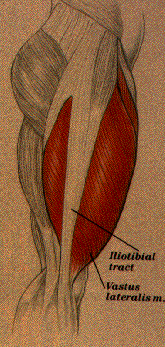
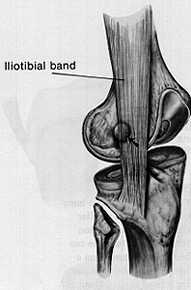
Pictures courtesy of a website about iliotibial band friction syndrome – which is apparently a common problem for runners, but it’s not what I had
And there we left it. I had had the best treatment that western surgery and sports physiotherapy had to offer. My knee was somewhat better than it was before, and livable with but by no means perfect. It was better than having arthritis at the age of forty, but still quite disappointing really.
gwendoline hunt r.i.p.
24th November 2004 permanent link
Yoga teacher Gwendoline Hunt is dead, drowned last week on a coastal hike in New Zealand.
I met and studied with Gwendoline three times, and she made a big impression on me. She was practicing advanced ashtanga yoga in her early 70s, which is no mean achievement physically, and puts any regrets I might have about not having started yoga until my late 30s into perspective. She was also one of a handful of people I’ve met in the course of my yoga studies who I regard as authentic geniuses in their understanding of the human body and how it works. She could show you, with the lightest possible touch in exactly the right place and direction, how to get far beyond what you thought were your physical limits.
Those are outward achievements, washed away by the Pacific Ocean now, and they don’t really matter any more. What remains and still matters is the kind, joyful, open-spirited person she was. The sort of person who, just by being who and how she was, could convince a struggling middle-aged yoga beginner that yoga must be worth persevering with if this is the sort of person it attracts and/or produces.
If there is reincarnation, Gwendoline, have a great time in your next life.
There is a memorial page for Gwendoline at ashtanga.com
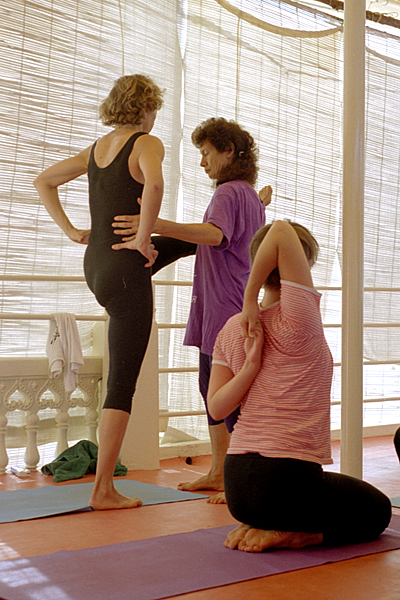
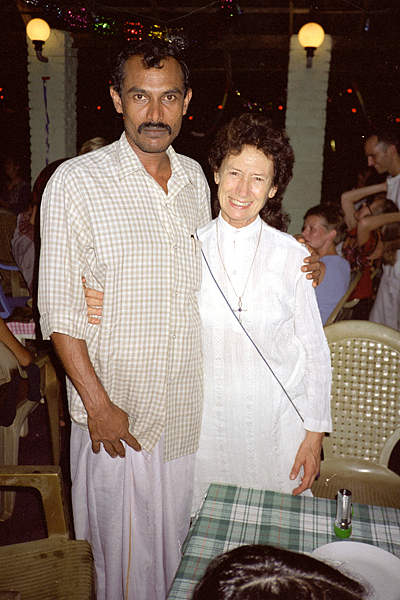
Gwendoline teaching, and with her good friend Vijay (who is another of the handful of true bodywork geniuses I have met, and on whom more another time)
gamma synchrony and yoga
18th November 2004 permanent link
One interesting point in the study of buddhist meditation I mentioned previously that may be very yoga-relevant: they talk about having to filter out signals on particular gamma band frequencies that are known to come from muscular activities, and that might otherwise interfere with measuring gamma band activity generated within the mind.
Now, one purpose of all the physical stuff in yoga is to serve as a focus point for “single-pointed meditation” – a different form of meditation, in buddhist terms, from the one being studied here.
But it’s also about training the body to be able to sit comfortably for long periods to meditate with minimal muscular activity. There’s a reason why seated Buddha figures are usually shown sitting in lotus position. Lotus, once you can do it comfortably, is the most stable, supported seated position there is. But for most people, especially most westerners who grow up never squatting or sitting on the floor, getting enough mobility in the hips, and enough strength in the core muscles of the abdomen, to be able to sit in it without strain in the hips, knees and lower back is a major undertaking. That discomfort in itself is a major distraction from meditation – it’s even worse if the muscular activity that accompanies it – tension, fidgeting – is generating interference in the very brainwave frequencies you’re interested in.
A yoga teacher I’ve studied with a couple of times, who also practices zen meditation, said he once asked his zen teacher how people who haven’t practiced yoga manage to get through long seated meditation sessions without excruciating pain. The zen teacher says the ability does come, eventually, but more slowly than with yoga practice.
gamma synchrony
18th November 2004 permanent link
Long-term meditators self-induce high-amplitude gamma synchrony
Experienced Tibetan Buddhist meditators practicing “unconditional loving-kindness meditation” generate the highest levels of gamma synchrony that have ever been measured in trials of normally-functioning brains, and still have significantly higher base levels before and after meditation than a control group of students with rudimentary meditation training. General discussion; pdf of the technical paper.
So what is “gamma band synchrony” anyway? Google tells us that it is strongly present in musicians listening to music (really listening to music … is actually quite an advanced form of meditation)
It “may reflect one way in which the brain ‘integrates’ activity from the plethora of its ongoing parallel processes”. It “has been related both to gestalt perception and to cognitive functions such as attention, learning, and memory”.
Patients with schizophrenia had significantly reduced gamma phase synchrony.
There is one clear problem with the study, that the authors do partly address: the meditators are mostly middle-aged Tibetan monks; the control group are American college students. So, are the differences they are measuring actually brought about by meditation practice and not by age, by cultural differences between America and Tibet, or by people who already have these characteristics pre-selecting themselves for monastic life? The authors do address these questions, and say no: the difference they measured correlates more strongly with length of meditation training than with age. Clearly more research needed in this area though: it would be reassuring to see a study that compared middle-aged Tibetan monks to a control group of middle-aged Tibetan non-monks, and/or one that followed novice monks at various stages in their training.
I find studies like these fascinating. From a yoga student point of view, it’s clear that yogis and buddhist meditators for thousands of years have been on to something real that western science is just beginning to scratch the surface of understanding. And from a software point of view(*), we [“we” = neuroscientists] are trying to reverse engineer a system where the software is rewiring the hardware it runs on at runtime, with only the crudest ways of measuring the outward state of the system. This is something like, I don’t know … trying to understand how Photoshop works by measuring the temperature of the cpu and the amount of hard disk activity, guided by a vague second hand description of the picture on the screen. (Or something. Clearly this analogy needs more work). Only the system you’re trying to study is orders of magnitude more complex than (even) Photoshop. It’s amazing that neuroscientists manage to get anywhere at all.
Is a study of Buddhist meditators necessarily relevant to yoga? I think so. I don’t claim to know much about the similarities and differences between Hindu and Buddhist theology & philosophy, but what I’ve read here and elsewhere about Tibetan meditation seems similar enough to what I read in Patanjali’s Yoga Sutras that I’m fairly confident that the mental states aimed at are similar, even if the techniques used look outwardly very different.
Link from the psychology and neuroscience of religion thread in the ezboard ashtanga yoga discussion group.
(*) My working assumption is that the mind is, at least in principle, explainable in purely material terms as software processes running on hardware – no spirit required. It may be that the complexity of the human mind is beyond the capacity of the human mind to grasp; it may be that quantum uncertainty makes it impossible in principle to fully understand it. But ultimately it’s still all just quanta and the laws of physics.
notes on nancy, part three
15th November 2004 permanent link
Yogablogging: various notes about, and/or random thoughts inspired by, the yoga course I did last month with Nancy Gilgoff. Part Two.
Some of this stuff enters into the realms of yoga controversy, so I want to be clear where I’m paraphrasing (my recollection of) what Nancy said, and where I’m expressing my own opinions. [I will put bits where I’m editorialising, that may not reflect anything Nancy said or believes, in square brackets]
Nancy says there are a lot of people hurting themselves in yoga these days – lower back, neck, knee and hamstring injuries – and there weren’t twenty years ago.
She attributes this to the creeping influence of Iyengar yoga notions of “correct” posture and alignment in a different form of yoga practice where they don’t belong.
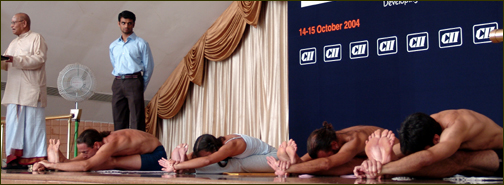
Some advanced yoga practitioners demonstrate forward bends with impressively straight backs.
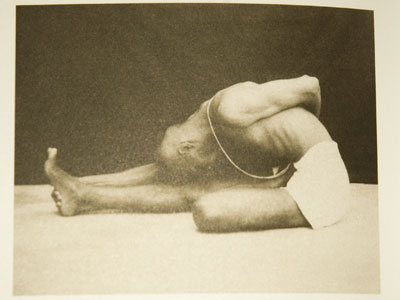
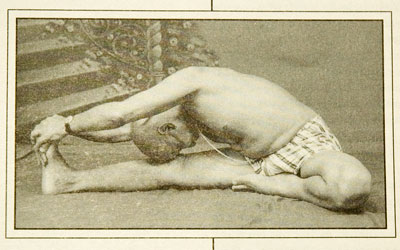
Some even more advanced yoga practitioners demonstrate impressive indifference to whether their back are straight or not in forward bends: Pattabhi Jois, photographed about fifty years ago, and his teacher Krishnamacharya – arguably the most influential yoga teacher of the last century. (Apologies for the lousy quality of these pictures, which I got by photographing pages in books)
This contrasts with the approach normally taught by Iyengar yoga teachers who emphasise folding from the hips and keeping the back as straight as possible. Here’s one of the things I respect very highly about Nancy. She explains what she believes and why she believes it, but then she also talks with obviously sincere respect about people who have quite different opinions. She mentions another senior and highly respected asthanga teacher (Graeme Northfield I think) who insists on the straight back approach because, she says, it’s what worked for him. Which is why she doesn’t believe in preconceptions about “correct” posture and alignment: “I can’t imagine there’s any one position that’s right for everybody”, and, “if what you’re doing [e.g. straight back] is causing you pain, then do the opposite [e.g. round back]”. [I’m quite sure this is true. Problem: most yoga students don’t have the confidence or experience to know if the position they are trying to get into is right for them. Bigger problem: many yoga teachers probably don’t either]
Note that Nancy absolutely isn’t against Iyengar yoga as a form of practice in it’s own right and speaks with very high respect about Iyengar teachers she has studied with – it’s the mishmash of styles and confused mixing of ideas about how to do things that she’s against.
[My thoughts on this for what they’re worth (note that Nancy has been practicing four times as long as I have and has seen a lot more than four times as many yoga students): I don’t doubt that what Nancy says she sees is true. But here are also an awful lot more people practicing yoga at some level now than there were twenty years ago, and more people hurting themselves is probably inevitable when that happens. Twenty years ago, only a few dedicated people were practicing ashtanga yoga. Now, lots of people are doing it and many of them are doing it on a casual, a couple of classes a week basis which is far more dangerous than dedicated daily practice – more thoughts on this to follow. The average level of teachers’ experience is lower too. I mean no disrespect to the many dedicated and well-intentioned people who are teaching ashtanga yoga these days. But twenty years ago, the only people teaching it were Pattabhi Jois, a couple of other very experienced Indian teachers, and a handful of Pattabhi Jois’s most senior western students who had all spent a lot of time studying with Pattabhi Jois in small groups with very hands-on teaching. Even in Mysore, the teaching just isn’t like that any more – there are many more students, and Pattabhi Jois is older. Less experienced teachers, (again, no matter how dedicated and well-intentioned nearly all of them undoubtedly are) inevitably means more mistakes in teaching, and more injured students.]
More thoughts on the subject of “alignment” and whether it matters from a yoga message board posting I read a couple of years ago (quoted at length because yahoo, these days, requires you to be registered to even read message boards)
… to suggest that “alignment” is of utmost importance and lack of this “alignment” is dangerous, is in itself an uninformed statement. All this hang up on starting a pose with a particular perception of “alignment” is from the BKS Iyengar newfangled method. This eye towards “alignment” is also increased by an attachment and false application of classical form (a western art, dance contrivance) laid onto the yoga system. “Alignment” in an asana develops over time with daily practice. It arises out of proper breath and gaze with mula and uddiyana bandhas. If the student or teacher is looking to create a renaissance inspired form of beauty in order to experience or begin the pose, then he or she is not practicing yoga but posing (ooh pretty).
Many long time ashtanga practitioners develop a graceful quality and line in their practice …. Many long time practitioners do not develop this quality yet have extraodinary, advanced practices with deep insight and experience of the practice as well as of yoga’s many facets. Should we judge a practice by this usually false graceful packaging? No way. Because geting hung up on “alignment” and slow, balletic movements are the biggest pitfalls and side tracks of an ashtanga practice. Focus on this crap and you'll never know what ashtanga practice is.
I am not engaging in some kind of ashtanga-versus-Iyengar sectarian Yoga War here. I have nothing against Iyengar yoga as such(*) – except where its ideas about how to do things intrude where they don’t belong, or when some of its practitioners falsely claim that theirs is the only safe and “correct” way to do things. I don’t like ashtangis who do that either.
(*) In fact, I have so little against Iyengar yoga that, this winter when my ashtanga teacher is in Mysore, I plan to go to classes with a friend of mine who teaches it. Not with any intention of switching, just to see what I might be able to learn from a slightly different yoga perspective.
Notes from the previous course I did with Nancy.
yoga pics
10th November 2004 permanent link
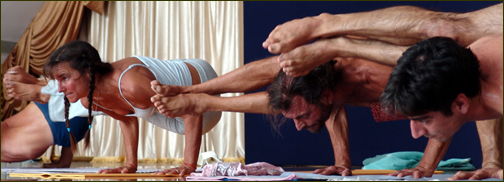
These excellent pictures of a yoga demonstration in Mysore by some of Pattabhi Jois’s advanced students go some way towards remedying the lack of decent yoga asana photos on the web.
UPDATE: Brian Micklethwait say “I know I shouldn’t mock, but some of these pictures cry out to be the basis of a caption competition”. Don’t worry Brian, the greatest yogi is the one who enjoys his or her yoga practice the most. Brian is also impressed by the spectacular modern building in the photos, which I think is new since I was in Mysore three years ago, and correctly observes there is a lot more in India these days than “dust, poverty and big white cows”. Although it still has plenty of those too.
mysore
28th October 2004 permanent link
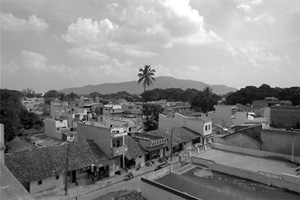
Today is the third anniversary of my arrival in Mysore to study yoga with Sri K. Pattabhi Jois. That was a Big Event in my life – one of the first times I had ever made a major decision to do something for myself, for my own reasons, rather than just going along with what parents & teachers expected of me or the vagaries of the job market.
It’s a shame I waited nearly forty years to start doing things like that – but many people never do, and in any case, you can only start from where you are.
It doesn’t feel like two and a half years since I got back, but then I’ve been quite busy.
bad days are good
26th October 2004 permanent link
On my way to yoga class. I don’t normally write blog entries about how well or badly the physical side of my yoga practice is going at any given moment, because I don’t see why anybody else should care. I actually shouldn’t care either. But.
When I was in India, studying yoga more intensively than I ever have before or since, I noticed that there is no obvious pattern to when practice sessions are “good” or “bad”:
November 28th 2001
Today’s practice – all lightness, air & freedom. Yesterday’s was all stiffness, pain & heaviness. Perhaps there is a reason for these things; perhaps there isn’t.
Last week on my way to class, I felt really up: light, fit, exhilarated. Certain I was going to have a “good” practice. And I did – I was strong, flexible, went further, more easily into many positions than I normally can. On the way to class, though, I almost wrote a blog entry about how even if that did happen, it didn’t mean anything and wasn’t something I should get attached to or start to expect.
Sure enough, that class marked the beginning of Stiff Week, in which every subsequent yoga practice felt as if my muscles had been taken out and replaced with little bags of aching cement. (Does cement ache? And how you spell “acheing”? Questions, questions)
And this is important: the “bad” days are the good ones. They’re the ones where you’re learning the most, being forced to confront your areas of difficulty, having your belief in yourself as some kind of mega-yogi knocked down a notch or two. The “good” days, if you’re not careful, can be dangerous – revelling in siddhis, stroking your ego instead of learning to control it, getting attached to being able to achieve the outward appearance of a certain level of practice. All of which are not yoga.
So it’s just as well those days don’t happen too often. Meanwhile, on the days when it’s hard, you just carry on and do your practice anyway.
And this week? Let’s see.
Meanwhile here’s a gratuitous picture of me on a “good” practice day, performing what would be a moderately impressive physical yoga feat if it weren’t for the distinctly non-serene facial expression.
david williams
26th October 2004 permanent link
the ultimate goal of Yoga is not to increase flexibility and strength. Increased flexibility and strength are simply the natural results and benefits of daily practice. While additional flexibility and strength are important and apparent benefits of Yoga, I believe the goals of Yoga practice are self-realization and keeping oneself balanced and healthy on a daily basis.
… the greatest Yogi is the one who enjoys his or her Yoga practice the most, not the one who can achieve the ultimate pretzel position.
Anybody who wants to read real words of yoga wisdom written by a real yogi could do a lot worse than check out this open letter from David Williams. David Williams, along with his then-partner Nancy Gilgoff, was one of the very first westerners to study yoga in Mysore with Pattabhi Jois thirty years ago. I’ve never studied with him, but he’s very highly respected by everybody I’ve met who has.
through slow, steady daily practice, one can achieve greater flexibility by generating one's own internal heat to relax into positions, rather than being forced into a position. I have observed this slower, steadier method is not only healthier, but it allows one to develop greater flexibility of a more lasting nature, than the kind that is forced.
Slow progress is definitely the plan I’m following.
A guy called Greg Natola originally emailed me asking for this link, because he thought I had posted a link to it on a yoga message board years ago. I have no recollection of doing so (which doesn’t necessarily mean it didn’t happen) so I couldn’t help him. He then went away and found it himself, and was kind enough to mail it to me. Thanks Greg.
beginner’s mind
25th October 2004 permanent link
Knifesmith Don Fogg on the state of mind necessary for a craftsman (link courtesy of Evelyn Rodriguez):
In my early attempts to gain self discipline, I had to develop an objectivity about my thoughts. I found a vantage point from which I could observe myself and as I watched my thoughts rise up into consciousness, I began to realize that many were silly, inspired by memories or fantasies, but having no relevance to the present moment and the objective I was seeking to accomplish. The mind fires continually, first this direction then that. It can develop whole stories that spin on endlessly, some like nightmares recur and follow a dreary cycle that have an enviable conclusion of depression, sadness, anger or defeat. To learn discipline, you have to disperse these thoughts, they are dreams and take you from your work. Allow the work to draw you back. Employ the mind or it will employ you.
A useful tool for centering the mind is the breath. I have heard the breath described as a silver thread that links you to the universe. If you purse your lips slightly and draw a slow deep breath, it is not hard to imagine the coolness of space and the silver light of the stars being drawn into your body. When you exhale, you imagine the energy passing through you and discharging into the ground beneath you. It has a calming and centering affect. This is ancient wisdom.
As you begin to control your mind, you realize that it is insatiable. It hungers for stimulation and will quickly divert to anything that distracts it. The modern world is a cacophony of sounds and images. We process so much information in the course of one day, an old timer would be dizzy from the effect of it, but we hunger for even more. The radio plays constantly, the TV is always on, we can not sit with out reading …
I learned this chopping firewood on volunteer work weeks in Scotland with Trees For Life. When you’re at the top of the stroke, with the axe above your head, if your clear your mind of intentions and expectations and just let the axe go, the log splits cleanly and effortlessly. If you think “right, this time I’m really going to hit it” – thud. The axe goes halfway in and sticks and you’re there for the next five minutes prising it out.
I assume – although I’ve never tried it and have no interest in doing so – that golf must be something like this. Even though many of the people doing it probably don’t think it has anything in common with yoga or meditation
This also goes back to what I was saying last week about the ability to do impressive-looking advanced yoga practices. When my feeble attempts to do these things nearly succeed, it usually catches me by surprise and seems to happen pretty much by itself. Then on the next attempt, I think “right, that was good so what was I doing that made it work? I’m going to try really hard to do it again”. So then the next attempt is hopeless. There’s the real lesson. The ability to do these things isn’t important; the state of mind you have to be able to get into in order to do them is. Yoga is the cessation of the fluctuations of the mind. Advanced yoga practitioners (I surmise, since I am not one) have learned to enter this mental state more or less at will; or at any rate to live in a way that removes some of the internal and external obstacles to it occurring.
measuring enlightenment?
22nd October 2004 permanent link
Here are some of my fellow ashtangis discussing whether measuring people’ brainwaves during meditation can tell us anything valid about “enlightenment”:
It’s silly because the whole idea of ashtanga yoga (and most other yogas), as explained by Patanjali in the Yoga Sutras, is to merge the observer with the observed, subject with object. The subject becomes absorbed in the object and in so doing is reunited with Universal Consciousness. That's what yoga means. It can only be experienced subjectively, by definition. An objective experience implies separation from the object being observed. If you measure brainwaves with a scientific instrument - that's what you are doing - which is pointless from a yoga point of view
…
If enlightenment or cosmic consciousness truly does exist than there ought to be some objective, real-world evidence of some sort. The enlightened, by definition, should be capable of feats of mind--of concentration, volitional control of autonomic bodily functions, entering and leaving states of consciousness at will (for example, displaying the brainwaves of a conscious person even when in deep sleep)--far beyond what is normally considered possible for human beings. And our machines should be able to objectively measure this fact, even if we personally, not having put in the decades of meditation and consciousness training, cannot experience enlightenment or cosmic consciousness for ourselves. And lo and behold, our machines DO in fact allow the uninitiated to verify that something truly extraordinary is taking place in the minds of the so-called enlightened.
For the time being I’m just noting this as something I want to come back to / think more about. Blog as notebook (something I used to do separately from blog for public consumption). My previous thoughts on the subject.
yogablogging, part two
21st October 2004 permanent link
Further to my previous thoughts on how compatible blogging is with serious yoga practice: in an email to somebody yesterday, I had occasion to quote Pattabi Jois’s book Yoga Mala:
the truth should be pleasant to others; an unpleasant truth should not be uttered
… a policy which, if implemented thoroughly, would shut down the blogosphere, usenet and all other forms of online discussion overnight. (Obviously I’m using the term “discussion” quite loosely in the context of most of usenet)
Just this morning, for example, I posted a comment on [somebody else’s blog] saying that the works of [a fairly well known novelist] are “adolescent wank”. This is my true and honest opinion, but does that mean I really had to write it down and put it on the internet?
Wouldn’t put something like that on your own blog, would you Alan? Leave that sort of thing up to the anti-Alan who scurries around the dark cellars of the internet posting comments on other people’s blogs, don’t you Alan? Not exactly a shining beacon of ahimsa for the world, are you Alan?
notes on nancy, part two
18th October 2004 permanent link
Apologies to my (three, that I know of) non-ashtangi yogablog readers if some of the following appears to be in sanskrit. That’s because it is. The bits I think are particularly important I will discuss and try to explain in English.
Things Nancy says Pattabhi Jois really doesn’t care about, and therefore she doesn’t either:
Preconceived ideas of “correct alignment” and what people’s practices should look like. To be discussed at length in the next part.
Fancy-looking frills, embellishments and optional extras in practice, especially handstands in primary series. Advanced ashtanga yoga involves a lot of amazing-looking arm balances and lifts – slowly floating into and out of handstands, doing all sorts of difficult and complicated stuff whilst you are up there. A friend in Mysore told me that the way one particular sequence used to be taught, your feet wouldn’t touch the ground for ten minutes or more. They’ve broken it up a bit since.
This is all fine and good for the few people who are practicing at that rarefied level. It becomes problematic when beginners see advanced demonstrations or videos and think “wow, I want to be able to do that”. One of my first teachers was exceptionally good at this stuff and liked to demonstrate it a lot in class – with the result that I spent hours and hours trying to learn to do those things when I really should have been working on far more basic things that I also couldn’t do and that did matter for a beginner. (He was a good and inspiring teacher in many ways and I learned a great deal from him. Nobody’s perfect.)
A lot of people also worry that their yoga practice is somehow inadequate if they haven’t already learned these amazing advanced tricks. Nancy says once you’ve learned urdhva kukkutasana, early on in the first advanced series, then you can easily float backwards and forwards in the vinyasas in primary series. Up to that point she’s never seen any evidence of Pattabhi Jois caring whether people can do it or not. Nor have I, for what that’s worth given that I’ve only spent a few months in Mysore. All advanced practitioners could do fancy lifts and extra handstands in the primary series if they wanted to: the advanced practitioners with the most beautiful practices I saw in Mysore chose not to – just did the most basic, plain simple practice with wonderful ease and grace.
Patanjali has a lot to say about this too. In the original yoga textbook, two thousand years or more ago, he devoted a large part of his discussion to siddhis. Siddhis are special powers, possessed by yogis and not by most other people, that come as a side effect of advanced yoga practice. Patanjali warns sternly that getting caught up in enjoying siddhis, or confusing them with the object of the exercise, is one of the most common and insidious obstacles to real yoga practice. Exceptional control of the body and the ability to perform cool-looking physical feats with it is a siddhi.
DISCLAIMER: I have never floated smoothly up to a handstand in my life, although – deluded siddhi-chaser that I am – I would like to one day.
Things that I thought were optional embellishments for advanced practitioners, but that Nancy to my surprise actually insists on:
Exiting from bhujapidasana and supta kurmasana via lift, tittibhasana and bakasana, with a pause at bakasana. I’m just about getting to the point where i can approximate this. I had always associated it with doing extra handstands etc., as discussed at length above, but no.
Between backbends, just touch the head down for one breath and straight back up again. No lying back down on the mat, having a cup of tea and a snooze in between which (exaggerating only slightly) is what I used to do. I’ve been trying to follow Nancy’s approach for the last couple of weeks(*). It isn’t as much harder as I expected.
(*) except on days when I have to do my advanced backbending practice where Guru Jack sits on my stomach.
Notes from the previous course I did with Nancy.
notes on nancy, part one
7th October 2004 permanent link
Yogablogging: various notes about, and/or random thoughts inspired by, the yoga course I did last week with Nancy Gilgoff. Part One.
Nancy says: “always touch a student like you know what you’re doing (even if you don’t)”. This works. For the first week after my son was born, he would scream blue murder the whole time when Maria and I were changing and dressing him. When the nurses in the clinic or Frau Meyer our visiting midwife did it, he would lie there quite happily gurgling at them. So one day I watched carefully how Frau Meyer did it. She was quick and decisive about what she did, like somebody who has done it thousands of times with hundreds of babies:
old pampers off and lift bottom and wipe! and new pampers under and bottom down and wrap! and lift shoulders and shirt on! …
Whereas I was slow and hesitant like some kind of new father who’s only been doing it for a few days:
old pampers off now where are the wipes ah here so now wipe carefully and where was the new pampers? ah over here oops missed a bit wipe again now put the bottom down to reach for the new pampers so we'll have to lift him up again – carefully, we don’t want to strain his little back – and finally that’s done but jesus how am I ever going to get this teeshirt over his head the neck's far too small ah I have to undo this button here …
And so on ad infinitum. I decided the way forward was to just try imitating Frau Meyer – quick. decisive. don’t show fear. Immediate success – happy, gurgling baby. Act like you know what you’re doing, even if you don’t.
yogablogging
4th October 2004 permanent link
As I expected, the intensive yoga course I did last week was intensive, and left me with no time or energy for writing anything. Apologies to Jim Henley readers looking for fresh yogablogging.
There will be some soon, when I’ve figured out which of my notes from the course it’s actually ok to publish – as I said when I did a shorter version of the same course a couple of years ago:I’m not going to describe specific adjustments here – there might just be people stupid enough to think that they could go and “help” their friends after reading a third-hand description of an adjustment on the web from somebody who did a weekend workshop, and then someone gets hurt. Wouldn’t want to be responsible for that.
But if yogablogging is what the public wants, yogablogging is what the public will get. Eventually.
no quick fix
28th September 2004 permanent link
A couple of days ago I mentioned that I had concerns that yoga “therapy” could lead to a short term, quick fix orientation that is foreign to real yoga practice, and was sceptical about whether such short term, quick fixes can actually work. Here, however is an article in Yoga Journal by Elise Browning Miller, who is a yoga teacher specialising in helping students with scoliosis (curvature of the spine). No danger of a quick fix mentality here:
The decision to do yoga to remediate a scoliosis entails a lifetime commitment to a process of self-discovery and growth. For many people, this kind of commitment is intimidating. It's tempting to turn instead to an orthopedic surgeon, who will "fix" a back by fusing it and get rid of the pain forever. Unfortunately, this operation results in a virtually immobile spine and frequently fails to alleviate the pain. I taught one teenage student with an extreme scoliosis who, weary of struggling with her yoga practice, gave up and had her back fused. To her dismay, her pain persisted, and she had even less mobility than before. When the rod in her back broke, she had it removed rather than replaced, and she returned to her yoga practice with a renewed and deeper commitment.
Choosing the path of self-discovery rather than surgery requires not only commitment but inner awareness. Guidance from a competent teacher is helpful, but awareness of our own bodies is crucial--no famous guru can fix our backs for us, any more than an orthopedic surgeon can. Only through our own constant awareness and loving attention can we transform our discomfort into a guide that helps us to get in touch with our bodies.
The goal of yoga practice should not be to straighten our backs; we must learn to accept them as they are, not deny them or judge them. Instead, we must work to understand our backs and to relate to them with sensitivity and awareness. Healing is much more than straightening a scoliosis, or curing a disease. It is learning to love and nurture ourselves and trust our inner knowing to guide us to a vibrant state of being.
yoga with nancy
26th September 2004 permanent link
This week I’m doing a yoga course with Nancy Gilgoff. Nancy was one of Pattabhi Jois’s first western students, and has been studying and teaching yoga for over thirty years. I did a weekend course with her two years ago – writeup here. This one is five days, six hours a day.
I don’t expect to have much energy for writing anything.
ujayi breathing
25th September 2004 permanent link
Michael Smith links to a couple of articles about how diaphragmatic breathing and inverted yoga postures (shoulderstand, headstand) stimulate the lymphatic system - “the respiratory diaphragm is the main pump of the lymphatic system” (Kelly McGonigal). Fascinating.
I realise here that I'm about to try to use words to explain something that needs pictures. I'll give it a go anyway. The diaphragm is a dome-shaped sheet of muscle that forms the floor of the thorax and the ceiling of the abdomen. Its centre is a tendon that rests on top of the abdominal organs and is indirectly tethered to the spine; its periphery is attached to the bottom of the ribcage. When the diaphragm tenses, two things happen: the centre pushes down on the abdominal organs, and the periphery pushes the ribs upwards and outwards. Ujayi breathing is a yogic breathing technique which is supposed to be used throughout an ashtanga vinyasa yoga practice, and is also done as a standalone breathing practice in other types of yoga. Ujayi breathing is done with the pelvic floor and lower abdominal wall lightly tensed (“bandhas”). This stabilises and slightly pressurises the abdominal organs, supporting the diaphragm firmly from below so that when it contracts, the centre can't move downwards (much). Instead (most of) the movement goes into expanding the ribcage.
David Coulter's marvellous book Anatomy of Hatha Yoga describes all this in more detail (with pictures) and points out the benefits of diaphragmatic breathing for lung capacity and blood gas levels, but I don't recall him mentioning the lymphatic system.
The technique recommended in McGonagal's article is different from ujayi breathing. She recommends lying on the back with a weight on the stomach, and then using diaphragm breathing to push the abdominal wall up and down. In this case the periphery of the diaphragm would appear to be held (relatively) still and the centre would move (more), actively pushing down on the abdominal organs to lift the stomach wall. Interesting, but I think I'll stick with my ujayi breathing during ashtanga practice. Should have much the same effect. (Controlled trials, anyone?)
Here we get to an area where I have some concerns about the idea of yoga therapy, or the borrowing of techniques from yoga to use as physical therapy for particular medical conditions. I firmly believe that many yoga techniques are capable of achieving the physical benefits that are attributed to them in old yoga texts. But I also think it probably takes years of diligent practice to develop the muscle control and body awareness needed to do them effectively and safely(*). Medical trials and systematised yoga therapy want results what are achievable quickly - months rather than years - and repeatable by large numbers of people who aren't motivated to devote large parts of their lives to yoga practice. About that I'm sceptical.
Take another example: use of yoga breathing techniques to assist in pregnancy and childbirth. I'm quite sure that women who already have advanced yoga practices can have enough diaphragm and pelvic floor control to help significantly in childbirth. I'd need to be convinced that somebody who hasn't already practiced these techniques for years can learn enough of them to be useful in six months. (Disclaimer: I am speculating. I have no first hand experience of pregnancy or childbirth).
(*) The other article Michael links to discusses how inversions - shoulderstands and headstands - quite possibly do have the benefits for the circulatory, lymphatic and endocrine systems that yoga teachers attribute to them. But it also cites examples of how they can cause problems in the neck and upper spine, even for experienced practitioners, if they're not taught safely and practiced carefully.
enlightenment and doing the dishes
24th September 2004 permanent link
Linking to Steve Kingston’s God Save The Queen turns out to have been a good idea when, a week later, he comes up with this …
Mystical union with the Godhead – absolutely, if you can receive it. But don’t let such blessings make you forget that it’s your turn to wash up.
yoga & weblogging
22nd September 2004 permanent link
I’ve been meaning for a while to write something about whether & to what degree maintaining a weblog is compatible with pursuing a serious yoga practice. (“Meaning” meaning thinking about, but consigning to the Too Hard pile).
You become a writer by writing. It is a yoga.
Mysore novelist R.K. Narayan, quoted by Michael Smith
… which I think it perhaps can be in some forms, but I have my doubts about whether blogging is one of the more conducive forms.
Any time you’re thinking about how you’re going to describe something afterwards, you’re clearly not, at that moment, fully experiencing whatever it is that’s happening in the present moment. So you’re not practicing yoga. It’s a tendency you’re bound to have if you are somebody who has any natural inclination to write at all, but perhaps not one to be encouraged if you’re trying to be serious about your yoga practice. And weblogging, I think, does tend to encourage it. Which is one reason why I write very little here about physical details of my yoga practice, but that isn’t a complete answer by any means.
UPDATE: KJS disagrees.
That isn’t the complete essay by any means either, but it will have to do for now.
First, it is absolutely necessary to clear the intellectual portion, although we know that intellectuality is almost nothing; for it is the heart that is of most importance. It is through the heart that the Lord is seen, and not through the intellect. The intellect is only the street-clearner, cleansing the path for us, a secondary worker, the policeman; but the policeman is not a positive necessity for the workings of society. He is only to stop disturbances, to check wrong-doing, and that is all the work required of the intellect ...
Intellect is necessary for without it we fall into crude errors and make all sorts of mistakes. Intellect checks these; but beyond that, do not try to build anything upon it. It is an inactive, secondary help; the real help is feeling, love. Do you feel for others? If you do, you are growing in oneness. If you do not feel for others, you may be the most intellectual giant ever born, but you will be nothing; you are but dry intellect, and you will remain so.
Swami Vivekananda, quoted by Michael BlowhardRational thought is not what we are doing in this practice
senior ashtanga yoga teacher Dominic Corigliano, quoted on the yoga is youth weblog
Although on the other hand, writing is an art and
The purpose of art... is the gradual, lifelong construction of a state of wonder and serenity.
Glenn Gould, 1962
great grandpa
20th September 2004 permanent link
I’ve written quite a bit about Pattabhi Jois the world famous great yoga teacher. Roy, who is (UPDATE: was) studying with his granddaughter in Bangalore at the moment, has pictures of Pattabhi Jois the great grandfather. Looks like he enjoys that as much as he enjoys teaching yoga.
music, meditation and heaven
14th September 2004 permanent link
Yesterday I was re-reading my essay from a few months ago about listening to music as a form of meditation, because I noticed that aworks had linked to it.
Then today I read this:
'The ultimate power of music,' continues Bittleston, 'is that it temporarily demands you to exist in the present. There are no problems in the present! The performing arts are unlike other art forms, which are tied up with anything but the present. In music you can literally leave your problems behind, because they're not there. That would be a very Zen Buddhist way of looking at what music is. In Christianity it was once argued that music transports one through the gates of heaven. But what they were really saying is the same thing - it transports one not through the gates of heaven, but slap-bang into the place where you actually are, which is the now. That process dissolves all problems, at least for a time. I think this might be defined as heaven in some circles.'
Richard Bittleston, quoted by Jessica Duchen in BBC Music Magazine, quoted by Brian Micklethwait.
indian genes again
12th September 2004 permanent link
Razib talks about yet another new paper on Indian genetic origins, in which the pendulum swings back towards very little sign of large scale immigration in the last ten thousand years in mitochondrial DNA, i.e. in the female line. I think I’m going to stop writing about this and just link to Razib.
first there is a mountain
2nd September 2004 permanent link
I’ve been reading Elizabeth Kadetsky’s First There Is a Mountain: A Yoga Romance: an account/expose of her time studying a BKS Iyengar’s yoga shala in Pune, mixed with some investigation/speculation about the origins of modern yoga .
It’s the buzz yoga book of this year. I had it on my shopping list anyway, then I noticed that a guy I met at a yoga workshop had it, and commented on it, and he said he'd just finished it and would I like to borrow it? In his opinion it was worth reading but not something essential to have on one’s yoga bookshelf. I said yes I would like to borrow it, and I pretty much agree. If I had spent money on it I certainly wouldn’t have regretted it, and might want to look at it again one day, but I don’t feel a burning urge to rush out and buy a copy right now. I intended to write a longer review but I don’t really feel like I have the time or the motivation, and it’s about time I returned my borrowed copy. (Yes, I actually return borrowed books).
So, short version: not an absolute must-read, but well worthwhile if a copy happens to fall into your lap. Makes the atmosphere at the Pune shala sound pretty poisonous, but I’m sure somebody of a suitably sceptical turn of mind could write something similar about Pattabhi Jois’s school in Mysore if they put their mind to it. Most interesting bit from my ashtangi perspective: at the end of the book when she goes back to Iyengar after studying with an ashtanga teacher elsewhere, and he launches into a big tirade against ashtanga generally on the theme of how can, in your asana practice, use your body as a tool for meditation if you keep jumping around and moving it all the time? Obviously I think you can, otherwise I wouldn’t still be practicing ashtanga yoga. Nevertheless it’s worth hearing the opinion of one of the greatest contemporary yogis on the yoga style that he learned in his youth but later abandoned.
Previous posting with lots of links relating to the book here; discussion of the book that the author has contributed to here. And thanks Thore for the loan – the book will be on its way back to you soon.
yoga blogs
2nd September 2004 permanent link
A roundup of some yoga blogs(*) I’ve been reading lately:
flying monkey, recently linked to here
prana journal – Michael Smith, whom I have linked to several times but not in the last few weeks, so he has dropped from my sidebar links. See below.
ashtangi.net is Julie Kremer’s yoga weblog aggregator / hosting project (illustrated with my photos, but doesn’t seem to pick up my yoga-related updates all that frequently)
UPDATE: Julie writes to say she tries to check my yoga feed regularly but it comes up empty. I need to look into this. It’s more likely my fault than hers – my weblog software is homegrown and gets written in one or two hour spurts in the evening after the baby has gone to bed when I'm tired.
days in my lives – I already have a permanent link to John under “friends & family” on my yoga links page even though I’ve never actually met him face to face. I’ve “known” him for years as one of the more prominent level-headed nice guys in the online ashtanga yoga scene. His blog updates come infrequently but in large chunks.
99 to 1 – Roy in Bangalore, studying with Pattabhi Jois’s grandaughter Sharmilla. An ashtangi.net blog. Interesting writing and she sounds good – worth noting if an IT project ever lands me in Bangalore with not enough time to visit Mysore.
yoga is youth – doesn’t appear to be being updated, but was an interesting group blog by some yoga students in Mysore earlier this year.
2 blowhards – like me, Michael Blowhard doesn’t write exclusively – not very much at all, in fact – about his yoga practice and vedanta studies. But well worth a read as one of the more interesting arts’n’culture blogs with the added bonus of occasional yoga references.
A note on my linking policy: one of the ideas I wanted to try out when I was writing my weblogging software was, instead of having a quasi-permanent edited-by-hand “blogroll” in my sidebar links, to generate the links sidebar automatically from the things I’ve linked to in my current postings. So if something appears in my sidebar links and then disappears a month later, it doesn’t necessarily mean I no longer think it’s worth reading – it’s just because I don’t happen to have linked to it in a blog entry for a month. I might rethink this though. I still like the idea of my sidebar links automatically reflecting what I’m currently reading/writing/thinking about; but I’m also developing more appreciation of the value people attach to mutual linking as an article of inter-blogger courtesy.
Automatically pruning links after 30 days also means my sidebar gets a bit thin if I go on holiday and don’t post anything for two weeks. So, changes to my sidebar linking policy quite possibly coming soon: possibly more permanent links, and/or retain automatic links longer, and/or have the main page contain the last thirty days’ entries or the last 20 entries whichever is the greater.
I also still have an old page of yoga links that I maintain, sporadically.
(*) For a long time I resisted the term “blog” as being a horribly ugly and stupid-sounding word, preferring “weblog”. I am gradually giving in to inevitability.
yoga friends
1st September 2004 permanent link
Interesting news from a couple of yoga friends. My Mysore roommate Christina is teaching in Oklahoma and I’m hearing good things about her from various sources whose opinions I respect. The photo on her personal page is one of mine, taken at a Christmas party in Mysore in 2001. She hated it when she first saw it. Presumably she doesn’t any more.
Christina & I keep in touch occasionally by mail; in her latest she informs me that another of our Mysore friends, Kate Hewett, is now teaching the ashtanga classes at triyoga in London.
Another of my Mysore roomates, and an old friend from the very beginning of my yoga studies in Manchester, is Janice Roscoe. She’s now living and teaching yoga in Ottawa, Canada with her brand new husband Stephen, and says one of her students recognised her from her photo in my Indian diary. I owe her an email too.
Go girls.
holiday yoga
31st August 2004 permanent link
Does doing extra hip-opening excercises in addition to your formal yoga practice actually help to advance (the physical aspects of) your yoga practice? Most ashtanga yoga practitioners would say no, whilst in many cases sneakily doing them anyway in the hope that they might. Here are my recent experiences and thoughts on the matter, derived from comparing lifestyle a: office job, toddler at home with lifestyle b: on holiday with toddler:
| working in office | on holiday with toddler |
|
you spent lots of time sitting down, and so can sit for hours in half lotus or similar supposedly hip-opening positions. (your colleagues may find this a little odd at first. They get used to it) |
you rarely sit down |
|
you can maybe squeeze forty minutes or so of yoga practice in in the evening while the baby is having supper (after you’ve put him to bed you’re tired and it’s too late)(*). (Mornings? forget it. You have to change the baby, feed the baby, dress the baby, pack the baby’s lunch, change the baby again, deliver the baby to daycare, and at some point eventually go to work.) |
you can do a full yoga practice every afternoon while the rest of the family has a siesta |
| your hips feel subjectively quite open due to all the sitting, but when you actually try something like marichyasana d during your practice it’s really hard | your hips feel tight and sore from all the not-sitting, but your practices are actually good and things you normally find hard like marichyasana d or supta kurmasana come relatively easily. |
So lots of time sitting in half lotus etc. outside of formal yoga practice feels like it should help, but actually doesn’t. Or at any rate isn’t a substitute for doing enough proper practice.
(*) Or not, if instead you get to waste an hour pissing about with network settings and thinking “why, oh why will the new network card I just bought for my new Powerbook not connect to my home network when every other bloody machine in the house will?” before giving up and asking the question on the Apple support forums. As I just did. I hate computers when they don’t work.
UPDATE: kudos to Netgear, whose online support actually works. A search on their site for “Apple Airport Extreme” tells me that I should upgrade the firmware on my MR814v2 router. I do. It works.
more vedic
31st August 2004 permanent link
Interesting discussion at gene expression, summarising the results of several recent papers on the genetics and possible origins of indian caste populations. I've also previously discussed some of these here. See in particular Razib’s comments on how radically different male and female lineages appear, and how upper caste female infanticide could have been a major factor favouring upward mobility of lower caste women.
UPDATE: more sensible commentary by razib here about the impact of genetics on the study of history. Razib is an extremely bright guy.
no spirituogram?
15th August 2004 permanent link
I was looking through some old yoga magazines before I went to bed last night, and found an interesting advert in an old copy of Yoga Journal.
The ad was for a book on “Synchronicity High Tech Meditation”, by a bloke with a dodgy hairdo styling himself “Master Charles”. Master Charles claims that his method “yields at least a fourfold acceleration factor over classical methods of meditation”. I haven’t got to the interesting bit yet.
The interesting bit is this: Master Charles’ claim of fourfold acceleration is based on EEG studies of the brainwaves of Zen meditators with various levels of experience, and claims that they are similar to the brainwaves of practitioners of his method with substantially less experience. He cites several scientific studies of Zen meditators that sound worth looking at:
- Tomio Hirai, Zen Meditation and Psychotherapy, 1989
- C.M. Cade & N. Coxhead, The Awakened Mind, 1989
- A. Kasamatsu & T. Hirai, “Science of Zazen”, Psychologia, 1963
No links because the ad was in a 1995 magazine, so I mention this here largely to remind myself to look some of this stuff up later.
Thoughts: there is a spirituogram. It doesn’t matter whether one believes that there is only the material universe , and learning to induce particular states of brain activity is enlightenment; or that enlightenment truly is a state of union with something outside the material world, but it happens to produce a particular measurable brainwave state as an epiphenomenon; either way it seems that the mental condition is clearly detectable in numerous studies of Buddhist meditators and some studies of yoga practitioners. I don’t know how cumbersome EEG equipment is: I suspect doing an advanced yoga asana practice whilst wearing it might be quite a bit harder than doing a sitting zen practice.
This doesn’t mean I’m going to rush out and buy Master Charles’ book. Even if it actually works and the degree of enlightenment one can achieve with five years of “Synchronicity High Tech Meditation” is comparable to twenty years of zen or yoga practice, I’m enough of a hair shirt Luddite to say so what? What’s wrong with doing twenty years of zen or yoga? And then there’s always the risk that the brainwave state is just an epiphenomenon and you might be spending five years just to learn to fake the outward appearance of something. Plus I’m automatically suspicious of people with pseudonyms and dodgy hairdos, even if they do put interesting things in their ads.
wish i was there
9th August 2004 permanent link
Flying Monkey is an interesting current Mysore yoga weblog, particularly good on Indian culture shock and the experience I also had, of thinking you’re quite well settled in and then suddenly after a while – in may case after about four months – just losing the ability to cope and needing to go home.
Describes Sharath, Pattabhi Jois’s grandson and a truly marvellous yoga teacher in his own right, as “unprepossessing”. I hope he doesn’t think “unprepossessing” means what I think it means. “Unassuming”, perhaps.
Also interesting: says Harini of the Three Sisters offers ayurvedic massage for women only. I hung out at Three Sisters almost every day when I was in Mysore and don’t remember being aware of that (but then I don’t come under the “women” heading). Says Harini’s massage guru is called Vijay. On my first trip to India I was treated by an ayurvedic masseur called Vijay in Kerala who fixed my old knee problem – a story I’ve been meaning to continue telling for a while now. This Vijay, the Kerala / Alan’s knee one, is right up there in my estimation with Pattabhi Jois and Sharath among Top Bodywork Geniuses I Have Known. I wonder if it’s the same guy? Wouldn’t surprise me.
UPDATE: it is the same guy
Found via the sunrise ruby via ashtangi.net.
yoga therapy
22nd July 2004 permanent link
Michael Smith emails me, in response to my response to his pointer to bindu magazine, with links to some more interesting yoga science articles. Thanks very much Michael.
The articles are by Dr. Timothy McCall, who apparently is medical editor of Yoga Journal, but nobody’s perfect. He also wrote the foreword to David Coulter’s marvellous book Anatomy of Hatha Yoga, which inclines me more in his favour.
And one of the articles is excellent. In Western Science vs. Eastern Wisdom he describes his visits to yoga therapy researchers in India, talks about the research they are doing and raises a number of serious issues. Probably the most serious of these is that medical science relies on repeatable studies of standardised treatment practices, whereas all good yoga therapists insist that treatments must be customised for the individual patient. Some yoga institutes are conducting standardised trials in the interests of gaining recognition from medical researchers - but is what they are doing then proper yoga therapy?
The irony is that if standardization does lower the quality of therapeutics, we might end up amassing the most scientific support for methods that are not the best yoga has to offer. This is no trivial matter, since the results of studies can influence which institutions get funding and, someday perhaps, which teachers get licensed or reimbursed by insurance companies.
I would call this more than an “irony”. It raises the same question I’m addressing in my sporadically-ongoing series of essays on yoga teacher qualifications: who is actually qualified to train and certify yoga teachers (or therapists) anyway? Answer: not governments or insurance companies, and especially not if it means some kind of bastardised, watered-down subset of practices ends up getting quasi-officially sanctioned as “yoga”.
Another concern that McCall raises:
Some view this “medicalization” of yoga as a problem; they worry that doing yoga for a bodily affliction trivializes this great spiritual tradition. But this didn’t concern the masters that I had met on my journey. “Everyone comes to yoga because of some kind of suffering,” says N.V. Raghuram, a senior teacher at Prashanti. In other words, it doesn’t matter what brings a person to yoga, a bum hip or a desire to find God: Duhkha is duhkha.
I am probably one of the people who view “medicalization” of yoga as a problem. I have absolutely nothing against borrowing yoga techniques as a form of physical therapy. I’m sure it can be very effective. I would question whether it is yoga. Certainly people whose physical suffering is relieved by "yoga therapy" might find that their spiritual well being is enhanced as a result. I can well imagine that if I had suffered from chronic backache and yoga therapy relieved it, it would reduce the fluctuations of my mind. It’s also definitely true that some percentage of people who start practicing yoga for any reason - backache, getting fit, meeting babes - will realise that there is more to it than that and become serious about their practice. For me it was reasons (2) and (3). So I think McCall’s point here is ok to a degree: yoga therapy is a good thing in itself and possibly also a way in to serious yoga practice for some people; but there is a danger of people confusing physical benefits with the real aims of yoga.
Another problem of current scientific yoga research: looking under the lamppost syndrome. It’s easier to measure maximum oxygen uptake or the straightness of somebody’s spine than their level of enlightenment. “Unfortunately, there’s no ‘spirituogram’ that can quantify this aspect of yoga, so science does not look there much”, says McCall. I think there is, actually, or could be. It’s just harder and more expensive than measuring VO2 Max. I personally believe that mystical states of enlightenment must correspond to [may be no more than] measurable, detectable states of brain activity that some very dedicated practitioners of things like yoga or buddhist meditation can learn to induce. The brain scans of yoga practitioners that bindu magazine wrote about, or of Tibetan buddhist monks that I read about elsewhere, would be one (early, crude, prototype) form of the “spirituogram”. There must also be tests/measures of general psychological wellbeing that I think would correlate with any reasonable definition of "enlightenment". Whether you could get randomised volunteers for a study would be a big question, though. Getting twenty randomly-selected soldiers to do hatha yoga instead of their normal PT for an hour a day for a few months is feasible. Getting twenty randomly-selected civilians to go into a Tibetan Buddhist monastery and meditate for several years isn’t. But there’s a difference between "not easy to measure" and "not measurable".
This all reminds me of a fascinating interview I once read in Yoga International magazine with a guy called Robin Monro. Monro was a high-flying research biologist in the 1960s - worked with Francis Crick of Crick & Watson fame. He also studied yoga with BKS Iyengar. “In 1969 he left research in molecular biology in order to dedicate the second half of his career to philosophical and ethical problems associated with science … In 1980 he decided to go in for research into forms of medicine which were largely unrecognised by modern medicine but which were in his own experience effective ... and founded the Yoga Biomedical Trust”. Sounds like an interesting character – unfortunately Yoga International magazine’s website (doesn’t work properly in Mozilla and ...) apparently either doesn’t have online archives, or only has them for subscribers.
Bonus link: this apposite quote from John Perry Barlow:
I’m realizing that one of the obstacles to an integrated model for Western Medicine, such as they are using me to develop, is that the better reductionism gets at yielding extremely granular insight into the parts, the harder it becomes to assemble them into a whole.
more vedic
13th July 2004 permanent link
I’ve been reading a 1999 paper by Michael Witzel, Early Sources for South Asian Substrate Languages, which comes to some very interesting conclusions about what languages were spoken, when and where in northern India in Vedic times. I have no idea what, if any, reaction to this paper there might have been from linguists; but Witzel is a serious historical linguist, not a biologist with some stats software and a bright idea, so I assume his ideas are at least worth taking seriously.
Witzel believes the vedic scriptures, because of their unbroken tradition of precise oral transmission as sacred texts, are the closest thing we will ever have to a tape recording of an ancient language, far better than any written evidence. Also that even within the earliest group of texts, the Rg Vedas, it is possible to clearly identify a sequence of composition in at least three different periods that also appear to have originated in different areas and with different substrate languages (*).
Very broad-brush summary:
- Geographical features identifiable in the texts at different periods show a clear geographical progression, from the north west into the Punjab and from there into the Ganges basin.
- There are no Dravidian loan words in the earliest parts of the Rg Veda. On this basis he completely rejects the idea that the previous inhabitants of the area, and the Indus Valley civilization (Mohenjo Dara/Harappa), were Dravidian speakers.
- Instead he identifies three probable substrate languages:
- One found in in the form of about 300 apparently non-Indo-European loan words in the earliest Rg Vedas, that he identifies as an Austro-Asiatic language related to the present day Munda language family. These languages are currently spoken in central and eastern north India, and there is no other evidence of them exisitng this far west. He believes this was the language of the northern Indus Valley Civilization.
- A different but related language encountered later and further south in Sindh, and possibly much further west along the Iranian coast into the Gulf. This may have been the language of the southern Indus Valley Civilization – he believes there are discernable differences between the (undeciphered) scripts of Mohenjo Dara (south) and Harappa (north).
- A third “Language X” already identified by previous researchers, encountered later and further east in the Ganges basin, that might be an even older substrate of the Munda-related languages.
- Dravidian borrowings are first encountered after the earliest Rg Vedas and further south in Sindh, but are not the same as substrate language [2] from that area. Witzel believes the Dravidians were also relative newcomers to the area at that time, having arrived by a different route further south – central Iran-Baluchistan-Sindh. Dravidians appear to have had horses – dravidian horse words unrelated to Indo-European – but not chariots.
- Both Vedic and Dravidian appear to have borrowed most of their vocabulary for agriculture and crafts from the pre-existing substrate languages, strongly suggesting that their speakers were pastoralists until they arrived in India and came into contact with more settled cultures.
Substrate language = a language that has died out in an area, but left traces in the form of borrowed vocabulary in the language(s) that replaced it.
yoga for squaddies?
11th July 2004 permanent link
A search on “subject:yoga” in the Indian Journal of Medical Research online archive in fact comes up with only one result, namely this study of a group of soldiers by the Indian Defence Institute of Physiology & Allied Sciences:
One group (yoga, n=17) practiced Hatha yogic exercises for 1 h every morning (6 days in a week) for six months. The other group (PT, n=11) underwent conventional physical exercise training during the same period. Both groups participated daily in different games for 1 h in the afternoon. In the 7th month, tests for maximal oxygen consumption (VO2Max) and PE were repeated on both groups of subjects.
Results: Absolute value of VO2Max increased significantly (P<0.05) in the yoga group after 6 months of training. The PE score after maximal exercise decreased significantly (P< 0.001) in the yoga group after 6 months but the PT group showed no change.
Interpretation & conclusion: The practice of Hatha yogic exercises along with games helps to improve aerobic capacity like the practice of conventional exercises (PT) along with games. The yoga group performed better than the PT group in terms of lower PE after exhaustive exercise.
Interesting. I do rather doubt, though, that producing superfit soldiers is really what Patanjali had in mind. Not to mention that this sort of thing does throw into question the standing of Indians to criticise western yoga students for an “overly materialistic” attitude if this is what their own researchers get up to.
OK, tongue somewhat in cheek - I do believe this sort of research is interesting and worthwhile, as long as people don't confuse it with what yoga practice is actually about.
yoga science
11th July 2004 permanent link
Michael Smith points to bindu, a quite interesting Scandinavian (in English) yoga magazine that has some reports on scientific research into yoga and meditation. Unfortunately, I find the level of detail and follow up references really isn’t enough to find out if there really is much substance to some of the potentially interesting things they are saying.
They have an article on the health benefits of lotus position, and quote the results of a 1975 study by an Indian researcher, Dr. Salgar, which found that:
Under a heavy load which demanded great muscular strength, the physical fitness training group showed the best results. However, under normal strain, the Lotus group surpassed the physical fitness group. Even though there had been no actual muscle growth, the Lotus pose people were better able to make efficient use of their strength. The control group showed no changes whatsoever.
With her findings, Professor Salgar was able to show that merely sitting in the Lotus pose has a positive influence on the metabolism and on the overall body fitness, which was significantly improved.
Which I find very interesting; also very frustrating because they provide no link and no reference for the study they are quoting. I’m immediately suspicious when I read something that appears to be telling me exactly what I want to hear – I want some more basis for assessing whether this result is really real than somebody’s third hand paraphrase of something they once read.
Fortunately, google is my friend and quickly comes up with a list of research papers on Psychophysiological Effects of Yoga with a reference to Salgar’s paper in the Indian Journal of Medical Research[1], along with a whole pile of other interesting-looking stuff. But how hard would it have been for bindu to just add one little footnote to their article?
Now, where can I get hold of the archives of the Indian Journal of Medical Research? Ah, here, but apparently not as far back as 1975.
Bindu has another piece on the brain’s activity during Yoga Nidra, showing completely different patterns in PET scans of brain activity between yogic relaxation and normal waking consciousness. Quite interesting, but just showing two scans begs a whole lot of questions: what about other forms of yoga or meditation practice? What about sleep? They also say “Researchers have for the first time succeeded in taking pictures of the brain during a meditative deep-relaxation” (my emphasis) - this may or may not be correct depending on when the study they are quoting was done, which they don’t tell us. I have read about another study of advanced Tibetan Buddhist meditators that was looking at something similar.
If I’m sounding carping, negative and un-ahimsic here, it’s because of frustration. I find this kind of serious research into whether and how yoga really works very interesting, but I want more than one-page gee wow articles that don’t offer me any way of going further if I find I’m interested in what they have to say. So thank you, Scandinavian Yoga and Meditation School, for your worth efforts producing bindu – just a few more links & references, please.
[1] Salgar, D.C., V.S. Bisen, and M.J Jinturkar. Effect of padmasana, a yogic exercise, on muscular efficiency. Indian Journal of Medical Research, 1975, 63:768ff (just so’s I’m not guilty of the same sin I’m accusing other people of)
happy birthday guruji
2nd July 2004 permanent link
Yoga master Sri K. Pattabhi Jois was born on the July full moon, 1915. He has been practicing and studying yoga since his teens, and teaching since the 1930s. If I have a quarter of the energy and enthusiasm he has when I’m 89 I will be a very happy man. Happy birthday Guruji.
roles & expectations
30th June 2004 permanent link
I live in a society that was once made transparent by the roles assigned by kinship, community, and religion. I knew who you were and what I could expect of you because I could identity the group and the role that defines you. In a society of strangers, where individuals are individuated, this is no longer true.
Western, First world societies are broken away from cultural continuities and shared definitions. Things change. We are unmoored. There is almost no domain in which change is not constantly “on the boil”. Religion, politics, family, community, entertainment, communication, all of these rewrite themselves and unmoor us.
Where does order come from in such a world?
I don’t often write weblog posts that say nothing more than “this post on some other weblog is great, go and read it”. But this post by anthropologist Grant McCracken is great, go and read it. It’s about how, in his view, modern western societies are fundamentally unlike traditional societies where people’s lives are largely governed by conventional roles and expectations; and how anthropologists really only understand how to think about traditional societies. I’m not sure if what we’ve been doing for the last forty years is trying to learn to live without stereotyped roles and conventions, invent a new set of same (the communes & cults McCracken mentions), or rediscover for ourselves that there was some sound basis to much of the old set after all. Or some permutation of all of the above.
Just so this is isn’t only a “this is great, go and read it” post: it is also very relevant to an interesting yoga book I’m reading at the moment in which Elizabeth Kadetsky reflects on the (perhaps) fundamental difference in expectations about the teacher-pupil (or is it guru-disciple?) relationship between Indian Brahmin yoga teachers and their western students. Among other things. Review to follow shortly, maybe.
ashtangi.net
30th June 2004 permanent link
Julie Kremer’s new website, ashtangi.net, is intended to be “a central resource for blogs and other information about Ashtanga Yoga in the tradition of Sri. K. Pattabhi Jois”, apparently largley built around an aggregation of ashtanga-related weblogs. She’s using my pictures (with permission of course) so she should be supported.
So, coming soon: RSS feed of only my yoga weblog entries so that they can appear on ashtangi.net, and an essay on yoga photography from my Perpetually Unfinished Drafts collection.
my right knee
29th June 2004 permanent link
A story of hubris, yoga and the anatomy of the human knee. Part One: Hubris
It all began in the summer of 1984, when Alan as a young climber decided to attempt a climb named Brown’s Eliminate, at Froggatt Edge in the English Peak District.
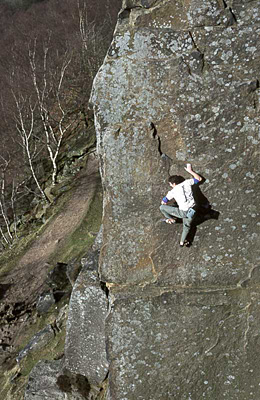
climber on Brown’s Eliminate
Note the absence of a rope in this picture. You either climb Brown’s Eliminate on a safety rope from above – which doesn’t count – or you Don’t Fall Off. The picture – © Carl Ryan, who was very gracious about granting permission to use it – isn’t by or of me or anybody I know.
The normal way of doing Brown’s Eliminate starts up a much easier route on the right, then moves out onto the face along the narrow ledge you can see just below the climber’s feet in the picture. I had already done it this way and found it straightforward. The direct start, which is considerably harder, comes straight up to the left end of the ledge; the hard bit is getting to the ledge, about 20 feet off the ground. The landing zone is flat but hard: hitting it from 20 feet isn’t life-threatening but is guaranteed to be unpleasant. As I was about to find out.
The kids these days use crash mats for this sort of thing, so I’m told. Twenty years ago we just used Moral Fibre. Ha!
According to the guidebook, the direct start should have been about at the limit of my abilities in ideal conditions. Conditions weren’t ideal – it was a hot, humid day in July, exactly the wrong weather for climbing gritstone where friction is everything – but I was young, arrogant & stupid and I thought I could pull it off anyway. Just below the ledge it all went horribly wrong. There was clearly no way I was going to reach the ledge in control. The climbing up to that point had already been tricky and I didn’t think I could get back down either. The right thing to do at this point would probably have been to jump off; I could have landed in control and probably got away with a bruised ankle or two. But jumping off was too scary. I knew if I could just reach the ledge, the rest was much easier. So I jumped for the ledge. Reached it with one hand, couldn’t hold it ... bang.
Five minutes with Excel and my faintly remembered school physics reveals that (assuming negligible air resistance) a body falling 20 feet hits the ground at 26mph.
Lots of bits hurt. I was still able to walk so I hitched home and took myself to Accident & Emergency at my local hospital. What they spotted at the time was a broken left wrist and some strained ligaments on the outside of my right knee.
To be continued …
yoga clothes
22nd June 2004 permanent link
Michael Blowhard in his usual refreshingly eyes-and-mind-open manner, writing about the aspects of culture other people really think about but think it’s beneath their dignity to write about, on yoga sociology. In particular, men in a minority, and “a big and underrecognized element here – there’s the whole yoga-clothes question.”
He doesn’t like lycra shorts. Sorry Michael, but lycra shorts (*) are, in fact, the only answer. The following comments apply to ashtanga vinyasa yoga, which is a vigorous physical practice involving a lot of movement and sweating:
Basic ground rule: cotton. Cotton is the only thing that is comfortable and unobtrusive worn next to the skin, especially when it’s sweaty. Synthetics are the right answer for running, cycling etc. but not for yoga. Fleece jackets are marginally ok for end-of-session relaxation, but wool blankets are better.
From the skin out: underwear. Reasonably supportive briefs are essential to prevent excessive flop, not to mention more severe hazards during some legs-crossed twisting manoeuvres. Boxers have no anti-flop properties and too much loose fabric that can get in the way. Shorts? The requirements are: complete freedom of movement, but also no swathes of loose baggy fabric getting in the way. Those baggy short shorts with built-in briefs are sort of ok on the freedom of movement / no excess fabric criteria, but offer completely inadequate protection against flop and unsightliness. Can you spell l-y-c-r-a? Sourcing your lycra is problematic, though – see below. Shirts? I hate practicing with a shirt on and avoid it whenever possible. If I’m forced to, e.g. by class rules, I find a fairly loose fitting, low cut cotton vest (tank top) is the only viable solution.
Some Indian practitioners favour Calvin Klein boxer briefs as a single-garment solution. I find these don’t offer enough flop resistance, and even in the privacy of my own spare room I feel too naked practicing in my underwear – even if in fact it covers about as much of me as a pair of shorts.
There are quite a lot of manoeuvres in ashtanga yoga that involve knees resting on the upper arms and/or arms wrapped around legs. These require a very high degree of core body strength and control – referred to in ashtanga circles as bandas – to keep everthing in place. In the absence of sufficient banda control (er, so I’m told) a spot of friction can help. Wet, sweaty knees pressed into wet, sweaty armpits do not have the desired frictional properties, so a teeshirt with sleeves or below-the-knee leggings can help. But in general teeshirts with sleeves are far too hot, clammy and uncomfortable, and leggings get in the way for certain other things. This is a difficult one, if only because the obvious and correct answer is “develop banda control so you don’t need the friction” which is much harder work than buying leggings.
Sources of lycra shorts for men? Difficult. I know a designer who produces her own line of Designer Yoga Clothing. All the Yoga Chicks I know wear it, and it’s great. I’ve been trying for years to persuade her to produce a line for men, but have so far failed to convince her that I am a viable market. Probably the nearest sport in terms of clothing requirements, with a majority of male participants, is rock climbing; so rock climbing gear can be a good bet. Prana make a good line of sports clothing that they aim at both yogis and climbers; difficult to find in Europe but possibly easier in the States. (I’m not linking to their flash-infested website though) Even climbing stuff tends to be a bit too baggy and made from too heavy fabric, though. So in the end I’m usually reduced to furtively buying extra-large women’s aerobics shorts. I don’t care if they’re not the height of style or elegance: they are the only things that actually do the job.
(*) Matte black cotton, not shiny synthetics. Other cotton colours are also acceptable - I had some rather fine brick red ones, made from a cut-off pair of climbing leggings, until I left them in a hotel room in New Orleans.
cursed
21st June 2004 permanent link
I have never intended this weblog to be a yoga practice diary, for various reasons not least among which is that it might reveal how embarrassingly little I actually practice these days. (If you want to read somebody who does, sporadically, maintain an interesting online practice diary check out Days in John’s Lives)
Right now, though, I feel the urge to moan publicly about how unfair it is that I seem to be cursed never to have any consistent spells of good practice. I’ve managed to spend the first half of this year clawing my way back to something like a (for me) respectable level of physical practice after several months of new baby and almost no practice last year. I already moaned about how hard I found the workshop I attended last weekend; for various reasons but two of the main ones were directly related my son’s sinus infection. This caused me to commute two hundred miles a day to class; I also caught it, which made it vary hard for me to breathe after I got there. Nevertheless, the workshop was still a rewarding and inspiring experience, and it came at the end of a few weeks’ steadily building practice intensity that felt like I might actually be seeing major progress on several physical aspects of my practice.
So I was looking forward to carrying on practicing last week with some of the energy and motivation I derived from the workshop, but at home in a less frenetic and intense setting. Not to be: the sinus infection took all week to go away, and since I couldn’t breathe properly I only managed a couple of very short practices.
At the weekend, though, I managed two long practices. They were great. Several important things were suddenly better than they have ever been: in particular, anything involving half lotus position with the right leg has always been a struggle for me because of an old knee injury (long story, to be told here one day, perhaps). For the last couple of years, since just before I went to Mysore, I’ve been able to do them but they’ve always been a struggle and always felt like they needed extra care and attention. This weekend, suddenly, they just felt like a normal part of my practice the same as everything else. Wow.
So, carried away with enthusiasm, I proceeded to strain my neck lifting up into urdhva mukha paschimottanasana. Hmm. For me, getting from here to here is one of those things that when it happens, happens easily. By means that I can’t analyse or, unfortunately, repeat at will. Other times, it goes with a certain amount of bending of the legs or letting go of the feet, both of which are not strictly speaking correct. If you actually try to make it happen … well, do it sufficiently wrong and you can strain your neck. Bugger. Please don’t try this at home if you haven’t learned it from a qualified yoga teacher. Thanks.
It wasn’t a *bad* neck strain, but that sort of thing can really linger for weeks and I was worried about it putting another major crimp in my practice just when things seemed to be going well. (Which, of course, wouldn’t matter in the slightest in the grand scheme of things. But.) Prodding to see exactly where it hurt, combined with hasty consultation of David Coulter’s excellent Anatomy of Hatha Yoga, suggested the levator scapulae as the injured bit – not good if correct, because it’s mostly underneath the trapezius and not easy to get at. Slathered the area with ayurvedic pain-relieving oil anyway, asked Maria to massage it, had a hot bath; and went to bed still half expecting to wake up in the morning with my neck and upper back completely seized. But no. I can tell I did something but it seems to be nowhere near as bad as I expected/feared. Will still go easy with it for a day or two until I’m sure it’s alright; but for the moment (touch wood) it looks like either it was nothing, or my emergency oil-massage-hot bath regimen actually worked.
Once again, looking for yoga asana photos to illustrate this item I came to the conclusion that the web really needs better yoga asana photos. Coming soon: thoughts on yoga photography.
yogic brain waves
17th June 2004 permanent link
Enhanced flexibility, strength, and endurance should not be yoga’s goal.
The “goal” is learning how to simply pay attention to “What Is ...”
Says Sam Dworkis, on a website that also contains the fascinating information that the brainwaves of advanced yoga students doing physical asana practice have the same “alpha wave” pattern as people doing sitting meditation, quite different from the pattern of people doing other physical activities.
Link courtesy of Michael Smith.
politics, art and yoga
16th June 2004 permanent link
Polibloggers vastly outnumber artbloggers because people are less interested in politics, not more. Art is just too damn personal. What you like goes to the core of who you are.
Which might also say something about why I tend to write more about music than photography, and more about photography than yoga.
Update: this is also what I like about Alice Bachini’s writing. You might not agree with what she says all the time, but you can’t deny that here is somebody really making a serious, honest attempt to work out what they believe about the things they care most about, in public, on a daily basis. I’m glad she’s back.
reflections on ahimsa
15th June 2004 permanent link
The first point of the first of the eight “limbs” of classical yoga is ahimsa, which can be translated as non-harming. Ahimsa has many aspects and implications. One is, as I mentioned to Michael Smith last week, that most serious yoga students take it to imply vegetarianism. Another important one is that non-harming starts at home: one shouldn’t beat the crap out of oneself in pursuit of a more “advanced” yoga practice. Last Saturday afternoon I was seriously asking myself if I was doing just that.
As I mentioned previously, I was attending a weekend yoga course taught by Andrew Eppler in Erlangen. Erlangen is about a hundred miles from where I live, and my son wasn’t well so I didn’t want to spend the whole weekend away. I skipped the Friday night session and did the 200 mile commute for the Saturday and Sunday classes.
I found the workshop very tough for various reasons, none of which have anything to do with Andrew’s teaching. Taught classes are always hard because you’re practicing at somebody else’s pace and rhythm rather than your own(*). Workshops are hard because inevitably to some degree, whether consciously or not, you’re trying to practice at your absolute best in order to look good in front of a new teacher and other students who you don’t know. I hardly ever have the chance to practice uninterrupted for two hours or more at a time at home these days, so I’m not used to it. And I was having breathing difficulties – a sinus infection that I picked up from my son, I think, rather than hayfever – that didn’t help at all in the normal practice sessions and made the pranayama class on Saturday afternoon almost impossible. And getting up at 5 in the morning, after a night of intermittent sleep with a sick child, to drive 100 miles to class presumably wasn’t helping either. I don’t think would choose to put myself through that last bit again although – I want to make this completely clear – I would jump at the chance to study with Andrew again in less trying circumstances.
That’s enough moaning about my largely self-inflicted personal struggles and sufferings. Was it worth it? Yes. Apart from those the workshop was very good. Andrew is a really nice guy and an inspiring teacher who clearly has immense depth of experience and commitment in his own practice. The group was pleasantly small – about 15 students – but still managed to include me from Munich and two guys from Hamburg, which is about as far apart as you can get with major German cities. A friendly bunch of people, and all appeared to be serious and committed yoga students.
It was great to see the organisers of the workshop, Arjuna and Melanie of yogachola.de, on their home ground – I’ve only ever met them before when they’ve travelled to yoga classes in Munich – and to hear about their travels and adventures (they’re just back from studying with Pattabhi Jois in India).
I didn’t take any pictures, for reasons I will explain another time.
(*) There are two normal types of class in ashtanga vinyasa yoga. The one that is recommended for normal practice is “Mysore style”, where the students go through the standard practice series at their own pace, and the teacher(s) keep an eye on what’s going on and help individual students as and when needed. Practicing this way ensures that students learn the practice properly and therefore also learn to go away and practice on their own. It also means that students can go at the pace that is appropriate for them and only as far as they are able, rather than struggling to keep up with a "one size fits all" class. The other approach, “led classes”, are more like what a begnner would normally expect from a yoga class – the teacher says what is to be done and everybody does everything at the same time. Pattabhi Jois used to teach all “Mysore style” at his school in Mysore, hence the name. When I was there he said he was planning to start doing one led class a week because he had noticed a tendency for students to get sloppy about pacing if they are allowed to do their own thing all the time. I hear he’s actually now doing led classes two days a week. Led classes also have obvious advantages for workshops, where the teachers don’t know the students and have teaching points they want to convey to everybody at the same time. I generally don’t like them because I find practicing at somebody else’s pace more harder and less congenial than practicing at my own – but precisely for that reason I think it’s quite a good mental discipline to do them once in a while.
Update: ahimsa could also be interpreted to include not saying scathing things about online music shops, no matter how much their allegedly vast music selection miraculously fails to include almost everything one looks for. I never claimed to be perfect.
small world yoga
8th June 2004 permanent link
In unrelated yoga news: this weekend I’m going to a yoga workshop. It’s in Erlangen, which is about a hundred miles away, so I’m going to have to either skip the Friday evening session or spend a night away from my family for the first time since Jack was born. (Agenda for this evening: discuss weekend logistics with family). I feel vaguely guilty about (literally) leaving Maria holding the baby for a weekend while I go and have fun, but I’m reasonably sure this won’t keep me from being fully focused most of the time in class. I can ease my conscience by telling myself I would do the same if Maria wanted to do something for a weekend somewhere, secure in the knowledge that (a) yes I really would but (b) as Jack’s mum, she’s probably far less likely to contemplate doing something that involves spending a night away than I am as his dad.
This event is brought to me by Small World Yoga: I’ve never met the teacher but he’s a friend of my former Mysore rommate.
Update: Maria points out that I overlooked the weekend I visited my brother in England, and says she’s booking a week’s holiday. Oops. Suggesting that visiting my brother can’t possibly count as “away from family” turned out not to be a good idea. As it happens I can’t get away early enough to make it to the Friday night session anyway.
prana journal
8th June 2004 permanent link
Michael Smith has a newish weblog, Prana Journal. He was kind enough to say nice things about me(*); now I’ve had time to read some of his stuff I can return the complement. He is making a serious, honest and open-minded attempt to document his encounter with yoga as it goes through the “hey, this stuff really is something more than a way to keep fit and look at babes” phase, and I will be following his adventures with interest.
I think I may have rather different ideas than Michael about how complementary weblogging and serious yoga practice really are, or can be. But that’s another of the perpetually unfinished items in my Drafts folder, sub-folder “Too Hard”.
Michael is thinking about a buying a new yoga book that I also have on my shopping list: Elizabeth Kadetsky’s First There Is a Mountain: A Yoga Romance. Links courtesy of Michael: excerpt from a different book, describing her experiences studying at the Iyengar Institute in Pune; article by her on Killing the Buddha about just how tenuous the evidence is for a continuous tradition linking modern yoga practices to classical and mediaeval traditions, but also how little that really matters; interview by her publisher and another one for MetroActive. While we’re about it, here’s her website and here are a couple of discussions of her book on my internet yoga home-from-home, ezboard.
Ms Kadetsky’s writing style is rather generic American journalese for my tastes, but I have the feeling her attitude is one I might be able to relate to. She’s appreciative of the real effects and benefits of yoga, hard-nosed sceptical about the actual history and origins of the way it’s currently taught.
(*) And to alter his original description of me “blogging from the louts position”, which I sincerely hope was a typo all along. If it wasn’t, watch those apostrophes Michael ;-)
yoga with jack
14th May 2004 permanent link
For the first few months of my life as a father I had very little time and energy for yoga practice: a senior yoga teacher warned me when I was an expectant dad that children are great for teaching you to let go of any ego attachment you might have to physical “achievement” in your yoga practice. For the last couple of months I’ve been trying to get back to practicing on a regular basis– but when I get home from work and want to do my practice, Maria has already been looking after the baby all day and needs a break. So, yoga as childcare.
In ashtanga vinyasa yoga, the style I (attempt to) practice, a practice session is supposed to be one continuous meditative flow. Mine is a series of three to four minute meditative flows with pauses in between to play peekaboo, catch the ball etc. (Hey, interval training!). Anything that involves raising the arms overhead becomes a “lift the baby” game. Strengthens the shoulders. Certain things, like attempting handstands, are completely out of the question because of the risk of falling on the baby. Headstand still works ok despite the fact that, when Jack was crawling, he would come and put his fingers in my nose and pull. Babies have sharp fingernails. Now that his practice has advanced to include standing and walking, he just goes round behind and pushes. This is much better because it doesn’t hurt and he’s not strong enough push me over. Yet. Backbends are ok, you just have to come down carefully in case anyone has crawled underneath without you noticing. A ten kilo baby is not heavy enough to have much effect on my stiff right hip (old climbing injury) when used as a weight on the knee in baddha konasana.
There is a certain breed of purist/puritan yoga practitioner who disapproves of this sort of thing. I remember a course where the teacher’s six year old son, and a friend of mine’s nine year old, would come and play in the practice room while classes were going on – mostly imitating what the yoga students were doing and/or laughing at them. I thought this was great; some people really disliked it. To such people I say: babies and small children are part of life and a lot more important than whether you can get your toe up your ass, get used to it.
Last night Jack fell asleep on my lap while I was sitting in bharadvajasana, a position in which you sit with one leg folded back and the other in half lotus position. You’re then supposed to twist round, grab the lotus foot from the back with one hand and put the other under the knee. This is tricky when you have an inert baby slumped over the leg that is in lotus. As is getting out of the position without waking the baby up in order to carry him to bed.
The Bharadvajasana picture isn’t of me – I don’t have that many tattoos (in fact I don’t have any) and rarely paint my fingernails blue. The blue fingernail guy with the tattoos is, however, doing the best bharadvajasana I was able to find a picture of on the web. (The heel could perhaps be in a little more towards the navel). In general, I discovered while searching for illustrations for these comments that the web is full of really bad pictures of yoga asanas. Hmm. It might not be the world’s most pressing problem, but it’s one that I could conceivably do something about …
music, meditation and 4'33"
5th May 2004 permanent link
I remember when I was growing up people I knew who were serious about music regarded John Cage’s 4’33” – four minutes and thirty three seconds of silence – as the ultimate expression of absurd modern music, on a par with the Tate Gallery’s pile of bricks as the definitive silly work of non-art. I hadn’t really thought about it for years, until recently I was surprised to find Peter Gutmann saying I’m occasionally asked, “So, what’s your favorite piece of music?” I instinctively cringe at such an impossible question, yet if really pressed for an answer my choice would be John Cage’s 4’33”.
I generally respect Peter Gutmann’s musical opinions – his excellent biographical article on Wilhelm Furtwängler, for example, introduced my to Furtwängler’s marvellous 1944 recording of Bruckner’s 9th Symphony. His essay on historical recordings, and what they tell us about what’s wrong with late twentieth century classical music, is fascinating too. So if I know he’s no fool, and he takes 4’33” seriously, perhaps there’s more to it than meets the, er, ear:
Although often described as a silent piece, 4’33” isn’t soundless at all. While the performer is quiet, you soon become aware of a huge amount of sound, ranging from the mundane to the profound, from the expected to the surprising, from the intimate to the cosmic – nervous giggling, shifting in seats, breathing, air conditioning, a creaking door, passing traffic, an airplane, ringing in your ears, a recaptured memory. Concerts and records standardize our responses, but no two people will ever hear 4’33” the same way. This is deeply personal art, which each witness shapes to his or her own reactions to life
This reminds me of a thought, and a conversation I had with my brother, a few years ago when at around the same time I was just starting to practice yoga and to really listen to classical music, to the effect that really listening to music – especially intense, introspective chamber music – is actually quite an advanced form of meditation.
One of the clever things about yoga is that, by apparently giving you a lot of things you’re supposed to think about – where am I trying to put my arm? My leg hurts. Look up, not at her. Don’t forget to breathe. Heels down. If I could just get my knee a bit more to the side. Breathe … it actually ensures that you think about nothing else. It’s difficult to worry about office politics and at the same time be aware of what your diaphragm and your pelvic floor are doing.
Or, as one of my first yoga teachers put it much more simply: “there’s nothing like a bit of discomfort for bringing the mind into the present moment”.
All this, if you can really focus your mind on what you’re doing in your practice to the exclusion of everything else, starts to take you towards the fifth and sixth of the eight stages of meditation in classical yoga as described in Patanajali’s Yoga Sutras: pratyahara, withdrawal of the mind/senses/attention from extraneous sensations and dharana, the ability to focus concentration on one thing. It’s all about learning voluntary control of the focus of the mind, as opposed to the normal state of being constantly distracted by thoughts, images, fears, worries, desires – the thin stream of semi-random noise that we call the consciousness and commonly regard as “ourself”. Patanjali’s classical sanskrit definition of yoga – yogas citta vrtti nirodaha – is commonly translated into English as yoga is the cessation of the fluctuations of the mind. Which is clumsy and ugly but sort of conveys the idea. If you are struggling to reach your toes and your mind is truly focused on what you are doing, you are doing yoga. If you have been sitting absolutely motionless in lotus for two hours thinking about how angry you are with your boyfriend, what you intend to cook for dinner, how cool you look sitting in lotus for two hours, or what you could write in your weblog about what an advanced understanding of yoga and meditation you have, you are not doing yoga.
Back to music: clearly getting one’s body into difficult and strenuous positions is not the only way to learn to focus the mind – it’s just one way that yogis have discovered over the centuries is accessible and effective for some people. Another one, that I personally find harder and rarely have time for, is to really, intently listen to music and lose yourself in it 100%. Most cultures throughout history have found that the most effective way to do that is by combining music with dance – as dance therapist Gabrielle Roth says, “the best way to still the mind is to move the body”. Doing it with music alone, without dancing, is much harder. Take away the music too and you might as well just go to a Zen class and be done with it.
So I still think 4’33” is pretty silly. Or, to put it another way, I sit in silence for at least five minutes at the end of my yoga practice most days anyway, so I don’t see it as anything special. I think it’s a good thing to do but I wouldn’t choose to go to a concert hall to do it. I suppose there is some possibility that a “performance” of 4’33” might introduce some people to just sitting, listening to what is happening around them and in their head, who might otherwise never consider trying anything described as “yoga” or “meditation”.
more yoga teaching
21st April 2004 permanent link
Some thoughts – prompted by my friend Bettina’s graduation from one of the most rigorous yoga teaching programmes in the world – on how yoga teachers are trained.
Here’s how it works in ashtanga vinyasa yoga, the style I practice and am most familiar with.
Teaching qualifications are only issued by the head of the school, Sri K. Pattabhi Jois, to students who personally attend his school in Mysore, India. There are three levels of qualification.
- Students (e.g. me) who have attended the school at least once and completed the basic “primary” practice series to Pattabhi Jois’s satisfaction, are ok’d to teach the first half of the primary series to beginners, but not to bill themselves as qualified teachers.
- Students (e.g. my friend Bettina) who have attended the school several times and completed most of the “Intermediate” (pretty damn tough) practice series can request Pattabhi Jois’s authorisation to teach. Note the presence of words like “several”, “most” and “request” in that last sentence. There is no formal entitlement to a teaching qualification if you attend X hours of classes or can get into positions Y and Z – it’s more a matter of convincing Pattabhi Jois that you are competent, dedicated and serious about your yoga. About 80 people worldwide have this qualification – the semi-official list (everybody who is on it is qualified, but not absolutely everybody who is qualified is on it) is at ashtanga.com. These people are referred to as Authorised teachers.
- The most senior Certified teachers generally have to have studied with Pattabhi Jois for ten years or more and to have completed the first of several (hair-raisingly) Advanced practice series. There are just over 30 Certified teachers worldwide. (The certification is actually a something like doctoral-level degree officially recognised by the Indian government, but that’s just a curiosity. The Indian government has no more authority or competence to make pronouncements on yoga matters than any other)
I believe this teacher training system is excellent. Why? Because it works when judged by its results. Pattabhi Jois has been practicing and teaching yoga longer than almost anybody else alive, and he knows what he’s doing. I mentioned previously that I know about a third of the hundred-and-some Authorised and Certified teachers – have attended their classes and/or studied alongside them in Mysore. In my experience they are generally very dedicated yoga practitioners, capable teachers and good folks.
Some people object to the system for various reasons. One is that it absolutely requires attendance in Mysore for substantial periods and so is too much commitment in time and/or money for some people. My view on that is: tough. I wouldn’t want to be taught yoga by somebody who wasn’t dedicated and serious; willingness to go to India for several spells of several months and pay substantial tuition fees is one pretty good way of demonstrating dedication and seriousness. It’s not the only way, of course, and people who are serious about their yoga but can’t, because of family commitments or whatever, drop everything and go to India can pursue yoga teaching qualifications in other schools, some of which are also good.
In any case, acceptance of the reality of where you are is a yogic virtue: I have a small child now, and I started practicing ashtanga yoga when Pattabhi Jois was already in his eighties, so it’s very unlikely that I’ll ever be able to spend as much time studying with him as people who started twenty or thirty years ago. But that’s my karma and there’s no point wailing or gnashing my teeth about it – I just get on and do my practice anyway (currently, as much as my eleven month old son allows).
Another, superficially more serious objection is that Pattabhi Jois’s “curriculum” simply consists of aspiring teachers convincing him that they are serious about, and have attained some level of proficiency in, their own yoga practice. There is nothing in it about teaching skills or techniques as such; no anatomy training; no formal classes in yoga philosophy. In reply to which I would just reiterate: it works. All the graduates of Pattabhi Jois’s non-system that I have taken classes with have been capable, safe and inspiring teachers.
Some of Pattabhi Jois’s senior western students do offer more formal teacher training classes including study of anatomy and theory and teaching assistantships at their own schools. I’m sure this is helpful and people learn a lot from it. But they all also emphasise that the real training is from doing, observing and learning from one’s own practice, and the qualification that counts is Pattabhi Jois’s say-so. Some of the people I’ve studied with have had this kind of apprenticeship, some haven’t. The ones that haven’t are mostly the more experienced ones who started studying with Pattabhi Jois in India years ago and didn’t have anybody to help them when they went home. I haven’t noticed that any of them are any the worse for that.
The “system” has other peculiarities. One is that some of the most experienced western teachers, who studied with Pattabhi Jois long before yoga was fashionable and starting to become commercialised, didn’t bother with any form of official authorisation or certification. I mention this partly as an excuse for a gratuitous picture of one of them, Danny Paradise, doing a demonstration at a course in England a few years ago:
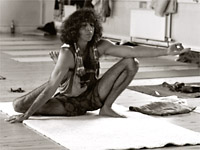
Danny is resented by some latter-day purists because he never “served his time” in Mysore and (note the hairdo) because they regard him as a morally lax aging hippy who doesn’t take the whole thing seriously enough. Ha. I found him an inspiring teacher and a thoroughly nice guy, his demonstration was the most impressive I have ever seen by a westerner, and the clincher: Pattabhi Jois speaks fondly of him. A few years ago when I started a lot of these hippy-era “dinosaurs” didn’t appear on the quasi-official teachers’ list. Most but not all of them now do.
There are other good teachers who also don’t have formal qualifications from Mysore. One of my first teachers was a student of one of Pattahi Jois’s Certified teachers in England, but hadn’t been to Mysore himself. A lot of people who are visiting Mysore regularly also start teaching before they have formal authorisation. If you’re going to do this stuff seriously you pretty much have to be doing it full time, and how are you supposed to support yourself through several years of full time yoga study, including regular long trips to India, if not by teaching? So fair enough. Bettina was one of these people up until a couple of weeks ago, and I suspect she probably hasn’t suddenly, magically become an even better teacher just because she now has a piece of paper. When I was in Mysore I never noticed newly authorised teachers being taken off into a corner to be told The Secret.
That’s just the process as it works in one particular school of yoga – the one that I personally have practiced for several years and am therefore qualified to talk about (and, indeed, teach at the most basic level). Other major Indian yoga schools do things somewhat differently but similar basic principles apply in many cases. Probably the largest and most organised is the school headed by BKS Iyengar in Pune, India. Mr. Iyengar also studied with Pattabhi Joi’s teacher Krishnamacharya in the 1930s before going on to found his own school. He was one of the first Indian yoga teachers to become famous in the west in the 1960s and now has a large network of associate schools worldwide. Iyengar yoga has an elaborate system of tiered teaching qualifications. The basic levels are done by training courses in the student’s home country and the minimum training time generally appears to be two years part time; for the more advanced levels the aspirant has to attend advanced teaching courses at Mr Iyengar’s institute in Pune, for which you have to be personally recommended by one or more existing senior teachers, and I’ve heard there is a waiting list of several years. (I prefer Pattabhi Jois’s style – he’ll let anybody who shows up into his classes, but you have to convince him you’re serious before he starts to take much notice of you)
That’s already more than long enough and I haven’t even begun to get on to some of the things I wanted to talk about like: how these current systems as adopted by some of the more traditionalist Indian yoga schools represent an adaptation of the traditional guru-lineage apprenticeship to a world where there is more interest in yoga than ever before; how they compare to more formal teacher training programmes that are springing up in the west; and who, if anybody, really benefits from expecting yoga teachers to have formal paper qualifications anyway. So Coming soon: Part Two.
more indian genetics
20th April 2004 permanent link
I’ve picked up pointers from gene expression for two newer papers on the genetic origins of Indian populations, following on from the one by Bamshad et al that I mentioned a few months ago.
The first one is The Genetic Heritage of the Earliest Settlers Persists Both in Indian Tribal and Caste Populations by T. Kivisild et al in the American Journal of Human Genetics 2003. The authors argue that the DNA of Indian populations – both caste and tribal – appears to go back to the first wave of human settlement from Africa in the Pleistocene era and that the genetic impact of subsequent immigration, if any, has been very limited.
The second paper, Independent Origins of Indian Caste and Tribal Paternal Lineages by Richard Cordaux et al (Current Biology, February 2004) supports Bamshad et al and points out that, although there are no genetic markers that are unique to either caste or tribal populations – suggesting that there has been a lot of mixing between the two groups – nevertheless the frequencies of a number of key markers are very different. When this is taken into account the male DNA of the caste population resembles central Asians far more than it resembles the assumed-to-be-indigenous tribal populations. This appears to be true both in north and south India.
We conclude that paternal lineages of Indian caste groups are primarily descended from Indo-European speakers who migrated from central Asia 3,500 years ago
I’m inclined to agree with this conclusion. But it is far too sweeping to make just based on the evidence presented in this paper, and depends on some major unexamined and questionable assumptions.
- Cordaux et al assume, for no stated reason whatsoever, that there is a connection between genetic lineage and language. “[P]aternal lineages of Indian caste groups are primarily descended from Indo-European speakers …”. “Haplogroup O-M95 … might be associated with the spread of Austro-Asiatic languages, which are exclusively spoken by tribal groups in India”. This, remember, in a paper that discusses how Indo-European-speaking north Indians and Dravidian-speaking south Indians are genetically almost indistinguishable; how both are closely related to mostly Turkic-speaking central Asians and not so closely related to Indo-European speaking Europeans. Hmm.
- In addition to the completely unexplained assumption about genetics and languages, they say nothing about where they get their “3,500 years ago”. There is a passing reference to the “relative homogeneity” of caste DNA being an argument for “recent” arrival, but no attempt to quantify this. I strongly suspect they are just echoing what they call “archaeological and linguistic evidence” (actually, as far as I have been able to tell, pretty much a purely linguistic hypothesis for which there’s no clear archaeological evidence one way or the other).
- Another question that occurs to me as a non-specialist is: does a genetic resemblance between Indian and central Asian populations necessarily tell us anything about the direction of migration? What are the reasons for thinking the shared genetic markers originated in central Asia not in India? Would the evidence also be consistent with a population that originated in northern India and moved outward in both directions, northwards into central Asia and southwards into southern India?
I’m not suggesting that anybody should be expected, in a five page paper, to examine every possible nuance and counter-argument for every assumption they make. But some mention of these rather large and obvious questions might not have been a bad idea. While I’m niggling, a couple of smaller niggles:
- They cite Cavalli-Sforza as an authority on “archaeological and linguistic evidence”. Cavalli-Sforza may be an important pioneer of genetic research, but I’m not aware that anybody would accuse him of being an authority on archaeology or linguistics.
- (and this is a really minor nitpick, but I can’t help it. I care about language and the blighting effect political correctness has on it). There is a very interesting discussion of several reasons why the maternal DNA of caste and tribal populations is much more alike than the paternal; one being that women are generally far more likely than men to marry upwards in social hierarchies. Good point, interesting. But then they say this is an alternative to “the proposal that the Indo-European migration was male mediated”. I presume this is some sort of bizarre PC-speak for “the proposal that the immigrants were mostly men”. So why not just say “the proposal that the immigrants were mostly men”?
Nevertheless, niggles aside, it’s becoming clear that the genetic evidence points to Indian caste populations – in the male line at any rate – having originated as migrants from central Asia, whereas tribal populations appear to be indigenous, quite possibly dating back to the first wave of “Out of Africa” migrations in the Palaeolithic. This would be consistent with the general view held by linguists that the Vedic speakers were immigrants to India. Note that I say “consistent with”, not “proves”: firstly because there is no provable direct correlation between genetics and language and secondly because I haven’t seen anything that seriously argues a date for the arrival of the immigrants based on the genetic evidence. For linguistic and archaeological reasons (chariots, mainly) I don’t believe the Vedic speakers can have arrived much before about 3500 years ago; Cordaux et al also give this date, but there’s nothing in their paper to say whether they base it on the genetic evidence or are just parroting the linguists’ standard geusstimate.
When I first wrote about this whole subject of trying to reconstruct ancient history in the face of sparse evidence and political agendas, I said “I find this both fascinating and rather depressing … wondering whether there’s any chance of anything other than rival tribes shouting ideology & speculation at each other.” Razib, in this excellent essay at gene expression, thinks genetics may be that chance and talks eloquently about how genetic studies have the potential to give us some sort of firm scientific basis for studying prehistory and the origins of present-day “peoples”, whereas until now we have had really quite limited scraps of linguistic and archaeological evidence used to back up all kinds of racist and nationalist fantasies.
In the past ten years genetics has begun to highlight very sharp divergences from national myths and even linguistic and historical analyses (the latter often influenced by and used by the mythicists)
…
First, there are the National Essentialists. These are people who are nationalists at the least, and racialists at the most. Historical questions are crucial to the identities of these people. They come in all sorts. From Native Americans that reject the Siberian origin of their peoples on the grounds of spiritual chauvinism to upper caste Indians who react with fury when told that they are genetically closer to their black-skinned Dalit neighbors than other “Aryans.” Genetics tends to throw the “Great Chain of Being” of these people out of kilter since they invest so much in the current state of knowledge, reverse engineering the facts to show their own heritage to be the most prestigious. If they hold that “group A” brought civilization to the world, and it turns out they are a member of “group B,” it takes great effort to reinterpret the facts so that group B are the jewels of God’s creation. Rather, instead of throwing out years of self-serving “scholarship,” this group will reject the genetic evidence as long as possible.
…
Second, there are the National Idealists. The statistical nature of genetics gives them the room to reject all assertions of the movement of genes and people. Though a given set of results is provisional and subject to revision, they tend to deny the results a priori (or evince a divine skepticism) because they prefer to think that culture, ideas, are the prime movers, not peoples.
…
Both groups are concerned with norms and re-creating idealized utopias. Their values might be different, one group worships the primacy of Blood and another idolizes the power of the Idea, but their enemy is the same, facts, reality, tightly constructed deductive models buttressed by empirical evidence, subject to provision, de-sacralized and reduced to the bare necessities that science demands , but no more. They stand united as romantics against the unfeeling march of science and scholarship. Without the aid of natural science the human sciences have traditionally been hijacked and used as tools in the furtherance of ideological crusades. But now that natural science has joined the fray (the scientists have the “back” of empirically oriented scholars and the reverse), the ideologues are terrified, their utopian visions always threatened by the encroachment of reality. The scholarship is strengthened and more difficult to dismiss when buttressed by genetics or skeletal morphology (augmented by computation).
…
there are people out there that live in terror of facts.
Read the whole thing, it’s excellent. However, as Razib also mentioned in an email, the time of the great genetic light-shedding has not yet come because we simply don’t know enough yet:
I suspect that we'll know what's going on in about 10-15 years after we have 100 studies on every given question. right now we have about 10 years of fine precision laboratory work (the PCR era), so there are “ground-breaking” and “revolutionary” results coming out because the sample is so small that the variance is all over the place (sampling error)
These three papers on India, coming out two-to-one in favour of major immigration from central Asia based on largely the same sample of a few hundred individuals, certainly backs up Razib’s view. Not only sampling error, but apparently competent and serious researchers coming to almost directly opposite conclusions by applying different statistical techniques to the same samples. Still, it does look as though the genetic evidence is starting to point in something like the same direction as the linguistic evidence.
Discussion ...
german yoga news
17th April 2004 permanent link
I am delighted to hear that my friend and yoga teacher, Bettina Anner, has just received formal authorisation to teach yoga from Pattabhi Jois.
Pattabhi Jois is one of the most experienced senior yoga masters in the world. I also studied with him a couple of years ago, and have previously written about his lineage and teaching style. Getting a personal seal of approval from one of the world’s most senior yoga masters is a big deal for an aspiring yoga teacher. A lot of people teach without it, and some of them are very dedicated yoga students and good teachers (Bettina was one of them, up to about a week ago). But to have his formal authorisation is the gold standard for ashtanga yoga teachers.
According to the quasi-official (but not quite 100% complete) teacher listing at ashtanga.com there are in total just over 100 yoga teachers in the world authorised by Pattabhi Jois. Looking at the list, I find to my surprise that I know – meaning, have taken classes with and/or practiced alongside in Pattabhi Jois’s classes in Mysore – about a third of them. Bettina is the only one in Germany (not the only German, but the other two I know of are expats).
This seems like a good time for another plug for Bettina’s workshops in Erlangen in May and Tuscany in July.
Coming soon: further thoughts on how yoga teachers are trained and certified, and why I would sooner trust a system based on the gut feel of a nearly 90 year old guy in India, than any kind of formal examination and certification scheme.
yoga workshop
28th February 2004 permanent link
I was sorting through some photos with a view to a weblog entry / photo gallery page on yoga photography, and I came cross this one that I took a couple of years ago of my teacher, Bettina Anner, in action.
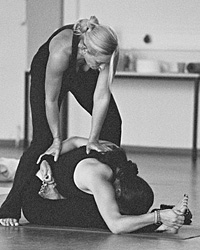
Bettina Anner
… which reminded me that I promised to link to the website for the classes she is teaching in Tuscany this summer, when she gets back from her current spell in India studying with Pattabhi Jois. It’s now up, ashtangayoga-toskana.de, or you can still email the organiser, Peter Kollbach, for details.
aloo chana masala
28th February 2004 permanent link
The slow morph into Alan’s Recipe Weblog continues with my own recipe for aloo chana masala, chickpea and potato curry. This makes no claim to be an authentic Indian recipe, but after over twenty years’ more-or-less informed experimentation, followed by two years of actually having had proper Indian cookery lessons, I think I’ve about got it right.
Ingredients
Serves two to four people, depending on how hungry they are
- 250g / 8oz cooked chickpeas (*)
- 4 large potatoes, peeled & chopped into about 1 inch chunks
- 4 large onions, finely chopped
- 4 tomatoes, finely chopped
- 4 large cloves garlic, chopped
- large piece ginger root (about 2 inches), peeled & chopped
- about 1 inch cinnamon stick, crumbled
- 2 tsps coriander seeds
- a pinch fenugreek seeds
- 1 tbsp cumin seed
- 1 heaped tsp turmeric powder
- 1 tsp sambar powder
- 3 large black cardamoms (elaichi)
- 1 tsp tamarind paste or half tsp mango powder
- 2 to 4 fresh green chillis to taste, coarsely chopped
- salt to taste
- large handful coriander leaves (“cilantro” in American, I think)
- sunflower oil (ghee would be more authentic but less healthy)
Partly boil the poatoes. (It’s good if they are firm-cooking ones that don’t go floury when boiled).
Blend the ginger, garlic, cinnamon, fenugreek seeds and coriander seeds to a paste. I add a little water and use an old electric coffee grinder. A mortar & pestle would both be more authentic and probably get a finer texture.
Heat the sunflower oil in a wok or saucepan. Add the cumin seeds and cook until they froth and sputter (this smells wonderful). Add the onions. Fry until soft. Add the garlic-ginger (etc.) paste and stir. Add the cardamoms, chillis, half the sambar powder, tamarind (or mango powder), salt and tomatoes. Stir and cook vigorously until the tomatoes are soft. Reduce the heat, add the potatoes and turmeric. Stir and simmer gently for about ten minutes. Add the chickpeas and simmer gently for about another five minutes. Add the rest of the sambar powder and half the coriander leaves, stir and simmer gently for about another five minutes. Garnish with the rest of the coriander leaves.
Serve with rice and/or chapatis and cucumber-yoghurt raitha (just finely chopped cucumber with yoghurt).
I know this weblog has the occasional Indian reader, because I’ve heard from a couple of you (Ramakrishna, sorry, I lost your email address when my laptop went sick). If anybody feels like sending me their grandmother’s absolutely authentic and wonderful recipe for aloo chana masala (or for anything else, for that matter) I will be eternally grateful.
(*) Cooking dried chickpeas is a pain. It’s almost impossible to get them tender, even if you soak them for twelve hours or more and pressure cook them. These days I mostly use tinned. 8oz is one medium sized tin.
indian arts – yoga teaching
22nd February 2004 permanent link
This article in my Indian traditional arts series focuses on yoga teaching as an example of how Indian culture reveres tradition and likes to suggest things are based on ancient teachings, even if aspects of them may not actually be as ancient as they seem.
The literature on meditation and yoga philosophy definitely goes back at least 2,500 to 3,000 years – the exact dates of the Yoga Sutras of Patanjali and the Upanishads are unknown, but they are generally believed to be roughly contemporary with or (the Upanishads) earlier than the Buddha, who is believed to have lived circa 600 to 500 BC. The buddhist scriptures also make it clear that advanced meditation techniques were already understood and practiced in India at that time. There may be traces of much older evidence – there is a carving that some people believe depicts the god Shiva sitting in lotus position from the city of Harappa circa 2500 BC. Texts that recognisably describe the outward physical practices of yoga as it is generally understood today – postures and breathing exercises – are much later. The best known of them, the Hatha Yoga Pradipika, dates from the 15th century AD. What I am going to discuss here is just how old the particular style of yoga I study might actually be.
The yoga teacher I studied with in India, Sri K. Pattabhi Jois, is practically a living tradition in his own right. He has been studying yoga for 75 years and teaching for over 60, having opened his own yoga school in 1942. His teacher, Sri T. Krishnamacharya, was probably the most influential yoga teacher of modern times – at least three major yoga styles that are widely practiced throughout the world today are his direct lineage.
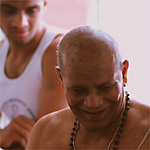
Pattabhi Jois
The “official” story goes that the form of yoga that Pattabhi Jois teaches was rediscovered by Krishnamacharya in an ancient manuscript written on palm leaves, the Yoga Korunta. The manuscript was subsequently destroyed (eaten by ants) and only Krishnamacharya’s notes remain. Now, it isn’t inherently implausible that such a document could have existed. Apparently lots of old Indian manuscripts are on dried palm leaves, and there are many uncatalogued private collections of them housed in very poor conditions, deteriorating and being lost all the time. (Hopefully India will become a rich country in time for some serious efforts to save this part of its heritage). See the following message board posting from a student of Pattabhi Jois who has clearly spent more time in libraries in India than I have:
So many yoga students on this board are quick to celebrate Sri T. Krisnamacaryas' accomplishments and references while dismissing and criticizing those of Sri. K. Pattabhi Jois. Those of you who fall into the above category have probably never visited a library in India and seen the deplorable conditions where stacks of palm leaf texts crumble upon touch, already laced with holes from hungry insects. You probably don't know that 100s upon 100s of precious palm leaf texts lie in disrepair and will never be translated into English let alone transcribed for modern day preservation in their original languages. Actually many poor and desperate Brahmin families burn these texts for cooking fuel as they no longer understand their inherent worth. Knowledgable pandits of the caliber of Sri T. Krisnamacarya and Sri K. Pattabhi Jois are ever rarer. The education system that taught these men to memorize for a lifetime thousands of slokas through repetition, no longer exists. The forefathers and community temples that taught them 100s of pujas with particulars of offerings, homas and mantras are also becoming extinct in an enthusiasm to leave off traditions in favor of "modern" pursuits.
Those of you that feel you are in a postion to reproach Guruji (LOL) and his reference to the Yoga Korunta probably don't know the following: Sri T. Krisnamacarya cites Yoga Korunta as a reference in two of his books, Yogasana and Yoga Makaranda. The Mysore Maharaja's library, that published these two books of Krisnamacaryas, lists Yoga Korunta among its vast collection.
Another yoga student whose opinions I respect very highly takes a different view:
Warning: the following remarks are likely to offend some Ashtanga devotees.
It's fairly clear to me that there never was a manuscript that laid out the Ashtanga system. If there was a Yoga Korunta (which I tend to doubt) then it didn't set forth the system of postures in any form close to the way they have been practiced. Essentially, Krishnamacharya (K) made up the sytem himself. Here's why:
- Early treatises on classical yoga deal very little with asana. The use of asana beyond a few seated postures appears to have been a development of the Tantric movement, which took hold in India from about 500 AD – well after any likely date of Patanjali. The earliest texts dealing with asanas beyond seated postures date from the 1100-1300's AD. The use of large numbers of postures seems to date from the 1700's and later, when folks became interested in the therapeutic aspects of asanas. Therefore an extensive asana system such as that of Ashtanga is not likely to date from Patanjali's time.
- The elements of the current Ashtanga system can be found, in disparate form, in manuscripts available to K when he was teaching at the Mysore palace earlier in the twentieth century. The author of "The Yoga Tradition of the Mysore Palace" investigates some of these documents: one, dating from the 1800's, has an extensive list of asanas with a nomenclature similar to that of the K schools (Iyengar, Vinoyoga, Jois). Also, there is a gymnastics text, again dating from the 1800's, that illustrates several excercises performed by Indian wrestlers. These resemble the vinyasa of the Ashtanga system. It is plausible, therefore, that K could have derived the Ashtanga by hybridizing yoga and gymnastics practices from texts that were available to him.
- The Yoga Korunta is not the only no-longer-extant manuscript from which K claimed to have derived a system of yoga. In "Health, Healing and Beyond", K's biography written by his son TKV Desikachar, K tells how he was once visiting a temple near the birthplace of Nathamuni, a ninth century sage and reputed ancestor of K. During this visit, K says he went into a trance and had a portion of the the Yoga Rahasya (a now-lost text ascribed to Nathamuni) dictated to him. The "dictated" portion includes many of the element so the viniyoga school, including yoga for health, yoga for pregnant women (no early yoga text envisages women practitioners), etc. The Yoga Korunta alone is a bit much to take – TWO systems of yoga based on two separate "discoveries" of lost texts is simply not credible.
K was a very creative yogi who was working from a cultural situation in which you don't take credit for your own discoveries but instead try to ascribe them to a teacher or a tradition, so I think humility was his motive for inventing these two texts (or at least inventing the content of these texts). I don't hold any grudge against K for doing this, but respect for K, Jois, and the Ashtanga system should not cause us to jettison our critical faculties.
On the subject of this second (alleged) source text, the Yoga Rahasya, here is a quote from another Indian yoga teacher, Srivatsa Ramaswami, who studied with Krishnamacharya for many years:
During the early years, Sri Krisnamacarya used to quote often from the Yoga Rahasya of Nathamuni, many of which quotes I noted down. For instance, he quoted the following passage to emphasize the importance of finding means for contraception and family planning (mita santana). This sloka, Pasasanam yoganidra garbhapindanca bhadrakam | Matsyendrasanakhyete, sarva garbha nirodhakah, mentions the asanas (noose posture, yogic reclining posture, fetus posture, auspicious posture, kingfish posture) that prevent conception. But when I aked him where the text was available, he said with a chuckle that it used to be available at Sarabhoji Maharaja of Tanjore and that he had seen the text, which was written on palm leaves and kept in an ivory box. He even suggested that I write to the Sarasvati Mahal library in Tanjore and ask for a copy. I did write to them, and received a reply that no such text existed. I subsequently learned from a Vaisnavite friend that Nathamuni had intended to transmit the knowledge of Yoga, the Yoga Rahasya (Secret of Yoga), to his grandson, but he passed away before he could do so. I sort of figured out that Yoga Rahasya was the work of my own guru, inspired by the upasana (devotion) to Nathamuni. The work contained several of the instructions Sri Krisnamacarya used to give while teaching yoga. But there were variations in the same slokas, when he quoted them on different occasions, which is further evidence that Yoga Rahasya may have been the masterpiece of my own guru, inspired by tradition and devotion.
I personally don’t really believe in the Yoga Korunta, although I also wouldn’t fall over in amazement if somebody did conclusively prove its existence. There is a book, The Yoga Tradition of the Mysore Palace, that describes a (different) text the author found in the Mysore Palace archives, describing a nineteenth century synthesis of native yoga and martial arts traditions with British gymnastic training. The author, Norman Sjoman, believes that something like this – possibly even this actual text – was an important influence on Krishnamacharya’s teaching.
Attitudes to this question vary widely among yoga teachers; even among senior Indian yoga teachers who are direct students of Krishnamacharya, of whom I have studied with two and read books by three more. Of these:
- Pattabhi Jois says he teaches exactly what Krishnamacharya taught him, and that K derived this from the Yoga Korunta - which he (Jois) never saw. Generally denies that the system he teaches is evolving in any way, although what senior western teachers say he taught them 20 or more years ago definitely is slightly different from what he teaches now.
- BNS Iyengar also says he teaches exactly what Krishnamacharya taught him, which is slightly different from what Pattabhi Jois teaches. Reputedly has Krishnamacharya's notes on the Yoga Korunta.
- BKS Iyengar (the more famous Iyengar) teaches a system of yoga he developed himself after studying with Krishnamacharya for a few years in the 1930s. I am not aware that he mentions anything anywhere in his books about the origins of Krishmacharya's teachings, but quite clearly claims his own system as something he developed himself, within the framework of established yoga traditions.
- TKV Desikachar , Krishnamacharya’s son, is the author of an excellent yoga textbook, The Heart of Yoga . Here he states that there is no known manuscript of the Yoga Rahasya, but that the sections quoted quoted by his father are an authentic oral tradition and not Krishnamacharya’s own composition. This is perfectly possible: word perfect memorisation and recitation of holy texts was an important part of traditional Brahmin/Vedic education. The tradition is dying out these days, but Krishnamacharya was an acknowledged master of it. Desikachar also quotes a manuscript that Krishnamacharya definitely wrote himself, the Yoganjalisaram, a series of slokas or verses intended to remind the student of key aspects of his teachings in a manner similar to the yoga ur-text, the Yoga Sutras of Patanjali.
Desikachar has also written a biography of his father, Health, Healing and Beyond, which I haven’t read but probably should. - Srivatsa Ramaswami, quoted above, is less known in the west than the previous four, and in his book presents an approach that is more closely integrated with traditional Vedic education and religious practices. Still, he clearly says that he believes Krishnamacharya himself to be the author of one of his claimed “source texts”
If what Krishnamacharya was actually doing was putting together his own synthesis, based on classical sources combined with his own vast knowledge and experience, then why not say so? Why feel the need to invent a fairy story about an ancient manuscript “eaten by ants”? I agree with the assessment I quoted above, that he was “working from a cultural situation in which you don't take credit for your own discoveries but instead try to ascribe them to a teacher or a tradition, so I think humility was his motive”. I wonder if there might also be some element of self-mythologisation going on; if he might have seen himself as to some extent divinely inspired and, in fact, being in some spiritual sense actually the recipient rather than the author of texts that came into his head and that he wrote down?
The whole thing is an interesting contrast with the Japanese attitude to their martial arts. I studied karate for a few years when I was younger. One thing I noticed was that nobody had any problem with acknowledging that most Japanese martial arts as they are currently practiced were invented by great teachers around the turn of the last century – probably the most famous being Mr Uyeshiba, the inventor of Aikido – and with respecting these teachers as people who were drawing on ancient bushido traditions, but also innovating to produce their own new synthesis within that framework. Which I think is probably what Krishnamacharya and Pattabhi Jois were also up to in the 1930s, but the Indian way (*) is to pretend that nobody is doing anything new and it’s all ancient. This also plays well with suggestible New Age western students who want to fantasise about “ancient secrets of the pyramids” and suchlike nonsense. I prefer the Japanese way.
All this is of very marginal relevance to actually practicing yoga.
(*) in this context although, interestingly, not with classical music.
indian arts – cookery
22nd February 2004 permanent link
Not actually part of my sort-of-ongoing Indian traditional arts series (*), just a pointer to some really excellent and authentic south Indian vegetarian recipes that have recently appeared on the yoga is youth weblog.
The recipes are from the Three Sisters in Mysore - three utterly charming brahmin sisters who run a café frequented by yoga students. I used to go there almost every day when I was in Mysore, so I know the sisters are truly excellent cooks, but at the time I didn’t actually get to write down any of their recipes. I saw these on the web on Friday, and immediately went shopping and made some of them for Maria’s birthday party yesterday – which is taking quite a big risk, using recipes I have never made before for an important party. They were marvellous.
Key cookery lesson here – if you want to taste spices in your food, don’t muck about. Note that the standard units in these recipes are “handfuls” and “tablespoons”. Just say no to “pinches” and “teaspoons”.
Oh, and a note regarding coconut, which is important and much used in South Indian cookery (anybody would think they just grow on trees or something). If you can’t easily get whole coconuts or don’t have a coconut grater – a highly specialised scary-looking device found in every Indian kitchen – don’t use dessicated coconut sold for baking. It is almost always sweetened. Instead get dried coconut flakes from a wholefood shop. These aren’t sweetened.
(*) Part two of which, on yoga teaching, I have been messing about with in draft form for the past week. Must get my finger out and finish it.
indo-european languages update
11th February 2004 permanent link
In December I wrote about a paper on the origin of the Indo-European languages by Russell Gray and Quentin Atkinson of the University of Auckland in New Zealand. The paper used statistical techniques derived from evolutionary biology and applied them to Indo-European vocabulary to come up with a date for proto-Indo-European that was about two thousand years older than linguists generally believe. And linguists were, shall we say, sceptical.
It looks as though Russell Gray, to his great credit, is serious about explaining and defending what he has done. He now has the full text [pdf] of the original paper up on his website (must read it and see if I understand any of it!), together with a response [Word document] to criticims of the paper by Larry Trask, a leading historical linguist. Gray says he and Atkinson are preparing a more detailed (book chapter) explanation of their method.
Another observation regarding linguists’ responses to the original paper – I re-read the abstract in the course of some email correspondence on the subject with Michael Jennings, and it does not say that Gray & Atkinson believe anything in their findings points towards Anatolia – just that their date ties in with others (i.e. Renfrew?) who have suggested an Anatolian origin in the same timeframe.
I am alarmed to see that my weblog entry from December is the number two hit for a google search for “gray atkinson indo european”. (At least the abstract of the original paper is number one). Goodness knows what anybody who actually knows anything about this stuff (i.e. actual real linguists or statisticians) would think about that.
Update: linguists are still sceptical - here is the latest discussion on sci.lang.
new mysore weblog
26th January 2004 permanent link
My Mysore Diary, from when I was studying yoga in India two years ago, still gets read a couple of thousand times a month. Which is three to four times the readership of this weblog, but it’s still not exactly hot off the press any more. A couple of days I go I noticed this current Mysore weblog. I haven’t had time to read much of it yet, but on first impressions it looks well written and interesting.
nama rupa magazine
26th January 2004 permanent link
Issue 2 of Nama Rupa is out; my copy arrived yesterday. In addition to photographs by me (only two this time) it contains:
|
|
|

more yoga workshops – small world
10th January 2004 permanent link
A bit more yoga workshop advertising: my teacher Bettina, when she comes back from her current spell studying in India, is teaching a workshop in May in Erlangen, near Nürnberg. Also visiting Erlangen in June is Andrew Eppler – I’ve never met him but he comes very highly recommended by my former Mysore roommate Christina, who now studies with him in Oklahoma. Small world.
Both these workshops organised by Arjuna of yogachola.de. Links in German.
yoga workshops
5th January 2004 permanent link
My long time friend and yoga teacher, Bettina Anner, is teaching a yoga workshop in Tuscany in July. Bettina is currently on I believe her fourth visit to Mysore to study with Sri K. Pattabhi Jois (with whom I also studied a couple of years ago). Website Real Soon Now; meanwhile contact Peter Kollbach for details.
Another of my (former) Munich yoga acquaintances, Lori Sjollema, is organising a yoga workshop in Marbella in Southern Spain at Easter. Details.
(This website is not a general listing service for yoga workshops. For ashtanga vinyasa yoga there is already a good one of those at ashtanga.com. As I’ve stated before, both here and in mails to quite a few people, I normally only link to that sort of thing if I know the people concerned – in which case if I can draw one or two more people’s attention to a workshop than might otherwise hear about it, I’m very happy to help. See also the friends & family section of my yoga links page)
the vedas and the aryans
2nd January 2004 permanent link
Some general notes on the subject of the age of the Rig Veda and the origins of the Vedic speaking Aryans who composed it. I’ve written about aspects of this before – war chariots, the genetics of upper caste Indians and a new but rather questionable theory on the origin of the Indo-European language family. Here’s some more stuff around those subjects that I’ve picked up recently or not mentioned here before – just notes, not an attempt at a coherent essay.
I don’t think I’ve mentioned here before that by far the best thing I have read on the whole subject is Edwin Bryant’s book The Quest for the Origins of Vedic Culture: The Indo-Aryan Migration Debate. Edwin is not only a fine scholar but also (a) a nice guy who answers his emails helpfully and (b) a yoga student who is producing a series of commentaries on Patanjali's sutras for Nama Rupa. A good online starting point is the archive of the Religion In South Asia mailing list. I used to maintain a page of notes & links on the subject. I haven’t updated it for a while, but it’s all still relevant.
Whilst trawling usenet for reactions to the new Gray & Atkinson theory on Indo-European languages, I discovered that the sci.lang and sci.archaeology newsgroups have an odd mixture of some threads dominated by serious, well-informed and polite discussion, and some dominated by cranks and morons. There’s a lot of good information on the Indo-European languages in this thread, particularly this contribution from S.M. Stirling, and this one.
“There is no evidence of lightweight chariots existing anywhere in the world before about 2000 BC at the earliest”, I wrote in my essay on war chariots. Oops. Yes there is. The book I read was written in the late 1980s; then in the mid-1990s some chariots dated to 2100 BC were discovered in Russia. I have updated the chariots piece accordingly
anatomy and reflexes
1st January 2004 permanent link
Happy New year, everybody.
I’m reading an excellent book at the moment, Anatomy of Hatha Yoga by David Coulter. Full review to follow at some point, but meanwhile I’ve had reason to think about some interesting things Coulter says about reflexes.
There is a reflex, for example, that is triggered by nerve endings in the tendons that work as strain gauges. The reflex relaxes the associated muscles if the tendons are in danger of being overloaded. Coulter’s main interest in this reflex is how yoga students can learn to voluntarily trigger and use it; but he also mentions that it seems to be possible to override it in extreme crises, such as the often-quoted example of mothers lifting very heavy objects off of trapped children. We can switch off the safety cutouts and literally pull our bodies to pieces if we have to.
Another reflex, which is more highly developed in cats but also exists to a degree in humans, is to twist into a safe landing position if you find yourself falling. We can override this one too, I discovered recently.
On New Year’s Eve (note: before I was drunk) I slipped in the snow carrying my seven month old son. Made no attempt whatsoever to protect myself – just went flat on my back with the baby clutched firmly to my chest, startled but unhurt. The point isn’t whether, given time to think, I would have consciously chosen to do this – of course I would. Any parent would. But you don’t have time for conscious policy decisions when your feet have just gone from under you in the snow, you’re wired to just do it anyway. That’s what the fast hardwired bits of the nervous system are there for. The “protect the baby at all costs” instinct over-rides the “land safely when you fall” reflex.
(I was ok too, thanks for wondering.)
origins of the indo-european languages
29th December 2003 permanent link
Continuing our late December theme of heated-but-probably-ultimately-futile historical controversies involving the term “Aryan”: apparently some geneticists think they have convincingly traced the origin of Indo-Euopean languages to around 9 to 10 thousand years ago in Anatolia. The original Nature article is subscription only; the abstract is here. And just like the last time a non-linguist came to this conclusion (the archaeologist Colin Renfrew in his 1987 book Archaeology and Language : The Puzzle of Indo-European Origins ), apparently linguists are unimpressed.
utter bollocks
Desbladetpart of their results are the fruit of begging the question, and the rest (circa 80%) is at the mercy of the “glottochronological clock”, which is as accurate as a sundial at night … the basic tenets of glottochronology are rubbish
Jacques Guy on sci.lang (original messages)all their time estimates come from fourteen data points, deliberately chosen to have wide error bars … I should note that the selection of languages is dodgy as well
a commenter at languagehat
The geneticists in question are Russell Gray and Quentin Atkinson of the University of Auckland in New Zealand. They reached their conclusions by applying statical techniques normally used in evolutionary biology to linguistics. Linguists seem to have two basic issues with their conclusions. One is that they published in Nature – a journal with no linguistics expertise – and in the form of a five-page letter with nowhere near enough detail for a serious assessment of their methods. The other is that, from what little their letter describes of their method, it appears to be similar to a discredited technique in historical linguistics known as glottochronology, dating from the 1950s. Glottochronology attempted to date when languages that are known or assumed to have a common ancestor diverged by measuring differences in their vocabulary. Unfortunately the key assumption on which it was based – that the rate of vocabulary change over time in all languages is known and constant – is completely groundless. Gray and Atkinson are aware of this problem and claim that the statistical technique they used is somehow immune to it, but don’t provide any convincing explanation of how. It also seems to be unclear whether they did basic credibility checks, like using their technique to date historically known language splits (e.g. French, Italian and Spanish from Latin, Old English from Old German).
The most detailed explanation of the apparent problems that I’ve found is by Bill Poser in Language Log, a group weblog that is actually written by real linguists (oh no, not another bloody interesting weblog to read). There is another detailed critique by Peter Daniels in the sci.lang newsgroup – the whole thread is worth reading.
My attention was originally drawn to this by the gene expression weblog. The folks there seem to think the general hostility to Gray & Atkinson from linguists is at least partly a tribal reaction to outsiders trespassing on their turf. From what I’ve read, I disagree. It looks very much to me like the linguists are right – Gray & Atkinson at the very least have made some wild claims based on an unproven technique, and provided nowhere near enough explanation of what they have done to actually convince anybody.
Update on chariots: in the course of reading up on Gray & Atkinson, I came across references to chariots dated to 2100BC having been found in the southern Urals. A while ago I wrote at length about Robert Drews’ theories on chariots and Bronze Age warfare, and why I think the Rig Veda cannot be much older than western scholars generally think it is – i.e. somewhere around 1500 BC. The Urals chariot finds knock a rather large hole in Drews’ theory about the Greeks, which is based on the belief that the chariot was invented (a) south of the Caucasus and (b) not much earlier than about 1800 BC. I don’t see that it materially affects my opinion on the Vedas, though – chariots being known before 2100 BC on the Steppes still isn’t any kind of evidence that they were in use hundreds or thousands of years before that in northern India. More on this later.
link exchange is no robbery
15th December 2003 permanent link
I get a steady trickle of offers to exchange links, most commonly with my yoga pages. Some of them are blatant paid directory scams which I ignore. A lot of them are from people with genuine, reputable yoga-related businesses, in which case I generally thank them politely and tell them that I don’t link to commercial sites unless I know the people involved personally and/or have done business with them.
I reserve the right to make arbitrary exceptions to my own policies, though, and I’m making one for yogafortheeyes.com, who wrote to let me know that I’m on their links page. Why? Partly, I think, because I initially thought their mail looked like the scam-link type – such is the sad state of paranoia with strangers necessary on the internet these days – and was so relieved to find it wasn’t that I immediately liked them; and partly because I actually find what they’re trying to sell interesting.
I haven’t had time to look at the site in detail yet, but they appear to be selling a book about a method of “eye yoga” that’s supposed to be able to corrective defective sight without resorting to glasses or surgery. I’ve heard of something before called Bates Method that claims to be able to do this; a friend of mine practiced it and said she found it worked when she put time and effort into it, but not all the time. I would certainly be interested in something like that if I thought it was practical. Glasses are a pain sometimes. I tried contact lenses but couldn’t get the hang of putting them in. (My optician said men often find that harder to learn than women – her theory was that women are used to things like mascara brushes, and so have learned to overcome the reflex fear of things coming near the eyes.) I’ve thought about laser surgery too, but now I’m a dad I have more important things to spend my money on.
In principle I’m sure it must be possible to learn some degree of voluntary control over the focusing muscles of the eyes and/or the low level software processing that goes on behind them. It’s possible for advanced yogis to learn to voluntarily stop their own heart – I’ve heard of a couple of cases of this from the 1930s. The teacher I studied with in India says his teacher could do it. (My teacher, however, can’t, and is one of the most advanced yoga masters alive today – if his generation didn’t learn to do it, the skill may have been lost). If people can learn to stop their hearts, how hard can it be to learn to squeeze your eyeballs into a slightly different shape? I suspect it would require too much time and discipline to be a practical everyday solution for most people (and I include myself in that), but that doesn’t mean it’s not possible.
pattabhi jois's teaching style
14th November 2003 permanent link
Brian Micklethwait has been reading Yehudi Menuhin’s memoirs, and talks about Menuhin’s experiences with his first violin teacher. Some of what he says reminded me of Pattabhi Joi's teaching approach, as I said in Brian’s comment section:
This is very interesting. I study yoga (as Menuhin also did) and the yoga master I studied with in India - who has been practicing for 75 years and teaching for over 60, and is now one of the best known and most senior teachers in the world - has exactly the kind of minimalist approach Menuhin describes in his violin teacher. He doesn't care in the slightest what students' practices look like. He teaches mainly by touch - helping students into positions they never thought they could get themselves into, so that they then experience what it's like to be there and have their perceptions of what they are capable of altered. Outside of class he does - sometimes, when he feels like it - issue long philosophical lectures in a very endearing but not easy to follow mix of idiosyncratic English and fluent sanskrit - but in class it's all short, sharp commands/reminders - "breathe!", "straight arms", "your heel to your navel!". As to why the arms need to be straight, or the heel at the navel - he doesn't bother explaining, just says you should do your practice diligently every day and "all is coming". If you're willing to put the effort in, it will all make sense eventually; and if you're not, what good was a verbal explanation going to do you anyway?
photo exhbit - indian landscapes
12th November 2003 permanent link
A few months ago I had a photo-essay published in Nama Rupa. Nama Rupa is a project I feel very honoured and proud to be involved with — it’s a serious magazine about yoga and other systems of Indian philosophy (unlike Yoga Journal, which is a rag that exists to sell designer yoga clothing and expensive workshops with celebrity yoga teachers. This of course also means Nama Rupa can’t afford luxuries like paying its photographers – I’m purely in it for the karma)
I’ve been busy in the last few months, but I’ve finally got round to putting all the Nama Rupa pictures up on the web. This page has everything I submitted, including text and pictures that they chose not to use. (WARNING - lots of big images. Will be slow for dial-up readers). It’s an interesting experience submitting a portfolio to a photo editor who says “hey, these are great”, and then proceeds to use your least favourite pictures that you put in almost as filler, and not use your beloved masterpieces. I assume professionals get used to it. The text is more a series of extended picture captions than a coherent article.
Full disclosure regarding Yoga Journal and possible accusations of inconsistency/hypocrisy: I am well acquainted with the designer/celebrity yoga scene. I know a designer who designs Designer Yoga Clothing. I bought some for Maria; it looks great and is outstandingly well made. Fashionable yoginis of my acquaintance reckon it is better then Christy Turlingtons “Nuala” range. I would have a “buy Nathalie’s stuff” link, but I can’t find her website just now — exclusive, see? I have studied with a couple of the celebrity yoga teachers who regularly feature in Yoga Journal. They are very good yoga teachers. So I have nothing in principle against Designer Yoga Clothing or Celebrity Yoga Teachers. Nama Rupa is still a much better magazine than Yoga Journal.
mysore, city of culture
8th November 2003 permanent link
I wrote in my Indian diary about how impressed I was with Mysore as a city of culture - everywhere you go you meet artists, sculptors, choreographers, sanskrit scholars in practically every street. Apparently it was even more impressive when Vish Murthy, who emailed me recently, was growing up:
Pattabhi Jois lived very close to our home, he in Lakshmipuram ( where you probably were too) and me at my grandfathers house very near what used to be called the 5 lights circle (now Ramaswamy circle). Between people like him (who were held in awe as the original yoga masters and whose gleam in the eye I can still vividly remember), between the Maharaja of Mysore (Jayachamrajendra Wodeyar, whose last tragic days are perhaps only known to a few folks like me), between writer RK Narayan and between the musical doyens like T. Chowdiah (who used to practice his violin in our house and in whose honor my family dedicated a performing center in Bangalore in the shape of a violin and which happens to be a now famous landmark of Bangalore ), Mysore remains in my memory a quintessence city (something like Padova to an Italian). Of course the city then did not have the population and the burdgeons of a declining system that it has now.
yoga links
31st October 2003 permanent link
I’ve updated my yoga links page - mostly just reformatting it to my super new-model weblog look, but also added a couple of new links:
Anne-Marie Newland and I are practically cousins - our families are very close, but we hadn’t actually been in touch for years until we discovered that we’re both now into yoga. She started out as a sivananda teacher (the real sort, studied in India with Devananda, not the one month “teacher training” sort) and now teaches a kind of sivananda-vinyasa fusion style. I went to one of her classes the last time I went home to visit my folks, and had a great time.
… whereas I’ve never actually met this guy, but I’d like to. John has been one of the good guys in the online yoga scene for years under the nom de plume “okrgr”. (I’ve never been able to get into online pseudonyms myself. Just too literal-minded). How he has a weblog, Days in my Lives.
God how boring. Don't I have anything more interesting to write about than maintaining my own website? Not really. Sorry. Or to put it another way, yes, lots of things, but they all require more thinking and writing time than half an hour on the train to work, so they get written slowly if at all.
And furthermore, if somebody is going to find their own Authentic Voice as a writer, everybody says they need to write stuff than comes from their Own Reality. My Reality these days features: maintaining my own website, maintaining other people's financial software, maintaining my son's various input and output processes. And not much else. Maybe, rarely, the odd half hour to actually spend together with Maria doing something other than preparing bottles or changing nappies. Maybe, rarely, the odd half hour for actual yoga practice. So what am I supposed to write about?
paul brunton reprise
10th October 2003 permanent link
Norman Blair responded to my previous mention of 1930s yoga researcher Paul Brunton with an interesting pointer to and quote from Jeffrey Masson’s book My Father’s Guru: A Journey Through Spirituality and Disillusion. Reviewers on Amazon have mixed views on whether the book is well enough written to be worth reading, but apparently pretty unmixed views on its debunking of Brunton.
i wish pb had been the person we all thought he was...pb offered wisdom, not knowledge, divine love, not human regard, visions, not insight, access to secret forces, not meditation, magic powers, not peruasion, mystery, secrecy, obfuscation, and paranoia....you must obey the guru, you must humble yourself, for the greater he is, the lesser you are - until you too reach the inner circle and can start abusing other people the way your guru abused you. all of this is in the very nature of being a guru....as for pb, i can’t find it in my heart to hate him, or even to despise him. i am still left with the mystery of a human being who is more than the sum of his ignorance and his pretense....he brough solace and joy to many by making claims that were not true
moderation
30th September 2003 permanent link
I'm a subject area moderator for a pretty active yoga discussion forum on ezboard. It's not a particularly onerous job - the folks there are generally intelligent, articulate and polite, and my bit is one of the quieter corners. I've only actually had to do anything twice: once to move something that was a bit off-topic to a different area, and once to delete something completely irrelevant. And last week I learned a valuable lesson about continuing to be as hands-off as possible.
Somebody - apparently a newcomer - posted something very critical of a highly respected yoga teacher - in fact, of the senior teacher in the world of the style of yoga that the discussion forum is about, saying among other things that what he teaches isn't genuine yoga at all. Having spent four months in India studying with the teacher in question, I disagree with this rather strongly; and in a forum that's about this school of yoga, I'm not likely to be alone in that view. Equally clearly, it's a valid opinion and disagreeing with somebody's opinion is not a good reason in itself to exercise moderator powers. But I also found the tone of the message rude - not out-and-out abusive, but bordering on unacceptable, and seriously considered deleting it for that reason.
Initally I posted a comment about the tone of the message and left it at that. Then I thought about it some more, and eventually ended up posting a couple more rather long and rambling responses. Other people came up with some things that were more to the point, and it ended up being one of the more lively and constructive discussions we've had for a while in "my" little corner of the forum.
Lesson for moderators: if in doubt, don't.
aryans in india - genetic evidence
18th September 2003 permanent link
More on the origins of sanskrit speakers and the Rig Veda in India, and why the previously very speculative and questionable “Aryan Invasion Theory” is looking convincing after all.
Strong support for the idea that the upper castes in India were, at some point, invaders related to European populations comes from a 2001 article in Genome Research by a group of researchers led by Michael Bamshad: Genetic Evidence on the Origins of Indian Caste Populations. I’m not a geneticist or a statistician, but these guys look convincing to me. They’re absolutely explicit about their methods and approach; they state their findings without drawing any sweeping conclusions; and they’re in a serious peer-reviewed journal.
The article is very technical, but the broad outline and implication of what they’re saying is clear. There is a major genetic difference between the upper and lower castes in India, with the upper castes having more in common with European populations and the lower castes more Asian. The European affinity is possibly most pronounced among kshatriyas, although the authors point out that their sample is too small to be really clear on this point. The difference is greater in genes that are passed down in the male than in the female line.
This would be absolutely consistent with a takeover of the upper echelons of Indian society by a foreign warrior aristocracy, and so appears to support a version of the now-controversial “Aryan Invasion Theory” - although not with the “Aryans” as a migrating barbarian horde as fantasised by nineteenth century European nationalists. It is also exactly the kind of scenario Robert Drews envisages for Indo-European conquests in the Middle East and Greece. There are also plenty of obvious historical examples of similar takeovers - England in 1066, the Magyar invasion of Hungary, the Mongol conquests in central Asia to name just a few.
This study was done with a mostly Dravidian-speaking sample from Andhra Pradesh in central India, but they also briefly compare with another study of north Indian Hindi speakers, where the results were not greatly different.
They say nothing about when the predominantly male European population who took over or became the upper castes might have arrived. Although, as I’ve already discussed at length, I believe that chariots give us a firm “not much earlier than” date of around 1500BC.
Discussion ...
chariots and the age of the rig veda
20th August 2003 permanent link
I’ve written a fairly long piece about the military significance of chariots in the Bronze Age, and why I think the earliest Hindu scripture, the Rig Veda, can’t have been composed much earlier than about 1500 BC. Why? I first came to this subject through my interest in yoga, specifically through reading in Georg Feuerstein’s The Yoga Tradition that the Rig Vedas - the earliest Hindu sculpture and therefore in a sense the root of yoga philosophy - might be far older than western scholars generally used to believe.
I started doing some reading on the subject and discovered that this is a hotly controversial subject in Indian history, bound up with Indian nationalist backlash against British imperialism and with all kinds of domestic political agendas. I find this both fascinating and rather depressing - I’m a retired historian myself (i.e. did a PhD in history before realising that the prospects of actually being able to make a living were better in software) and I still have an interest in looking at controversial historical topics like this and wondering whether there’s any chance of anything other than rival tribes shouting ideology & speculation at each other. There are some people in the field who are genuinely interested in trying to get at what might actually have happened based on the very sketchy evidence available, but are they ever going to be the loudest voices? Probably not.
I will have more to say on this subject but meanwhile, here are my thoughts on what I think is one of the clearest and most obvious reasons why the Vedas can’t be much older than European scholars originally thought.
The Vedic heroes are chariot-riding archers. This single undisputed fact tells us a lot about both the nature and the date of their society. It means that the Vedas - at least the parts that describe chariot warfare and rituals to do with horses - can’t be much older than about 1500 BC. But it also means that the Aryans were living in a sophisticated technological civilization and weren’t a nomadic barbarian horde.
robert drews on chariots and the bronze age kingdoms
American classicist Robert Drews, in two books, outlines his theory that the rise and fall of the the rise and fall of major Bronze Age civilizations in Greece and the Middle East in the second millennium BC can largely be explained by the history of the war chariot as the ultimate weapon of the ancient world.
Summarising very briefly, based on archaeological and linguistic evidence he believes that the war chariot was invented and first put to effective use by people speaking Indo-European and related languages, probably somewhere in Eastern Anatolia / the southern Caucasus, around 1800 to 1600 BC. Circa 1600 Troy and the Hittite empire were founded in Anatolia, Mycenae and other city states arose in Greece, and Minoan Crete was conquered by Greek-speaking rulers from the mainland (other historians question how useful chariots would have been in the mountainous terrain of Greece, and I find it it hard to see how they would have been relevant to a seaborne invasion of Crete). Egypt was briefly conquered by the Hyksos, a group of chariot warriors from the north at least some of whom were Indo-European speakers. In order to fight back successfully against the invaders the Egyptians themselves had to adopt the chariot; and it remained the military basis of the power of the New Kingdom pharaohs, the most famous of whom was Ramses II. Numerous other kingdoms in the Levant and Mesopotamia appear to have been ruled for some time by Indo-European speaking chariot warriors.
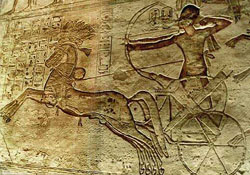
Ramses II
Drews assumes that the arrival of the Sanskrit-speaking Vedic people in India was part of this wave of military/political takeovers of already existing civilizations, and speculates that they could have arrived by sea from Mesopotamia rather than overland.
the chariot as the ultimate weapon of the bronze age
technology
The chariot was a complex, expensive, high technology and high maintenance weapon system. Chariot armies required a wide range of professional specialists to build, maintain and fight - chariot-makers, bow-makers, horse breeders and trainers, drivers, archers, scribes who kept detailed records of the royal chariot fleets. According to Linear B tablets from Greece and Crete, royal armies seem to have kept more spare parts in stock than actual operational chariots - a good indication that they were a valuable but fragile piece of state-of-the-art technology. In terms of their cost and technical sophistication relative to the societies that used them, they could perhaps be likened to modern jet fighters.
Maintaining a chariot army also assumes trade links over a wide area - chariots were built from temperate forest hardwoods, but were only of military relevance on open plains and were used in places far away fom any temperate hardwood forests. Birch bark, for example, was used to lash the spokes to the rims of Egyptian chariot wheels; and Ramses II wasn’t growing many birch trees in Egypt. The horse wasn’t native to the chariot kingdoms either; the best horses came from Armenia and were traded all over the Middle East. Bronze weapons also required trade over vast distances - the tin used to make bronze in the Eastern Mediterrannean came from mines hundreds of miles away in Sardinia, or even Cornwall.
psychology
There is a fascinating book by on the psychology of warfare by Dave Grossman which offers a number of explanations of why the chariot was such a devastating weapon.
Grossman is a former American special forces officer turned psychologist. He has a fundamentally optimistic view of human nature: he believes that, like nearly all mammals, humans have a strong innate reluctance to kill one another. Primitive tribal warfare in his view is largely aggressive posturing, and much less lethal than it looks. This continues into modern times - as late as the second world war, there is lots of evidence that most soldiers in battle are reluctant to shoot at the enemy and most of the killing is done by a small minority. Grossman maintains that for most people, the psychological stress of having to kill other people in war is actually stronger than the fear of being killed.
One of the fundamental things armies have learned over the centuries, then, is a range of tools and techniques for overcoming the average soldier’s natural reluctance. Grossman’s main interest in this is that he believes these techniques have become far more psychologically sophisticated and effective since the second world war, to the point where they pose a serious danger to modern society. Maybe. But he also discusses how they have evolved over the entire history of warfare, and several of them are relevant to why chariots might have been so effective:
- Soldiers are more likely to kill fighting in close teams than fighting alone. In modern warfare, machine gun and artillery crews don’t show the same unwillingness to fire effectively as individual riflemen do - reluctance to let the team down partly overcomes reluctance to kill. Chariot soldiers fought in pairs, driver and archer. And the most famous description of a chariot team in all of history and literature is, of course, Krishna in the Bhagavad Gita convincing Arjuna to fight at Kurukshetra.
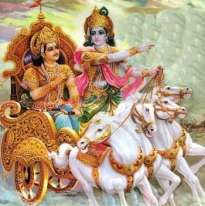
Krishna & Arjuna - It is psychologically easier to kill at a distance than close up. The chariot team’s main weapon was a composite bow with an effective range of 70 metres or more.
- It is psychologically easier for soldiers to kill people they percieve as socially, culturally, linguistically (’racially’ if you like that basically meaningless word) different from themselves. Hence why modern societies in wartime put so much effort into propaganda that demonises and dehumanises the enemy. Chariot warfare seems to have been an ’Aryan’ / Indo-European invention that enabled foreign warrior aristocracies to conquer and - at least for a while - displace the native rulers of settled kingdoms. Even after the native elites in places like Egypt copied the invaders and fought back, chariot warfare was still carried out by a privileged professional warrior caste who lived lives very different from most of the population.
- A small percentage of the population seem to be ’natural soldiers’ who lack the normal innate reluctance to kill. Small professional armies can pick out and train a higher proportion of these people than mass conscript armies. Chariot armies were small professional armies.
the end of the bronze age
According to Drews’ theory, chariots were the basis of the military power of late Bronze Age kingdoms for several centuries. Around 1200 BC, though, Bronze Age kingdoms collapsed all over the Eastern Mediterranean world. He cites archaeological evidence of almost 50 major cities that were destroyed within a few decades including Troy, Mycenae, Knossos and the Hittite capital of Hattusas. The longest established civilizations in Egypt and Mesopotamia survived, but the golden age of the pharaohs was over. Elsewhere, there was a ’dark age’ lasting several centuries until the rise of iron age civilizations such as pre-classical Greece. Why the collapse? Drews discusses a number of theories that have been put forward:
Invasions by migrating barbarian hordes from the north. Indo-European speaking migrating Aryan hordes were a favourite fantasy of European nationalist historians in the nineteenth century - but there simply isn’t much evidence for them, either in India or the Middle East. What archaeological evidence there is for the post-collapse world shows no sign of the existing populations having been displaced by invaders with a different culture. It does suggest that the surviving populations were living in a world with much lower levels of wealth, safety and political stability.
Destruction by massive acts of god - earthquakes or volcanic eruptions. This one is a favourite among pop historians and the general public - but again, the evidence doesn’t fit. The damage to the cities that were destroyed isn’t consistent with earthquake damage; it is consistent with them having been sacked and burned in wars. Some of the famous cities that were destroyed - Knossos, Mycenae, Troy - were in earthquake zones, but lots weren’t. And there is no evidence from any period of known history of earthquakes so devastating that they end civilizations. Cities get destroyed, but the survivors rebuild them and carry on much as they did before.
’Systems collapse’ - the Bronze Age kingdoms collapse under the weight of their own internal social/economic failings. Drought, or famine, or shortage of tin to make bronze; over-dependence of the palace elites on international trade in a few valuable commodities; risings of oppressed peasants against their (often foreign) rulers. These ideas have been favourites among Marxist-influenced writers since the British historian Gordon Childe in the 1940s - but Drews sees little actual evidence for them. They don’t explain the sudden destruction of cities: why would an unarmed and downtrodden peasantry suddenly be able to overthrow kingdoms with professional armies that had successfully oppressed them for hundreds of years? And they don’t explain why, as far as we can see from the written evidence, the royal administrations were functioning smoothly right up to the day the cities burned.
Drews’ own theory is that the kingdoms were overthrown, not by their own oppressed peasants or by invading hordes from far away, but by soldiers from semi-barbaric territories on the fringes of the civilized world who had previously been employed as mercenaries in the royal armies. He points to archaeological evidence that armour suitable for light, mobile infantry started to be widely made and used around this time; effective swords were first invented in Italy and the Balkans and were soon copied in Greece and the rest of the civilized world; and javelins seem to have been far more commonly used as a military weapon than they ever were before or since. Putting all this together, he believes that light infantry had been employed all along by the chariot armies, as skirmishers and support for the chariots. These soldiers were mostly foreign mercenaries, not natives of the kingdoms. The kingdoms were ruled by tiny elites, some of them foreign to the populations they ruled, who certainly would not have wanted their peasants to have effective weapons and military training; barbarian boys from the hills were also fitter and tougher than peasants from the river valleys. Some time around 1200 BC, helped by improved weapons and armour - javelins to bring down the horses, armour and swords to fight the crews - the mercenaries realised that they could beat the chariots and loot the wealth of the kingdoms. The rule of the kings and their chariot warriors was over.
but what does any of this have to do with india and the vedas?
dating the vedas
There is no evidence of lightweight chariots existing anywhere in the world before about 2000 BC at the earliest. There is no evidence of war chariots having been of great military significance before about 1650 BC. In India, archaeological evidence of horses existing at all before about 1500 BC is at best sketchy and controversial. Anybody who believes in a date much earlier than circa 1500 BC for the Vedas (and some have suggested dates earlier than 4000 BC) therefore has a big job to do explaining away chariots. Some possible explanations could be:
- Chariots did in fact exist, and were the ultimate weapon system, in India hundreds or even thousands of years before they were known in the rest of the civilised world - but they left no archaeological evidence, and nobody anywhere else heard of them or managed to copy them, even though there were undoubtedly trade and cultural links between the Indus Valley civilization in India (circa 2700 to 1800 BC) and Mesopotamia. Which seems highly unlikely.
- Some parts of the Veda are, indeed, much older but the parts describing chariot warfare are later additions. This isn’t completely out of the question - an obvious parallel would be, for example, Mediaeval European paintings of the Trojan War or classical battles, where ancient Greeks and Romans were often shown with Mediaeval European-style armour and weapons. Either the artists had no historical sense of things having been much different in the past, or they just showed what they thought their patrons expected to see. The people who put the Vedas into their final form could have grafted anachronistic descriptions of warfare and horse sacrifices onto much older material. This is perhaps possible, but doesn’t seem at all likely - all commentators on the Vedas appear to regard horses and chariots as absolutely central to Vedic culture, not something that could easily have been added later.
- Chariot warfare arose in India about the same time as it did in the rest of the civilized world and probably in the same way - brought by a relatively small conquering army of Indo-European speaking chariot warriors who orginally came from somewhere in the Middle East, probably eastern Anatolia. In other words, the chariots in the Vedas strongly suggest that there was some kind of ’Aryan Invasion’, although it was not anything like the migrating barbarian horde that nineteenth century European nationalists dreamt up.
vedic society
What can we infer from all this about the nature of Vedic society? Who are the Aryan heroes?
If they are charioteers, they cannot possibly be semi-barbaric pastoral nomads. They are a professional warrior elite in a sophisticated society that can support a wide range of specialised professional skills, long-distance trade and complex technology.
They might well have been a distinct linguistic and cultural group within their society. According to Drews there is lots of evidence from the Near East that civilized Bronze Age societies were multi-lingual and multi-cultural, not the homogenous ’racial’ units of nineteenth and early twentieth century European nationalist fantasies. There is also evidence - for example from widespread borrowings of Indo-European horse and chariot words in other languages - that within these mixed societies, Indo-Europeans had a traditional role and reputation as horse trainers and chariot soldiers. Drews cites several examples of societies where people with Indo-European names lived alongside people with non-Indo-European names, and the Indo-Europeans appear to be disporoportionately concentrated in the court and the military.
The Vedic Aryans have a common cultural heritage with western Indo-Europeans that must have diverged after the chariot became an important part of the culture, i.e. after about 1900 to 1800 BC at the earliest, more likely after around 1600 BC. Vedic, Roman, Greek and Celtic culture have very similar rituals and myths involving chariot horses and ’heavenly twins’ who may well have originated as driver-and-archer chariot teams.
Even if Sanskrit-speaking Aryans brought the chariot to India, and became a dominant warrior elite as a result, this does not means that they were an invading horde that displaced the native population. They could equally well have been a small group of professional soldiers who started off as mercenaries serving an existing ruling elite, until eventually they built up the confidence to overthrow it and take power themselves. There are lots of historical examples of that sort of thing happening - see for example the entire later Roman Empire; and mediaeval Islam from Saladin in the Crusades, to the rise of the Ottomans.
references
On the rise and fall of the chariot as the ultimate weapon in the Eastern Mediterrannean and the Near East and its political and social implications, my main source is two interesting books by Robert Drews:
The Coming of the Greeks - Indo-European Conquests in the Aegean and Near East, 1988. ISBN 0-691-02951-2
The End of the Bronze Age - changes in warfare and the catastrophe ca. 1200B.C., 1993. ISBN 0-691-02591-6
Dave Grossman’s book is:
On Killing - the psychological cost of learning to kill in war and society, 1996. ISBN 0-316-33011-6
update
2nd January 2004
“There is no evidence of lightweight chariots existing anywhere in the world before about 2000 BC at the earliest”. Oops. Yes there is. Whilst reading up on a new theory about the origins of of the Indo-European languages, I came across references to discoveries in the mid-1990s of chariots in an area called Sintashta-Petrovka in the southern Urals, dated to 2100 BC. See particularly this sci.archaeology posting by S.M. Stirling. Apparently they are of a design similar to later Middle Eastern war chariots, although less advanced (e.g. narrower wheelbase, so less stable). This is interesting.
- It clearly seriously damages Robert Drews’ theory (1980s, predating these finds) that the Greeks came from eastern Anatolia and not much earlier than 1600 BC, based on the belief that chariot warfare was invented there not much before that date.
- The finds were in towns, but not in anything like the high Bronze Age civilizations of the Middle East. I may have overstated the level of cultural and technical sophistication required to produce and maintain war chariots.
- The date isn’t anywhere near early enough to support any “Vedas before 3000 BC” theories. I still think some time after the collapse of the Harappan civilization, and shortly after the Indo-European chariot warrior conquests in the Middle East, is the convincing date for Vedic-speaking chariot warriors in the Punjab – i.e. after 1800 BC.
paul brunton
6th August 2003 permanent link
The first yoga-related entry in this ongoing experiment of having one weblog for everything, including things that would previously have gone in my yoga links & notes weblog.
When I was in India I quite by chance found and read a book called A Search In Secret India by Paul Brunton. I was very impressed by it and wrote about it in my yoga weblog, but I knew nothing about the author except that for an Englishman writing in the 1930s, he showed remarkable open-mindedness and respect for what were then quite esoteric aspects of Indian culture. So I was very interested to find this biographical article about him by Georg Feuerstein.
Feuerstein is a well known and generally highly regarded yoga historian and researcher. I am actually sceptical of some aspects of his scholarship (for reasons I might write about at length at some point), but I see no reason to doubt the accuracy of anything in this article.
all text and images © 2003–2009