alan little’s weblog archive for may 2008
dead tree publishing
26th May 2008 permanent link
My wife says I’ve been posting too many pictures from business trips to India lately. But she’s not here this week so – ha! – more Indian business trip pictures coming soon. Meanwhile however …
I wanted to go for a walk at the weekend. Normally I would go the the Alps, but we had a lot of spring snow this year, and last week was school holidays in Bavaria. Everywhere I wanted to go would have been either still under heaps of snow, or crowded out with people.
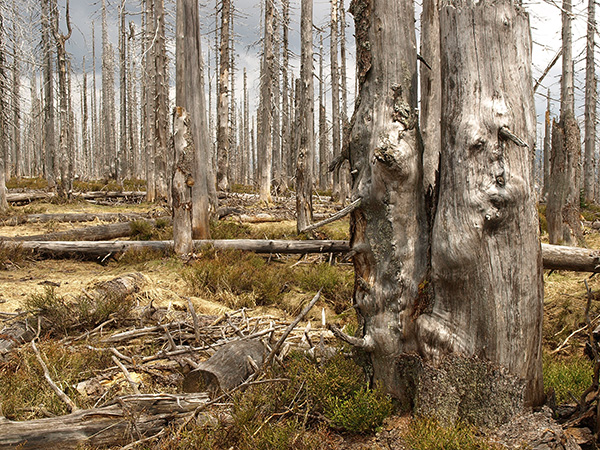
I went to the Bavarian Forest instead. I don’t know the area well, so I just picked the biggest blank bit on the map, near the Czech frontier, and headed into it. Turned out I was in a part of the forest where all the big trees were killed a few years back – not, apparently, by acid fog but by an infestation of bark-eating beetles. Interesting experience. Not depressing, exactly; the forest is recovering, there are still plenty of other living things and young trees growing. But eerie.
buskers
22nd May 2008 permanent link
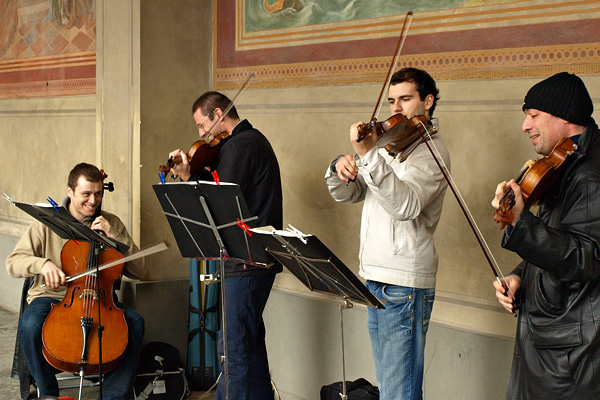
Genuinely good buskers are rare, and a great pleasure when you do find them. I found these guys today on my way from the U-Bahn to the art gallery. They were playing the Usual Suspects for classical busking - Eine kleine Nachtmusik, bits of the Four Seasons – and playing them well and with enthusiasm. I enjoyed them a lot.
And of course I had my new carry-around camera with me. This isn’t the world’s best or sharpest picture, sure – but I’m beginning to understand what people mean when they say the Olympus DSLRs produce subtly nice colours in their in-camera jpeg processing.
related entries: Music Photography
cruel and unusual
22nd May 2008 permanent link
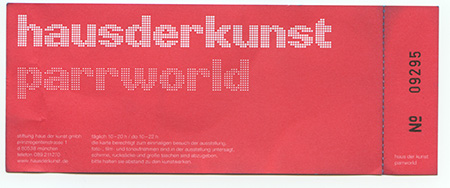
The parrworld exhibition turned out to be thoroughly interesting and worthwhile. Martin Parr is a very talented photographer indeed, with a very cruel eye indeed. I personally can’t imagine being motivated to go out and produce art every day, driven by the loathing Martin Parr appears to feel for the people he takes pictures of.
(Top marks to Haus der Kunst, by the way, for having an exhibition in a major gallery, featuring a very good picture taken recently in the nightclub in the basement of the gallery building.)
The exhibition wasn’t just Martin Parr’s pictures: it also featured his large collection of mostly political kitsch art objects, and pictures by other photographers – presumably ones he likes, or who have influenced him, or whom has influenced. Or any combination thereof. One that particularly blew me away was an English suburban townscape by a guy named Mark Power who I had never heard of before, although googling briefly now, I discover he is in Magnum, much published and so on. The picture in question is the left hand one in the third group of three in this review of Mark Power’s book. It doesn’t look like much in a tiny thumbnail like this, but believe me it does in a big gallery print.
This is the photographic ability I really admire, far more than the ability to make spectacular pictures of spectacular things: the ability to make spectacular pictures of utterly mundane things.
related entries: Photography
freedom
22nd May 2008 permanent link
I just dropped my family at the airport for a ten day trip to visit relatives in Russia and, whilst of course i’m missing them terribly already (etc. etc.), I’m (also) contemplating what to do next with my new and precious freedom.
I have a couple of little projects planned for the house, but guess what: today is a public holiday in Bavaria. A quaint but irritating feature of German life is that everything is closed on Sundays and public holidays (with elaborate legal exceptions for, e.g., food shops in railway stations and – this is true – florists within a 500 metre radius of hospitals or cemeteries or on Mothers Day), so I can’t go out and buy the wood that I need for Project A.
I was also contemplating going into the office for a few hours. Sad, I know, but I do have a lot to get done at the moment and a bit of time without the phone ringing or people knocking on my door would be a bonus. Another quaint feature of German public holidays is my boss saying it would be fine for me to actually do some work today, but could the hours please appear somewhere else on my timesheet, because heaven forbid that the workers’ council should get wind of somebody who has a lot of work to do voluntarily showing up and doing it. If the Germans don’t start rethinking this kind of nonsense soon, the people who think there is no hope for the country will be right.
All these plans were in any case doomed when I drove past the Haus der Kunst on the way back from the airport and saw that it has an exhibition by Martin Parr. I don’t find Martin Parr’s work congenial – nor am I supposed to – but there’s no doubt that he’s a very talented photographer with a unique, if cynical, point of view. (At this point I am struggling and failing to come up with the right succinct English translation of the German word schief. Interesting.)
That, supplemented if necessary by the small but decent collection of Indian sculpture at the Ethnographic Museum just round the corner, followed perhaps by a spot of hanging out in coffee shops(*), should get me through the achingly lonely afternoon quite nicely.
(*) Lest I be misunderstood: unlike Dutch “coffee shops”, German coffee shops primarily sell coffee.
related entries: Photography
available darkness
19th May 2008 permanent link
Don’t use a flash out of respect for the natural lighting, even when there isn’t any.
Henri Cartier-Bresson
I like taking photographs in the dark. If I were really serious about it I would be saving up for the current high-ISO boss camera, the Nikon D3. From the reviews this sounds like the digital camera that finally overturns Kodak T-Max 3200 black & white film as the way to take photographs in the dark(*). The D3, however, is big, heavy and very expensive. I was interested to see if my new small, light, cheap Olympus carry-around camera would be at least adequate at night.
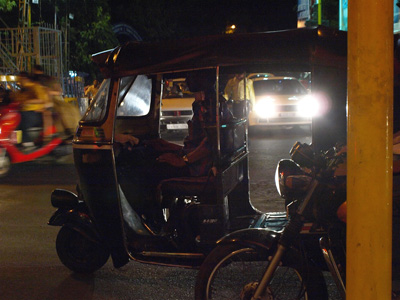
I would say it is, judging by the results of half an hour I spent standing at a busy crossroads in Pune one evening two weeks ago. The tiny little viewfinder is really dark at night, making composition tricky. The slow autofocus doesn’t help much either, and in theory the smaller Olympus sensor should be a stop or so less sensitive / noisier than a bigger one, other things being equal. But the results are, I would say, more than adequate. They’re sharp, with pleasing and accurate colour. They’re very noisy - not surprising considering I was desperately underexposing, in order to keep hand-holdable shutter speeds and avoid blowing the very contrasty highlights. But they clean up quite nicely with a bit of Noise Ninja in Photoshop, with a result that is probably slightly more grainy/noisy than I would have got with fast colour film, but with way better colour saturation and accuracy. I could never have done anything like this with a digicam. I don’t think I could have done all that much better with my D200, even allowing for brighter viewfinder, better autofocus and the fact that I have faster Nikon lenses.
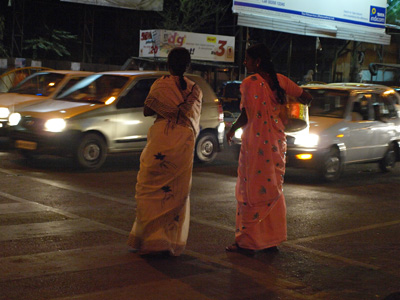
(Always use flash outdoors in bright sunlight, by the way, unless you’re specifically aiming for a stark, high contrast black & white look. But do try to avoid it in all other circumstances.)
(*) “4–6 stops better than anything we had in the film days”, says Michael Reichmann.
related entries: Photography
digicam
17th May 2008 permanent link
My current main camera, a Nikon D200, is a spectacularly good camera and I’m very happy with it. I feel no pressing need for the slight improvements over it that the current second-from-top Nikon, the D300, offers; I will be sorely tempted by the nearly 25 migapixel, awesomely capable, huge and expensive D3X when it comes out later this year, but for the amount I’m shooting at the moment there’s no way I could even try to justify the expense.
I’m thinking in a different direction camera-wise at the moment. Both on my first business trip to Pune and meeting Michael Jennings and friends at a beer festival in Munich, it struck me what a cumbersome thing the D200 is to lug around when I’m not going somewhere primarily to take pictures. A big pro camera with big pro zoom lenses would be even heavier, and a lot of the time that simply isn’t what one needs. I’m thinking smaller.
But not too small. I find myself here on the verge of repeating what I wrote about small digicams two years ago:
I do have a little digicam, a Fuji F10 which I bought because it's supposed to be one of the faster-focusing and generally more responsive small cameras, and quite good for available light photography without flash. Supposedly. I still find it frustratingly slow in the kind of fairly low light indoor situations where I usually want to take snapshots. Its six megapixel picture quality makes reasonable small prints of my son for his grandmothers, but is nowhere near even a previous generation six megapixel SLR like a D70, let alone something more state of the art like the D200. The F10 is better than nothing, but if I were willing to lug my D200 around with me everywhere I would enjoy taking pictures a lot more, and get better pictures.
This is actually a big difference from the film days, and not one that is favourable to digital. A lot of small 35mm film cameras, including the little Yashicas and Olympuses I used to use, were (are) capable in the right circumstances of producing results every bit as good as professional SLRs. They had limitations – fixed lenses, slow autofocus and general lack of control – but the lenses were just as good as SLR lenses, and of course they used exactly the same sensors as their big brothers, in the form of bits of 35mm film. In most of the circumstances where you want to carry a small camera just in case, being theoretically capable of the same image quality as an SLR isn’t particularly relevant, but I did sometimes get some pretty decent pictures with film point’n’shoots.
The problem with small digicams isn’t lens quality. Plenty of them have good lenses. Small good lenses are easier and cheaper to make than big ones, and Fuji’s ability to make excellent lenses is beyond question. But the physics of small batteries and small sensors dictate that autofocus will always be slower, and pixel-for-pixel image quality will be worse. I personally have yet to take a good picture with a small digicam.
… none of which has changed, including – hey! – the exact same cameras that I still own and use (not much, in the case of the Fuji). And none of which means, as I also went on to say two years ago, that nobody can take great pictures with little digicams. Clearly lots of people can and do. But I don’t seem to be one of them.
So what to do? I want a camera that is significantly smaller and lighter than the D200, but a better digicam isn’t going to do the job. Olympus to the rescue, as it turns out, in the form of the (now) second-smallest DSLR in the world, the E410, on clearance sale at my local electronics superstore for €299 complete with a reputedly perfectly decent 14-42 (28-84 equivalent) kit zoom lens.
(Real Photographer Lawrence Ripsher talks more eloquently about the severe limitations of small digicams and reviews – and likes – the E410)
I find this amazing. Sure, the price I paid for the E410 is a stock clearance price because Olympus just started shipping a slightly improved and even (fractionally) smaller replacement model, the E420. Nevertheless: this is a ten megapixel DLSR for about a fifth of the price I paid for my D200 only a little over two years ago. The D200 is still a far more capable ten megapixel DSLR (I hope – if it turns out not to be it’ll find itself on ebay PDQ). The Olympus feels lightly built and delicate: I’ll have not be careful about throwing it casually in bags or coat pockets, or taking it out in less than perfect weather. Which is a serious limitation for a casual carry-everywhere camera, as is the fact that the slightly smaller sensor is generally reputed to have about a stop less low light usability. But if I seriously wanted an indestructible camera that can take pictures in total darkness [I do, I do] then I’d be back to thinking about the behemoth D3 that can shoot three stops faster than the Olympus, but weighs three times at more than ten times the price.
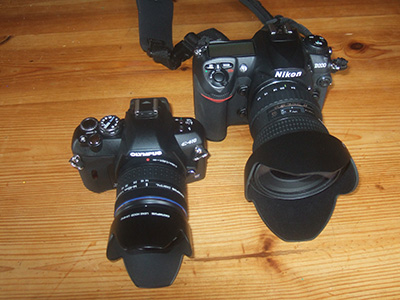
taking pictures of cameras: sad
Two weeks ago I was in India on business again, for the second time this year, and this time I only took the Olympus. First impressions: it’s a nice little camera. It's much less burdensome to carry around than the D200; it’s comfortable in a belt pouch, which the D200 very much isn’t. It has some drawbacks in comparison (as indeed it should at the price). Autofocus is slow and lacking in control. Highlights seem to blow out quite a bit more easily than the D200 – I haven’t done any like for like testing to confirm this, and shooting in the Indian midday sun is a challenge for any digital camera, but less dynamic range certainly would logically follow from the somewhat smaller sensor. Having to fiddle around on the screen to change shooting settings is slow and cumbersome compared to the dedicated buttons and switches that the bigger and heavier D200 has room for – although the Olympus menus are well organised which reduces the pain somewhat. The viewfinder is fine in daylight but terribly dark for night photography. But I like it. I didn’t buy it for “real” photography; I bought it as a super-digicam that is unobtrusive enough to carry around when I’m not primarily out to to take pictures, but capable enough that I can still take real pictures with it should the opportunity present itself. I think it will fill that niche pretty much perfectly.
related entries: Photography
mahatma gandhi road
9th May 2008 permanent link
People who were cremated and had their ashes scattered on the waters of a holy river clearly don’t “turn in their graves”, so: in an irony that doubtless has Mahatma Gandhi swirling in the Ganges, the main upmarket shopping street in many Indian cities is called “M G Road”.
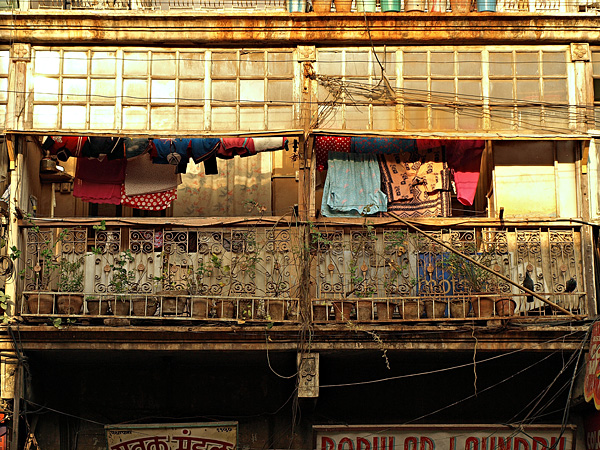
M G Road in Pune, I only noticed last week on my third visit there, has modern glitzy shopfronts; but if you look above street level, many of those shopfronts are tacked on to ramshackle and charming Pune old town buildings.
related entries: Photography
mango season
9th May 2008 permanent link
I’ve spent a total of about six months in India, spread over eight calendar months, October to May. That’s winter (October to February, approximately) and summer (March to June) accounted for; the monsoon is still on my to-do list (especially “landscape photography during”).
Summer is the mango season. I love mangos. When I was in Mysore in February and March 2002, the guy at my local fruit & vegetable store kept telling me they would be coming “next week, sir”, but they weren’t. At the beginning of April in Pune this year, I read in the paper that the early season mango harvest was bad, and saw – and ate – only one mango the whole week. Last week they had finally arrived in large numbers.
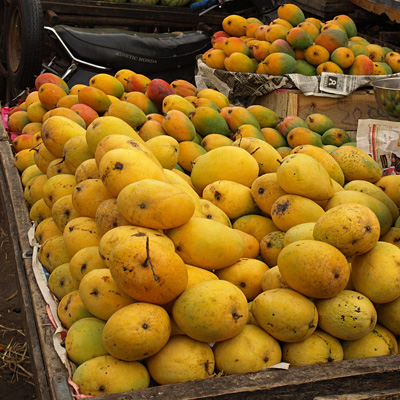
In the early days of the Mughal court – originally and predominantly Persian / Afghan / Central Asian – developing a liking for mangos was apparently regarded as “going native” to a dangerous degree. This (iirc) from Curry: A Tale of Cooks and Conquerors, Lizzie Collingham’s history of Indian cooking as experienced, and influenced, by foreigners. The Portuguese in Goa appear to have had no such inhibitions, judging by the fact that the most prized early season mango variety in India is called the Alphonso.
Indian mangoes are small, and one normally buys them in boxes of a dozen. I took one carefully packed one box in the centre of my suitcase to bring home. In departures at Mumbai airport I saw an elderly Indian gentlemen whose entire luggage appeared to consist of a stack of mango boxes taped together. Perhaps they were emergency supplies for a nephew working in Europe – my Indian colleagues in Germany are amazed what garbage the mangos in supermarkets here are.
all text and images © 2003–2009